Get Full Government Meeting Transcripts, Videos, & Alerts Forever!
Get email alerts on the Mandated Reporter Training topic
No spam. Unsubscribe anytime.
Committee advances bill to standardize mandated-reporter training
Summary
The Children and Families Committee advanced House File 1346, a bipartisan proposal from Rep. Jim Nash to standardize and expand training for mandated reporters after testimony from advocates and agency staff about gaps in current training.
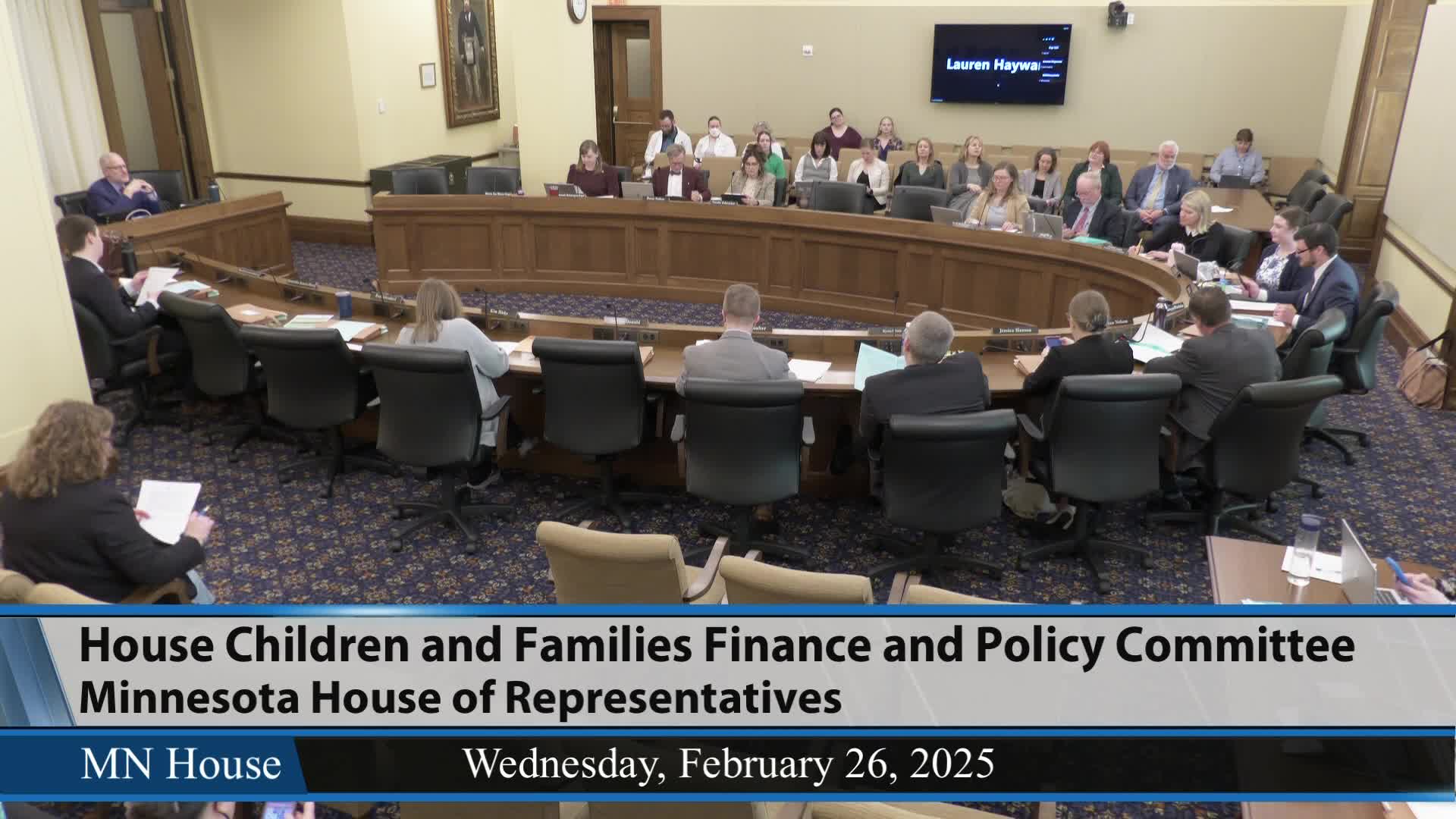
The Children and Families Committee advanced House File 1346 on a voice vote after hearing testimony that Minnesota’s mandated-reporter training is uneven and omits critical material.
Representatives and advocates said the bill would require more detailed, standardized training so teachers, childcare providers, health workers and other mandated reporters better recognize and report child maltreatment. Rep. Jim Nash (District 48A), the bill sponsor, told the committee the proposal grew from years of work with advocates and state staff.
"It's to create a standardized and greater detailed, training that will help people become a better mandatory reporter," Rep. Jim Nash said as he introduced the bill and described his personal reasons for pursuing the legislation.
Why it matters: Committee members and supporters said better training could improve early detection and intervention for at-risk children. Melissa DeBilsen, executive director of Safe Passage for Children of Minnesota, told the panel the current state training devotes only a few minutes to recognizing maltreatment and at times conveys guidance inconsistent with state law.
"Of the 45 minute training, only two-three minutes were dedicated to recognizing signs of maltreatment," Melissa DeBilsen said. "Additionally, the training misrepresented child protection as potentially harmful to families, and included guidance that contradicted state law."
Supporters asked the committee to require (1) that at least half of mandated-reporter training focus on recognizing signs of maltreatment and (2) that training be developed with subject-matter experts — for example, child abuse pediatricians, attorneys and social workers — to ensure clinical and legal accuracy.
Committee members asked clarifying questions about scope. Representative Hicks sought confirmation that the bill covers suspected abuse and neglect, and staff clarified the bill language would cover "suspected maltreatment" (including suspected abuse and neglect) rather than narrowing the covered conduct. A department staff member noted the bill requires offering improved training but does not itself compel every mandated reporter to complete it; organizations typically decide whether employees must take the training.
The committee moved the bill forward by voice vote. Representative Nash moved to re-refer House File 1346 to the Committee on Human Services Finance and Policy; the committee chair called for the voice vote, and the motion prevailed.
Discussion points: committee members highlighted bipartisan support and asked staff and advocates to return with implementation details, including whether training would be mandatory and how to ensure legal accuracy. Staff cautioned that the statute-and-policy landscape requires careful drafting to avoid conflicting instructions for reporters.
Next steps: House File 1346 was re-referred to Human Services Finance and Policy for further consideration and drafting work on requirements and implementation timelines.