Get Full Government Meeting Transcripts, Videos, & Alerts Forever!
Get email alerts on the Capital Infrastructure topic
No spam. Unsubscribe anytime.
Capital Investment Committee hears wide slate of local bonding requests including special education facilities, water systems and flood projects
Summary
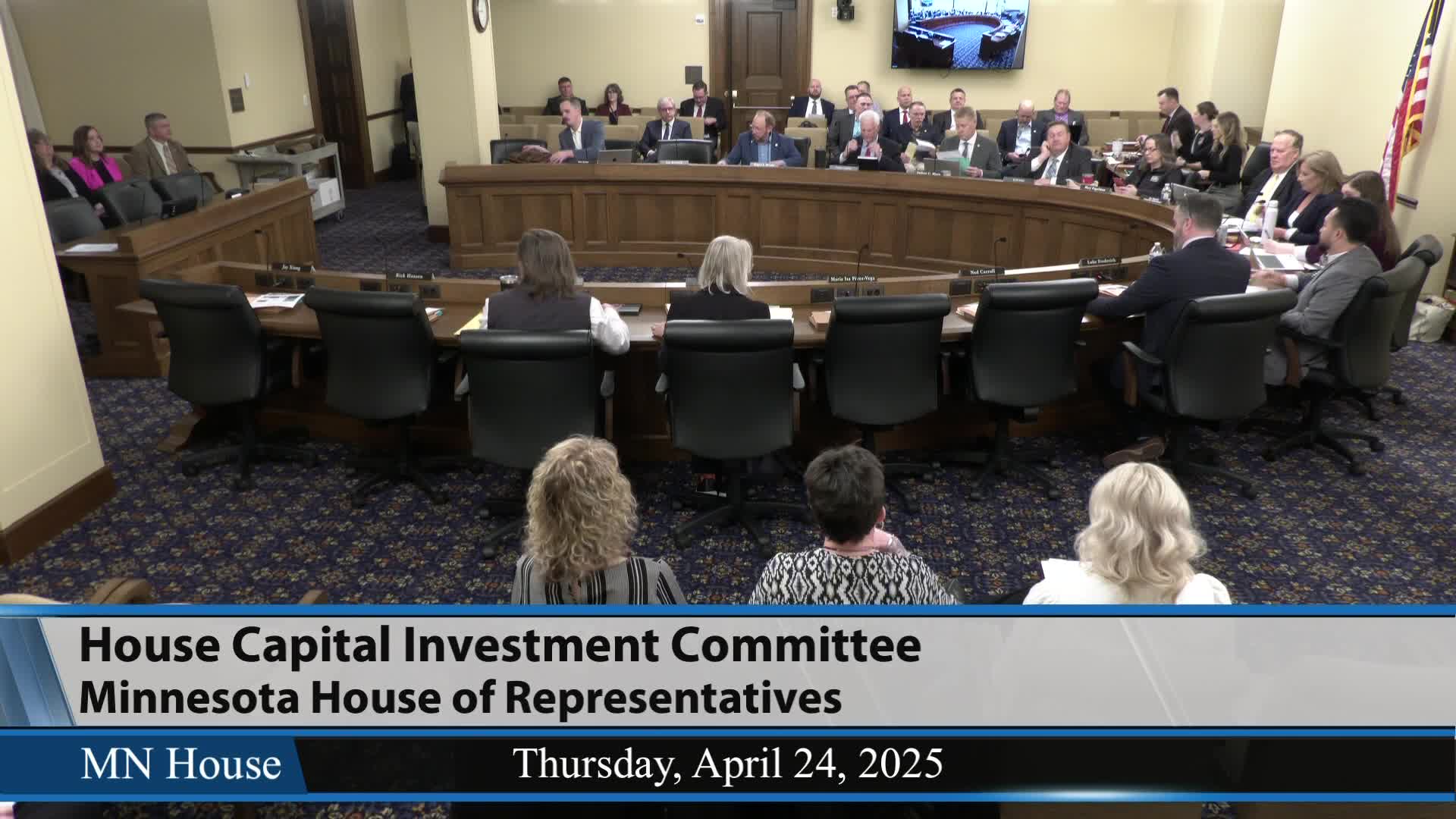
The Minnesota House Capital Investment Committee heard presentations May 20, 2025, on multiple bonding requests across the state, from special‑education school facilities in northeastern Minnesota to water and wastewater upgrades, a regional fire district facility, a veterans treatment campus and a major Red River flood‑impoundment project.
The Minnesota House Capital Investment Committee heard presentations May 20, 2025, from local officials and nonprofit leaders seeking state bonding and other capital support for projects across the state, ranging from special education facilities in northeastern Minnesota to water and wastewater upgrades, flood-impoundment work in the Red River Valley and recreation improvements in Hibbing.
Committee members heard about more than a dozen requests during the roughly 80-minute hearing; no committee votes were recorded during the session. Witnesses from cities, tribal governments, watershed districts, fire districts and veterans organizations described projects they said are “shovel ready” or urgently needed to address failing infrastructure, public-safety capacity gaps and regional economic development.
The requests presented at the hearing matter because most of the projects require state matching or bonding to proceed, and several speakers said local tax bases cannot shoulder the full costs. Committee members emphasized time limits for testimony and asked for follow-up information on costs and local matches.
Northern Minnesota special education cooperatives: Representative Jeff Dotseth introduced House File 568 seeking bonding to support facilities for two special education cooperatives. Barb Mackey, assistant special education director for the Northern Lights Special Education Cooperative, said the cooperative serves a multi-county, largely rural area and that its current academy is split between two outdated sites. “Currently, our facility is actually in 2 buildings, so we have 2 sites and they are both outdated, overcapacity, and not designed as a specialized school with secure environment that our students need,” Mackey said. Tanya Sievertzen, assistant director for the Area Special Education Cooperative (ASEC), told the committee that “the closest level 4 facility is more than a 100 miles away,” forcing some students to receive homebound instruction and creating strain on families and local districts. The bill, as described by presenters, requests $6.5 million for each cooperative.
Cloquet Area Fire District: House File 433, presented by Representative Dotseth and Cloquet Area Fire District Chief Jesse Buess, seeks $10.5 million to build a regional fire and ambulance facility. Buess said the district consolidated four departments in 2009 and now serves two cities and seven townships, routinely responding 20–30 miles for mutual aid. He said the district has limited access to traditional public-safety funding streams and that most local funding for the facility would come from a local levy; the state contribution would be a partnership to recognize a regionalized model of service delivery.
Magnus Veterans Foundation: Representative Nadeau introduced House File 1689 on behalf of the Magnus Veterans Foundation in Dayton. Lieutenant Colonel (ret.) Sean Alderman, founder of Magnus, described a comprehensive, whole‑person program serving veterans and families from across Minnesota. Alderman said Magnus has secured an initial $4 million donation of land and has delivered substantial charity care; the foundation asked the committee for $900,000 in state support to enable expanded facilities to deliver what the testimony characterized as roughly $3 million of annual care to thousands of patients.
Small-city water and wastewater projects: Multiple municipalities requested bonding or capital assistance for water and sewer needs. Testimony included: - Fulda (House File 1237): Jessica Mitchell and city clerk Julie Birchell described a multi-phase rebuild of water and wastewater systems they said has a $49.5 million total scope and a state bonding request of $17 million; without state support, city officials said household utility rates could rise steeply. - Kandiyohi/City of Kandiyoay (House File 2887): The mayor described aging wells (one from 1941, another from 1945), elevated iron and manganese and a multi-phase plan that includes two new wells and a treatment facility; the local request was about $7 million. - Palisade (House File 3049): Mayor Gaylene Spolrich said the city faces multiple drinking-water deficiencies and an aging wastewater system; the bill requests analysis and upgrades; local revenues are insufficient, the mayor said. - Tonka Bay (House File 2802): Mayor Adam Jennings described repeated water-main breaks and asked for assistance on projects approximating $5–6 million per project to reduce recurring emergency repair costs. - Barnesville (House Files 799, 800): City administrator Jeremy Cassette outlined street and utility projects, including reconstructing a main north–south collector and replacing aged water, sanitary and storm infrastructure in a northwest neighborhood that houses seniors on fixed incomes.
Red Lake Reservation wastewater capacity: Representative Duran presented House File 2819 to support a wastewater stabilization pond and related water/sewer lines for the Little Rock District on the Red Lake Nation. Sam Strong, secretary of the Red Lake Nation, and Thomas Barrett, Little Rock District representative, said existing lagoons are overloaded, limiting housing construction. Barrett said the project was shovel-ready with required documents and clearances and that modern wastewater capacity is a prerequisite for planned housing expansion.
Flood-impoundment and water-quality work: Jamie Beyer, administrator for the Bois de Sioux Watershed District, discussed a large flood-impoundment project on the Red River system (House File 2664). Beyer said the project is about 60% complete, is roughly six miles long and one mile wide at parts, and would be the second‑largest impoundment in the Red River Valley; the district requested $13.7 million to finish the final phase and noted matching local and legacy fund contributions.
Hibbing Cary Lake recreation improvements: Representative Igoe and Hibbing Mayor Pete Hajduk sought $5.2 million from bond proceeds (a $10.5 million project total) for shoreline, campground, trails and other improvements at Cary Lake Recreation Area; the city said it has committed $1 million in local match and completed archaeological, environmental and wetland studies.
Other infrastructure and road requests: Several communities asked for pavement and road funding, including Hendrum (House File 3145) requesting $2 million for street improvements; Holly (House File 2267) and Barnesville requested road and commercial corridor support; Douglas County and the city of Alexandria sought $1.5 million for preliminary design and engineering for an Interstate 94 interchange (House File 3135).
What the committee did and what happens next: Committee members heard testimony and asked clarifying questions; no roll-call votes were recorded during the hearing. Multiple presenters were asked to provide additional engineering details, cost breakdowns and documentation of local matching funds. Chair Franzen closed the session and said the committee will meet again next Tuesday with Co-Chair Lee presiding.
Taken together, the hearing highlighted recurring themes: widespread aging water and sewer infrastructure in small cities, regional approaches to public-safety and special education needs that exceed single-district capacity, and large-scale watershed/flood projects whose construction timelines span years and rely on layered public funding.