Get Full Government Meeting Transcripts, Videos, & Alerts Forever!
Get email alerts on the Parental Rights topic
No spam. Unsubscribe anytime.
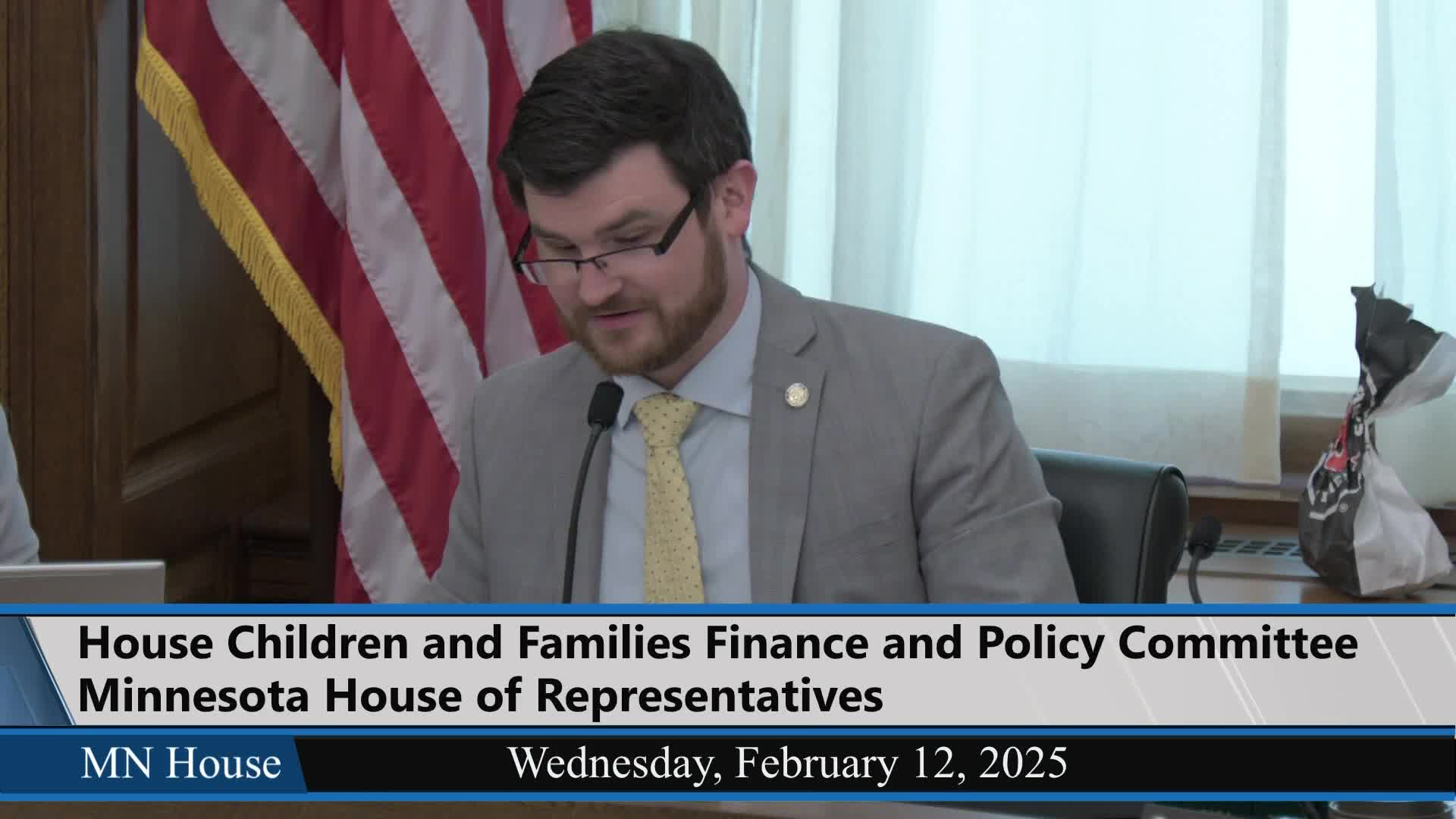
Committee re-refers parental-rights bill after lengthy testimony; amendment adopted
Summary
The Committee on Children's and Families adopted an author's amendment to House File 22 that adds a strict legal standard for any alleged infringement of parental rights, then re‑referred the bill to the Education Policy Committee after extended public and member discussion about child-protection, health-care consent and statutory placement.
Representative Dawn Gilman, the bill author, presented House File 22 to the Committee on Children's and Families and said the measure "establishes a broad parental rights to direct the education, upbringing, religious instruction, health and privacy of a child without government interference." The committee adopted an A1 author's amendment that requires any government action alleged to violate parental rights to meet a stringent standard of judicial review — generally described in the hearing as the "compelling state interest" strict‑scrutiny test — and then re‑referred the bill to the Education Policy Committee by voice vote.
Why it matters: House File 22 would enshrine a parental-rights standard covering education, upbringing, religious instruction and certain health and privacy decisions. Supporters said the bill provides clarity for parents and professionals; opponents warned it could interfere with child-protection proceedings and routine school health services.
Gilman told the committee the bill "empowers parents to direct their children's education, upbringing, religious instruction, health and privacy of their child without the interference of government at a state or local level." Testimony from supporters described family experiences and urged clearer statutory protections. Alicia Levisca, who identified herself as co-director of Minnesotans for Health and Parental Rights, said written testimony submitted to the committee contained more than 15 family accounts about parental rights and the need for clarity.
Opponents included educators and child-protection advocates who raised practical and legal concerns. Meg Lugar Nikolai, an attorney with Education Minnesota, warned the measure "could subject members of my organization to summary, termination, and other discipline merely for doing their jobs" and argued the bill could limit routine school screenings and hamper judges in child-protection matters. She told the committee the bill "adds a new burden of proof for judges" in proceedings where a court now may act to protect a child.
Committee members spent substantial time on statutory placement and scope. Vice Chair Hansen pressed the author on why the bill was drafted into chapter 260C (the Juvenile Court Act) and warned that language placed there "could be interpreted that what you're proposing would actually only apply in child protection proceedings." Nonpartisan staff explained the selection of 260C could be a way to gather rights currently scattered across statute but did not say the draft would be limited only to child-protection cases.
Members also flagged specific provisions the committee said need clarification: how the bill defines "parent," how it treats split or divorced parents and joint custody, how it would affect routine school activities (for example, teaching safety and manners), and how the measure would interact with mandated reporting and emergency medical care. Several members urged the author to consult county child-protection social workers, the Department of Children, Youth and Families and health‑care stakeholders as the bill moves forward.
Legal context was a repeated theme. Witness William Wagner, a law professor and vice president of Parental Rights Foundation, said the amendment fixed a drafting issue by aligning the bill with what he described as the courts' application of strict scrutiny to fundamental parental rights and cited U.S. Supreme Court authority invoked in testimony (including Troxell v. Granville and the Yoder line of cases).
After the discussion the committee adopted the A1 amendment and Chair West renewed a motion to refer House File 22 to the Education Policy Committee; the motion passed by voice vote.
What happens next: Because the bill was re‑referred to the Education Policy Committee, additional hearings and stakeholder work were expected before further votes. Members repeatedly encouraged the author to meet with child-protection and health stakeholders to refine statutory placement, definitions and enforcement mechanisms.