Get Full Government Meeting Transcripts, Videos, & Alerts Forever!
Get email alerts on the State Bonding Requests topic
No spam. Unsubscribe anytime.
Capital committee hears more than a dozen bonding requests for parks, transit, housing and local infrastructure
Summary
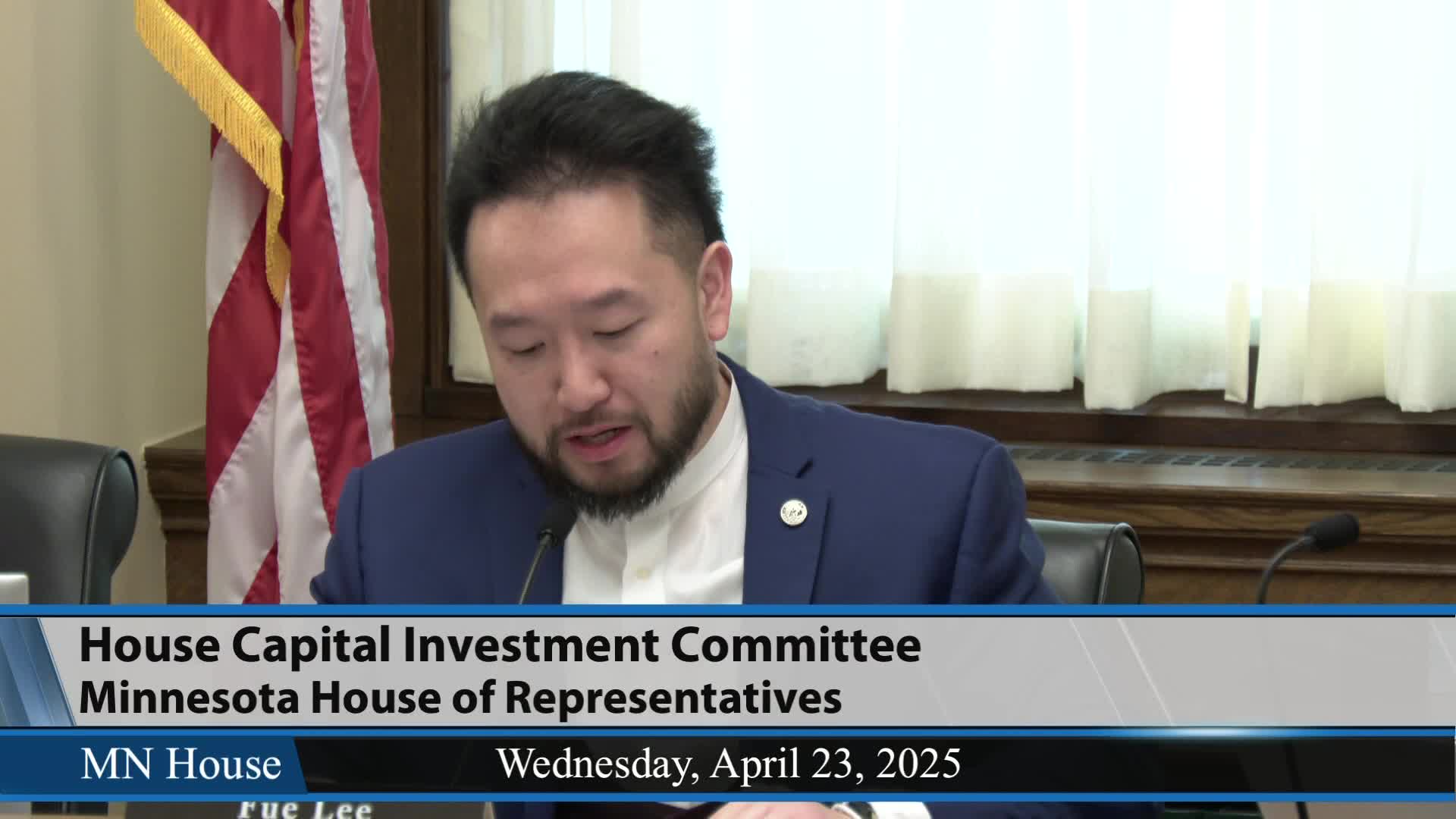
The House Capital Investment Committee convened an informational hearing April 23 to hear testimony on 19 separate bonding requests for capital projects across Minnesota, including repairs to the John Rose Minnesota Oval, infrastructure for Duluth’s convention center and a Duluth homeless engagement center paired with 40 units of supportive housing.
The House Capital Investment Committee convened an informational hearing April 23 to hear testimony on 19 separate bonding requests for capital projects across Minnesota, including repairs to the John Rose Minnesota Oval, infrastructure for Duluth’s convention center and a Duluth homeless engagement center paired with 40 units of supportive housing.
The hearing matters because the projects — which range from small town water and sewer repairs to multimillion-dollar downtown redevelopment and regional waste facilities — would rely on state bonding decisions that affect local budgets, tourism and services for vulnerable residents.
Rep. David Gottfried presented a request for the John Rose Minnesota Oval, asking for $1,125,000 to address an aging roof, HVAC system and restrooms that the city says do not meet current Americans with Disabilities Act standards. "The John Rose Minnesota Oval is a regional center for ice skating and hockey enthusiasts," said Rep. David Gottfried. Matthew Johnson, parks and recreation director for the City of Roseville, told the committee the Oval is one of only four full-size speed-skating ovals in the U.S. and the largest refrigerated ice sheet in North America; he described the investment as necessary to keep the facility viable for competitive and community use.
Rep. Johnson (another legislator presenting Duluth projects) sought $7,000,000 for the Duluth Entertainment and Convention Center (DECC) to pay for energy-efficiency measures, upgraded seating in Symphony Hall, and repairs to elevators and escalators. Daniel Hartman, executive director of the DECC, told the committee the venue draws about "over 500,000 visitors" annually and that replacing aging heating pipes would cut heating costs and address safety risks.
Duluth also brought a separate $8,800,000 request to fund a new community engagement center run by Union Gospel Mission paired with Mission Heights, 40 units of permanent supportive housing. Katie Hagelin, executive director of Union Gospel Mission, said the facility would include a commercial kitchen, warming spaces, health and social services and laundry and hygiene facilities. Jill Keppers, executive director of the Duluth Housing and Redevelopment Authority, said the upper-level housing is expected to cost roughly $16,000,000 and would be funded with housing infrastructure bonds, low-income housing tax credits or a combination of sources.
Regional infrastructure and recreation projects heard included: a historic bridge repair and trail connection proposals in southeast Minnesota (presented by Rep. Greg Davids and David Kelleher of the Minnesota Historical Society); a request for Trunk Highway 250 utility work in Lanesboro to align local sewer and water reconstruction with MnDOT roadway work (Rep. Davids and Mitchell Wahlberg, Lanesboro city administrator); and a $15,000,000 request for a five-acre central plaza and park in the Opus area of Minnetonka to be sited adjacent to a planned light-rail station (Rep. Falconer; Mayor Brad Wearsome).
Other requests and highlights:
• A $2,100,000 ask from Eden Prairie to build a regional public-safety equipment garage to house a mobile command center and specialized rescue equipment (Rep. Katiza Watoomb; Eden Prairie Police Chief Matt Sackett). Chief Sackett said the city will take delivery of a mobile command center in 2026 and needs central storage for regional response assets.
• A $8,000,000 request toward an estimated $25,000,000 Scott–Dakota County regional household hazardous waste and recycling facility in Lakeville; the counties reported a $15,000,000 local match and said construction could begin in 2025 with an early 2027 opening (Rep. Reyer; Dakota County Director Nikki Stewart).
• An $8,000,000 request for a homeless engagement center and 40 supportive units in Duluth (see above) and multiple smaller city requests including a community gathering site in West St. Paul, a new 17,000-square-foot refrigerated rink addition for Viaduct Park in Faribault ($2,961,500 sought for phase 2), and a sewer force-main replacement in Taylors Falls ($1,500,000 requested to replace a failing 4,500-foot force main).
• Transportation and safety projects such as Little Canada’s Community Connectivity Project to convert a confusing intersection and all-way stop into two roundabouts and other corridor fixes (City of Little Canada); Richfield’s Nicollet Avenue reconstruction request citing a high crash rate and pedestrian safety issues; and trail and bridge extensions in southeast Minnesota to link small towns and expand state trail networks.
• A legislative request to replace Minnesota’s U.S. Capitol statute with one honoring Hubert Humphrey and relocate the older Henry M. Rice statue back to Rice County (Rep. Long).
Presenters repeatedly emphasized local matches and regional benefits. Several speakers described past state investments, existing local spending, or planned financing: the City of Roseville cited a prior $3.9 million state appropriation toward refrigeration and drainage work; Duluth officials said the engagement center would leverage more than $15.6 million in housing infrastructure bond funding; and city managers from Lanesboro, Faribault, and Brooklyn Center described already-completed local investments that they said make the projects fiscally responsible and time-sensitive.
The committee conducted this session as an informational hearing (no final votes on the presented bonding requests were taken). At the close of the meeting, members moved and approved the minutes for the session by voice vote. Rep. Sexton moved approval of the minutes; the motion prevailed on a voice vote.
The committee will consider which of these requests, and at what funding levels, to include when leadership assembles the Capitol bonding package later in the session. Many presenters asked the committee to "consider this as part of a larger bonding bill" and stressed that several projects are shovel-ready or timed to other scheduled work (for example, utility work aligned with MnDOT roadway projects).