Get Full Government Meeting Transcripts, Videos, & Alerts Forever!
Get email alerts on the Agency Reorganization topic
No spam. Unsubscribe anytime.
New Minnesota Department of Children, Youth and Families outlines structure, budget and transfer timeline
Summary
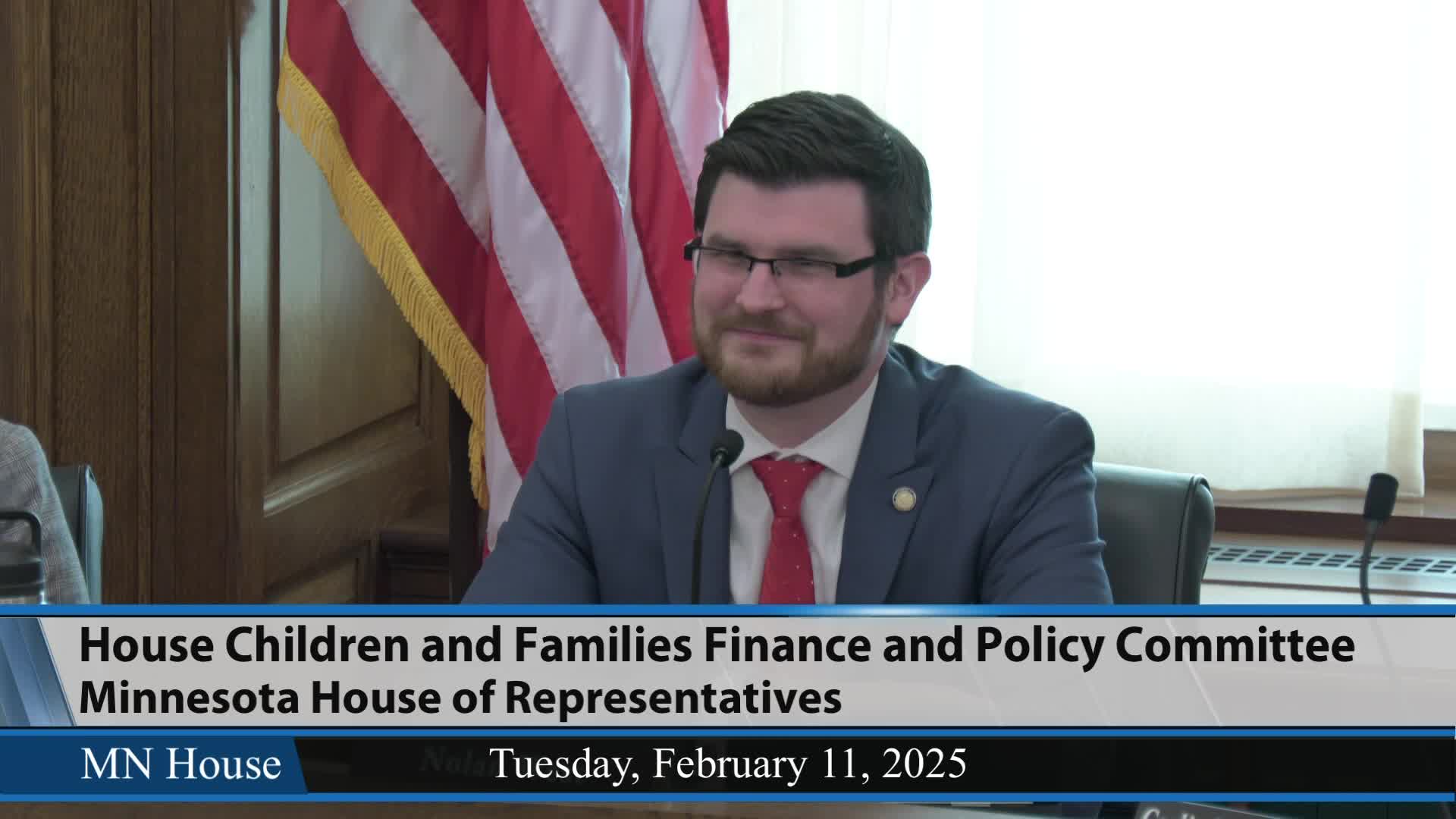
Commissioner Tiki Brown told the House Children and Families Committee that the newly created Department of Children, Youth and Families will consolidate programs from four agencies, manage roughly $3.7 billion in annual expenditures and prioritize modernizing an aging case-management system.
Commissioner Tiki Brown, Commissioner of the Department of Children, Youth and Families, told the House Children and Families Committee that the new agency launched July 1 to create a single “front door” for children and family services and to align programs and outcomes across state government.
The Department of Children, Youth and Families, or DCYF, will bring together programs from the Department of Human Services, the Department of Education, the Department of Public Safety and the Department of Health, Brown said. She told lawmakers the agency’s mission is to ensure “all children can and do thrive” by improving service navigation and coordination across Minnesota’s 87 counties and 11 sovereign tribal nations.
Ashley Reisenhower, Chief Financial Officer for DCYF, said the department’s total expenditures are projected at about $3,700,000,000 per year and that roughly two‑thirds of that spending is federal money. Reisenhower said about $1,000,000,000 comes from the state general fund, $290,000,000 from other funds, and DCYF also oversees about $1,000,000,000 in technical and fiduciary funds such as child support payments.
Brown described DCYF’s organization into four administrations — Children and Family (safety and permanency), Early Childhood, Economic Opportunity and Youth Services, and Family Well‑Being — and named assistant commissioners for each division. She said most leadership positions are filled but two senior roles remained open at the time of the presentation.
On implementation timing, Brown said early learning services and child and family services moved in July, more central operating functions transferred in October, Help Me Connect moved in January and the largest group of remaining transfers — including Office of Inspector General functions, youth justice programs and other DHS functions — are scheduled to move in June. She added that the after‑school community grant program will transfer only if additional funding is appropriated and that its current grants remain at the Department of Education through 2027.
Brown and Reisenhower said DCYF will manage a large grants portfolio — roughly $2,400,000,000 annually — with food assistance (SNAP) and forecast programs such as adoption assistance and childcare accounting for substantial shares of spending. Reisenhower estimated DCYF will have roughly 900–1,000 full‑time equivalent positions when transitions are complete.
Brown warned that a critical operational need is modernizing the Social Services Information System, or SSIS, which she described as running on “1980s and 1990s technology” and producing frequent crashes that impede staff work with families. Reisenhower added that federal match funding covers about half of SSIS costs on average and that DCYF continues to plan for modernization with that expectation.
The department will continue working with counties, tribes and community partners during transfers and has used an implementation office and interagency agreements to avoid service disruptions, Brown told the committee. She asked lawmakers to continue engagement as the department completes the remaining transitions.