Get Full Government Meeting Transcripts, Videos, & Alerts Forever!
Get email alerts on the Higher Education Capital Minnesota State topic
No spam. Unsubscribe anytime.
Minnesota State seeks demolition and HEAPR funding to reduce deferred‑maintenance burden
Summary
Associate Vice Chancellor Brian Swanson presented Minnesota State’s 2025 capital priorities, emphasizing HEAPR projects, a $25 million demolition operating request and $50 million non‑recurring repair-and‑replacement request to address aging, excess space and deferred maintenance across the system.
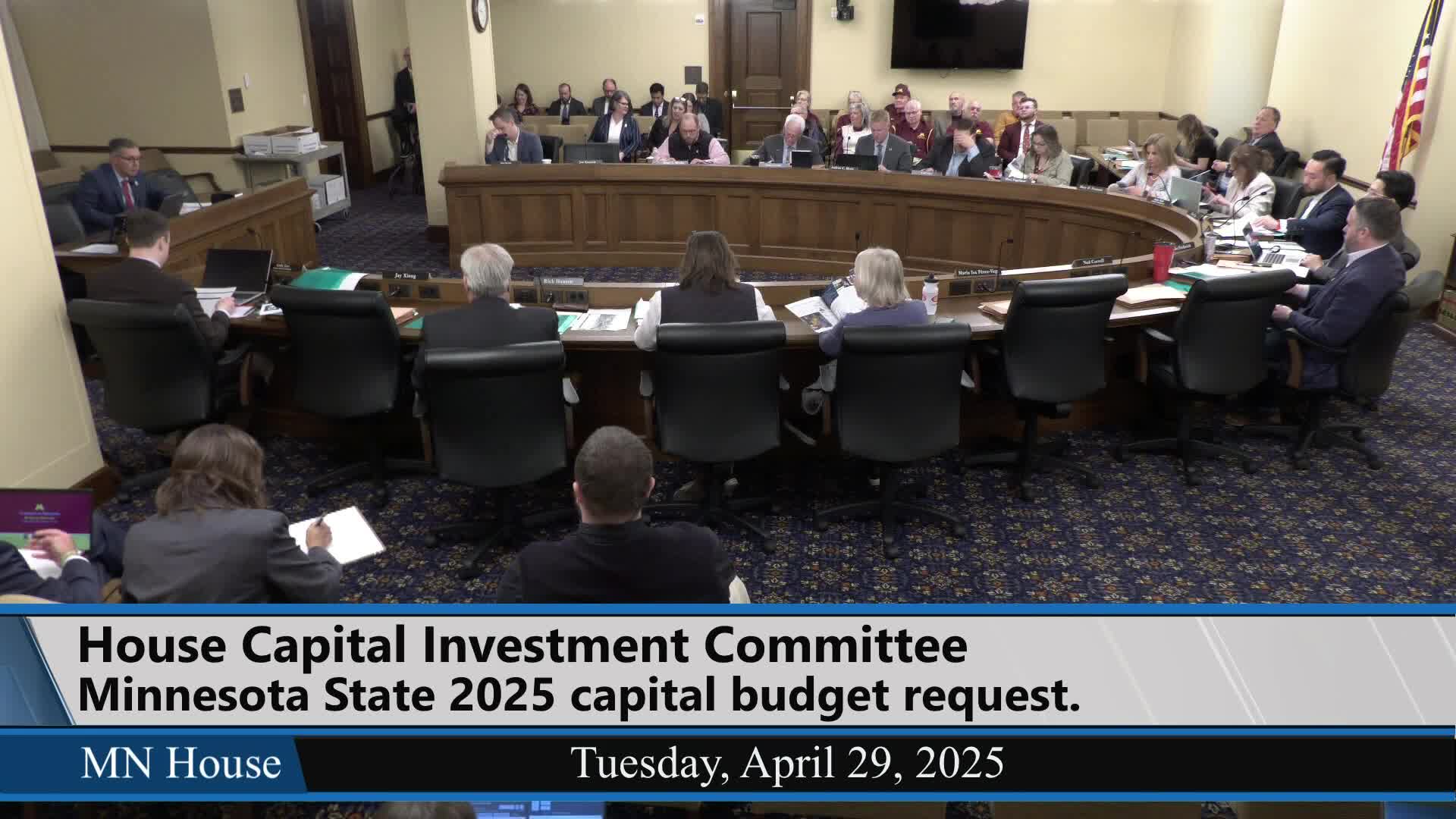
Brian Swanson, associate vice chancellor for facilities at Minnesota State Colleges and Universities, told the Capital Investment Committee on April 29 that the system’s capital priorities center on renewal, replacement and demolition rather than adding new space.
Swanson said Minnesota State manages about 28,000,000 square feet across 843 structures on 54 campuses and that deferred renewal is growing because capital funding has not kept pace with inflation and need. The system’s top priorities for 2025 include HEAPR projects and 14 major line‑item requests; in the operating budget Minnesota State seeks $25,000,000 in non‑recurring funds for demolition and $50,000,000 for repair and replacement to complement bonding requests.
Swanson said Minnesota State uses a no‑net‑growth approach to academic space and has identified about 1,300,000 square feet that could be demolished if funding were available. He noted HEAPR remains the primary mechanism to maintain building envelopes, mechanical systems and code accessibility issues and that earlier design funding (2023) has produced projects now ready for construction funding.
Committee members raised questions about how changing student demographics, PSEO enrollment and campus consolidation affect the system’s footprint; Swanson suggested those broader policy decisions belong at the chancellor and board level. He said Minnesota State welcomes additional operating and capital collaboration to preserve access while right‑sizing facilities.
No committee vote occurred on Minnesota State’s requests during the April 29 hearing.