Get Full Government Meeting Transcripts, Videos, & Alerts Forever!
Get email alerts on the Bonding Requests topic
No spam. Unsubscribe anytime.
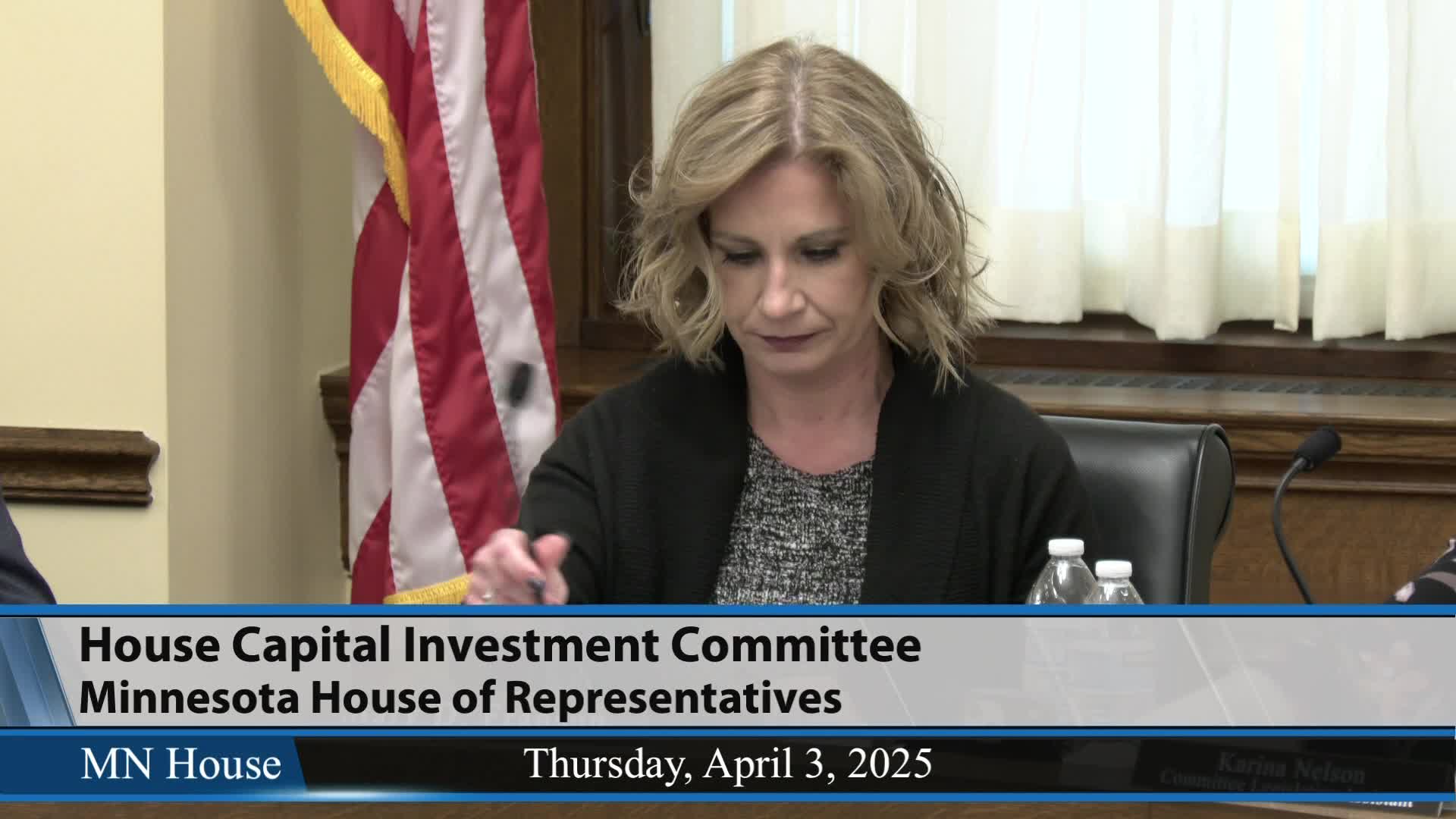
House Capital Investment Committee hears scores of local bonding requests for airports, water systems and public-safety facilities
Summary
City and county officials testified before the Minnesota House Capital Investment Committee about local infrastructure projects including airport runway paving, water-treatment plants, contaminated-soil remediation, and public-safety training centers; most requests were appeals for legislative bonding and no formal votes were recorded.
The Minnesota House Capital Investment Committee heard public testimony on a broad slate of local bonding requests on behalf of cities, counties and regional entities, covering airports, water and sewer upgrades, road and railroad grade-separation planning, public-safety training facilities and other municipal infrastructure.
City leaders and project engineers summarized need, cost and local funding so far, and asked the committee to include their projects in the next bonding bill. Committee members asked technical questions and requested follow-ups on operating costs, eligibility for certain types of state or federal funds, and potential participation by responsible private parties; the hearing recorded requests and discussion but no formal committee votes.
Why it matters: The projects are core infrastructure in small and mid-sized Minnesota communities. Committee consideration of bonding requests can determine whether cities shoulder the full cost through local levies and utility rate increases or receive state assistance that spreads costs beyond municipal boundaries.
Major requests and testimony
Carlson Municipal Airport (House File 604) — Representative Burkel introduced a $9.7 million bonding request for Phase 3 of the Carlson Municipal Airport project in Kitson County. Dale Nelson, mayor of Carlson, said the final phase would pave and light the runway, construct a taxiway and apron, relocate a township road for safety, add navigational aids and install an aviation fuel system. "When completed, the new Carlson Municipal Airport will be a critical piece of infrastructure for Northwestern Minnesota serving both recreational and business users," Nelson told the committee, adding businesses in the region rely on aviation access. The city reported prior state investments of $9.7 million for phases 1 and 2 and described a total project cost of $19.2 million; the request to the legislature was for $9.7 million. Committee members asked whether the project had FAA funding and for annual operating-cost estimates; a technical representative said she could provide operating-cost information to the committee.
Ramsey water-treatment plant (House File 2,637) — Leader Nisga introduced a request on behalf of the City of Ramsey for $6.8 million to complete a $42 million water-treatment plant and trunk-main project. City administrator Bridal Hagen described long-term local savings efforts and said the city has funded the project almost entirely with local dollars aside from a prior $3.2 million state award. Hagen said the city raised water and sewer rates in recent years (10% in 2023, 5% in 2024, and another 10% in the current year) to cover construction, and asked the committee to complete the state portion of a previously stated $10 million ask.
Breckenridge Infinity Center (House File 1,972) — Testifiers for Wilkin County described a proposed $26.1 million community and event center that project proponents say would house tenants including Sanford Health and classroom space for the local school district. Jeff Backer and a project representative said the community has raised $18.8 million and is seeking a remaining $7.3 million, while the county has pledged $5 million conditional on a December deadline. The testifier said several complementary projects — housing and child care — and tenancy by Sanford were contingent on the center moving forward.
Blooming Prairie and Trunk Highway 218 contamination (House File 629) — City engineer Brett Grabow described a request for roughly $3.9 million to address utility replacement and contamination remediation tied to a MnDOT trunk-highway reconstruction. The project corridor has extensive chlorinated volatile organic compound (CVOC) contamination that, Grabow said, must be excavated and hauled away as part of replacing water and sewer lines; the city estimates 20,500 cubic yards of contaminated material would need removal. "We were told by both the MPCA and the PCA that when we dig that up, the contamination becomes our problem," Grabow said. The city reported prior MnDOT scoping and phase-2 environmental work and said conventional remediation funding through federal or state agencies has not covered this CVOC contamination, prompting the request for state bonding.
Waldorf emergency sanitary-sewer repairs (House File 2,535) — Waldorf Mayor Rob Wilkening testified that a heavy rain and power outage created a sewage emergency that forced the city to pump sewage to a ditch and drew an MPCA violation with a 180-day deadline. He said the city has invested about $15 million previously, that 53% of residents are low-to-moderate income and that the city seeks roughly $3.77 million (the mayor said amounts have risen with inflation) to complete Phase 2 sanitary upgrades and avoid fines and further public-health risk.
International Falls water-treatment plant (House File 2,365) — Sean Kelly, lead water operator for International Falls, described a $12 million estimate to correct treatment-plant deficiencies and to protect the plant from river flooding that nearly forced a shutdown in 2022. Kelly said regulatory improvements alone would cost an estimated $2 million and another $2 million would be needed for building restoration; the city’s total ask to the committee was $4.8 million toward a shovel-ready $12 million project. "The total estimated cost for these crucial updates is $12,000,000," Kelly said, adding that the city faces higher construction costs because of northern location and that the work would help keep household water bills affordable.
Other notable requests — short summaries
- Hutchinson / HATS maintenance facility (House File 234): a requested $6.4 million for a new warm-storage building, mechanic bays and a new fuel system serving MnDOT, McLeod County and the City of Hutchinson; testimony noted about 300–350,000 gallons of annual dispensing and the fuel system’s 30-year life.
- Proctor utility expansion (House File 584): a $3.5 million request to extend water and sewer to roughly 150 acres targeted for workforce housing and development near I-35.
- Winona regional public-safety and training center (no HF number repeated verbally): a multi‑million-dollar proposal (testimony cited a $36.5 million total cost) to build a regional facility that would consolidate police, sheriff and training spaces; the state previously awarded $7.5 million for predesign.
- Long Lake Grand Avenue reconstruction (House File 2,530): a request for $11.7 million for full street reconstruction, water-main replacement and sanitary-sewer work in a neighborhood with many lower‑income households; mayoral testimony noted repeated cast-iron water-main breaks and clay sanitary pipe with infiltration issues.
Questions, clarifications and follow-ups
Committee members repeatedly asked about: eligibility of bonding for remediation work, whether projects had secured matching funds (federal, county or private), annual operating costs for new facilities, and whether responsible private parties or prior owners had been pursued for contamination liability. For Carlson Airport, a committee member asked whether FAA funds were involved; the testifier said the project had not received FAA funding to date and deferred technical details to municipal staff. For the Blooming Prairie contamination request, the city engineer said the MPCA has known about contamination since 1989 but the city has not engaged in litigation with past operators and said it is open to pursuing responsible parties offline.
Outcome and next steps
These presentations were requests for legislative bonding; the hearing recorded testimony and committee questions but did not produce committee votes during the session. Multiple testifiers committed to provide follow-up materials — for example, operating-cost estimates and environmental-investigation details — and committee members suggested off‑record coordination with agency staff (MnDOT, MPCA, MMB) to confirm eligibility for specific bonding or trunk-highway funds.
Ending note: Committee members ended the hearing with a schedule reminder and adjournment; the committee will consider bonding recommendations in the session’s broader capital bill process, which determines which requests advance to final appropriation votes.