Get Full Government Meeting Transcripts, Videos, & Alerts Forever!
Get email alerts on the Bonding Requests topic
No spam. Unsubscribe anytime.
Capital Investment Committee hears scores of municipal bonding requests for water, public safety and roads
Summary
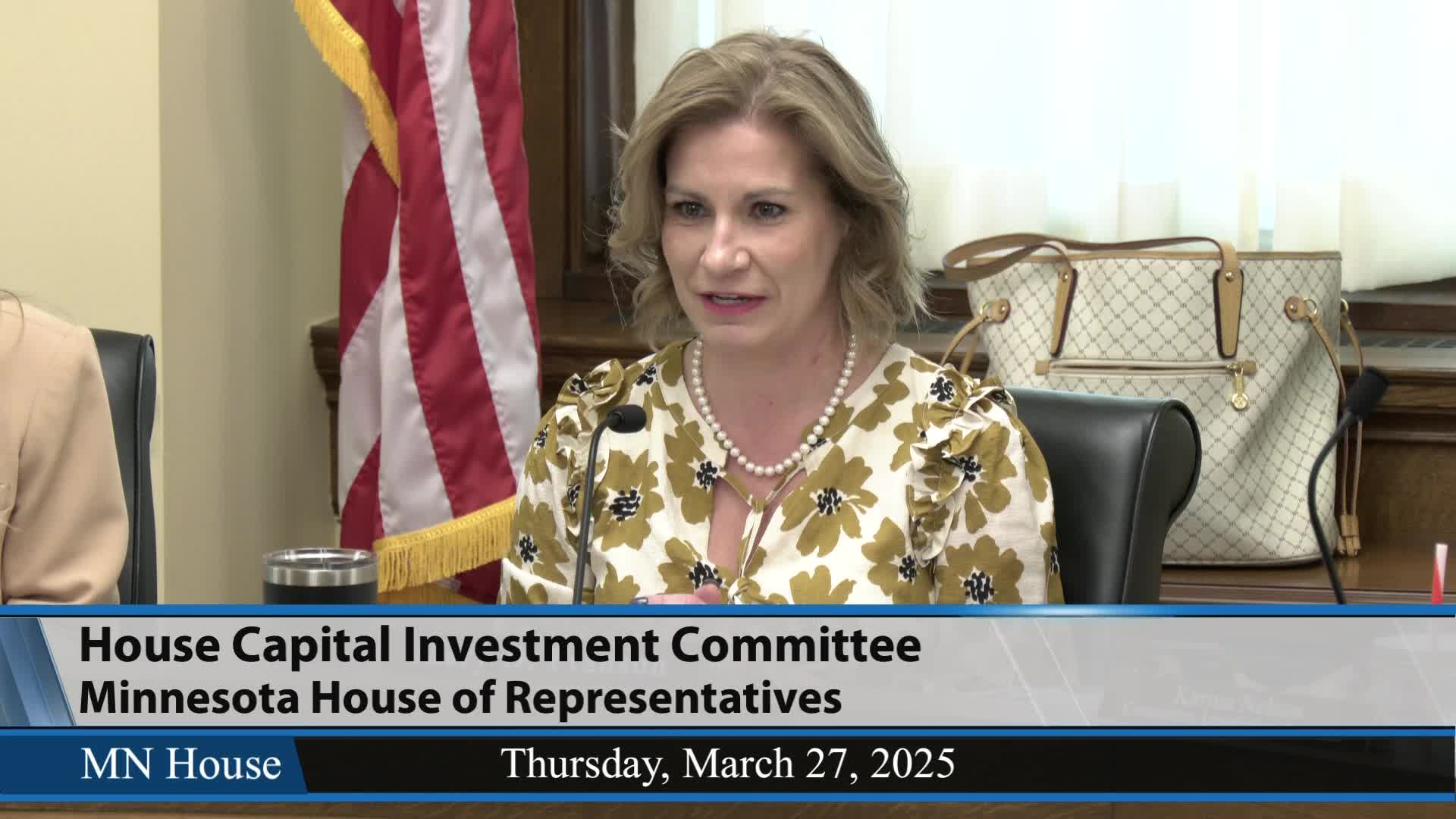
The Minnesota House Capital Investment Committee heard a slate of capital-bonding requests from cities large and small on Tuesday, with local officials seeking state help for water-treatment and sewer projects, public-safety buildings and road and sidewalk work.
The Minnesota House Capital Investment Committee heard a slate of capital-bonding requests from cities large and small on Tuesday, with local officials seeking state help for water-treatment and sewer projects, public-safety buildings and road and sidewalk work.
The committee, chaired by Chair Franzen, did not take final votes on the requests during the hearing; members moved through a packed agenda of municipal presentations and asked questions about project scope, phasing and local match.
Why it matters: State bonding decisions determine whether small cities can afford to repair century-old infrastructure, correct contaminated or discolored drinking water, expand police and fire facilities, or complete road and stormwater work that affects regional traffic and lakes.
Highlights from presentations
- Silver Lake (House File 942): Mayor Bruce Bebo and a technical witness reported that raw well water is untreated and exceeds secondary drinking-water secondary standards for iron and manganese (iron reported at 0.9 mg/L vs. a 0.3 mg/L secondary standard; manganese reported at 0.13 mg/L vs. 0.05 mg/L). They said $33 million in infrastructure work is needed overall, with roughly $24 million covered by a USDA rural development loan and about $9 million left unfunded; Silver Lake’s immediate request includes a $3,000,000 water-treatment facility to remove iron and manganese so tap water no longer appears discolored.
- Cohasset (House File 2178): Representative Igel introduced a $2,500,000 bonding request for water-tower work and sewer/water infrastructure along Pakegama Lake. Councilor Andy McDonald told the committee the project would address failing septic systems and prepare for future residential and business development.
- Rogers (House Files 318 and 319): The committee heard two requests for the city of Rogers: a public-safety training and emergency-operations campus (Chief Dan Wills described an $8,000,000 request toward a $22,000,000 police component within a larger City Hall project that would include training space, an emergency operations center and an embedded social-worker suite) and a Main Street turnback and full reconstruction (the second phase of a long-running Main Street project, with a $5,000,000 capital request to complete an estimated $10,000,000 phase that would reconstruct roadway, utilities and Safe Routes to School improvements).
- Virginia (House File 1287): City councilor Annie Bachchneider requested $2,500,000 to replace 60 windows, convert a municipal steam system to natural gas and install a variable-refrigerant-flow HVAC system at historic Virginia City Hall to reduce monthly utility costs reported at roughly $6,000–$8,000.
- Chisholm (House File 571): The city requested $300,000 to support infrastructure for a 30-lot market-rate Wynton Addition housing subdivision; city administrator Stephanie Scraba said the total Phase 1 infrastructure cost is about $2,500,000.
- Wright Technical Center (House File 1043): Representative Rearick presented a $10,500,000 request for the vocational cooperative’s aging facilities in Buffalo. Wright Tech’s director Brian Koslovsky said HVAC, electrical and roofing need replacement and described programmatic uses that include cosmetology and Head Start classroom space.
- Rice Lake (House File 401): Mayor Suzanne Herstead sought $8,500,000 for a regional public-safety training facility and a 17,000 sq. ft. addition and 7,000 sq. ft. renovation to provide joint operations space, backup capacity for the county emergency-operations center and an emergency shelter for displaced residents during major outages or storms; she said Rice Lake had contributed $74,500 to date and would consider covering remaining local gaps.
- Greenfield (House File 306): Representative Robbins and Mayor Nick Veil asked for additional funds to finish reconstruction of Greenfield Road, a rural collector with a long history of flooding and frost boils. The project’s estimated total cost is $5,500,000; the city previously received $3,000,000 in 2023 bonding and requested an additional $1,392,000 to complete the work.
- Howard Lake (House File 2470): The city described a large water-treatment plant replacement. City officials asked for $15,000,000 toward a project that is part of a larger $40,000,000 USDA package; officials said costs have risen sharply since initial estimates and the city’s existing plant is beyond useful life.
- Flensburg (House File 910): Clerk–Treasurer Carol Merton reported an urgent request to replace a failing 1950 sanitary system and to establish a municipal drinking-water distribution tied to a regional connection and new water tower. She presented a $12,900,000 project estimate and said more than 53% of residents are low- or moderate-income; a committee member later cited a $7,900,000 figure in discussion, and the presenter said the project could be phased.
- St. Louis Park (House Files 1230 and 1229): The committee heard two regional roadway and stormwater requests from Mayor Nadia Mohammed. One (HF 1230) would rebuild Oxford/Louisiana to address flooding and pollution before Minnehaha Creek; Mayor Mohammed described a roughly $13.8 million total cost and a request for about half in state funding (the prospectus and ask figures were discussed in committee and clarified during Q&A). The other (HF 1229) is a $8.1 million corridor update to improve walkability and trail connections; the city sought a 50% state share.
- Sacred Heart (House File 1055): Council members described Phase 3 of a long infrastructure rebuild. The city has completed phases 1 and 2 and sought $2,000,000 to finish water-plant equipment replacement, convert softening to reverse osmosis to meet chloride limits, recaulk and repaint the water tower (lead paint remediation), and cover MnDOT-mandated utility relocations along Highway 212.
- New Prague (House File 1881): Representatives and city officials requested $11,500,000 toward a new combined public-safety facility (police, fire and ambulance). The city described cramped evidence processing and training arrangements and said the full project cost is at least $12,500,000.
- Excelsior (House File 404): City officials described a $13,000,000 request to replace 70–100-year-old water mains (iron, galvanized and lead), failing clay sanitary pipes and undersized storm sewers that cause localized flooding and threaten Lake Minnetonka and adjacent lakes. Council members said the city has issued $22,000,000 in bonds since 2010 and that further state help is necessary to avoid unsustainable levies and utility rates.
- Owatonna / Boyntonah (House File 424): Representative Sexton presented a $1,500,000 request for predesign and design for a consolidated public-safety facility; Owatonna officials described evidence-storage and flooding risks in their current adapted bank building and emphasized the city’s regional response roles.
- Wyoming (House File 609): Mayor Lisa Iverson requested a regional public-safety building to provide trauma-informed interview rooms, consolidated operations and regional training capacity along the I-35 corridor; Wyoming officials said the city will commit a local share but asked the state for partnership.
Committee process and next steps
The committee did not vote on the bonding requests during the hearing. A motion to approve the committee minutes from March 25 was moved by Representative Carroll and approved; no other formal actions or roll-call votes on the presented house files were recorded in the transcript. Committee chairs asked presenters about phasing plans, local matches and whether projects could be reduced to earlier phases to fit limited bonding dollars.
What to watch: the committee will consider which projects to include in a bonding bill later in the session. Presenters repeatedly emphasized rising construction costs and limited local tax capacity, and several asked that small cities receive state help to avoid very high utility rates or unsustainable local debt.
Ending note: Committee members thanked the local officials for traveling to St. Paul to present their projects; Chair Franzen adjourned the hearing after the day’s presentations.