Get Full Government Meeting Transcripts, Videos, & Alerts Forever!
Get email alerts on the Housing Infrastructure topic
No spam. Unsubscribe anytime.
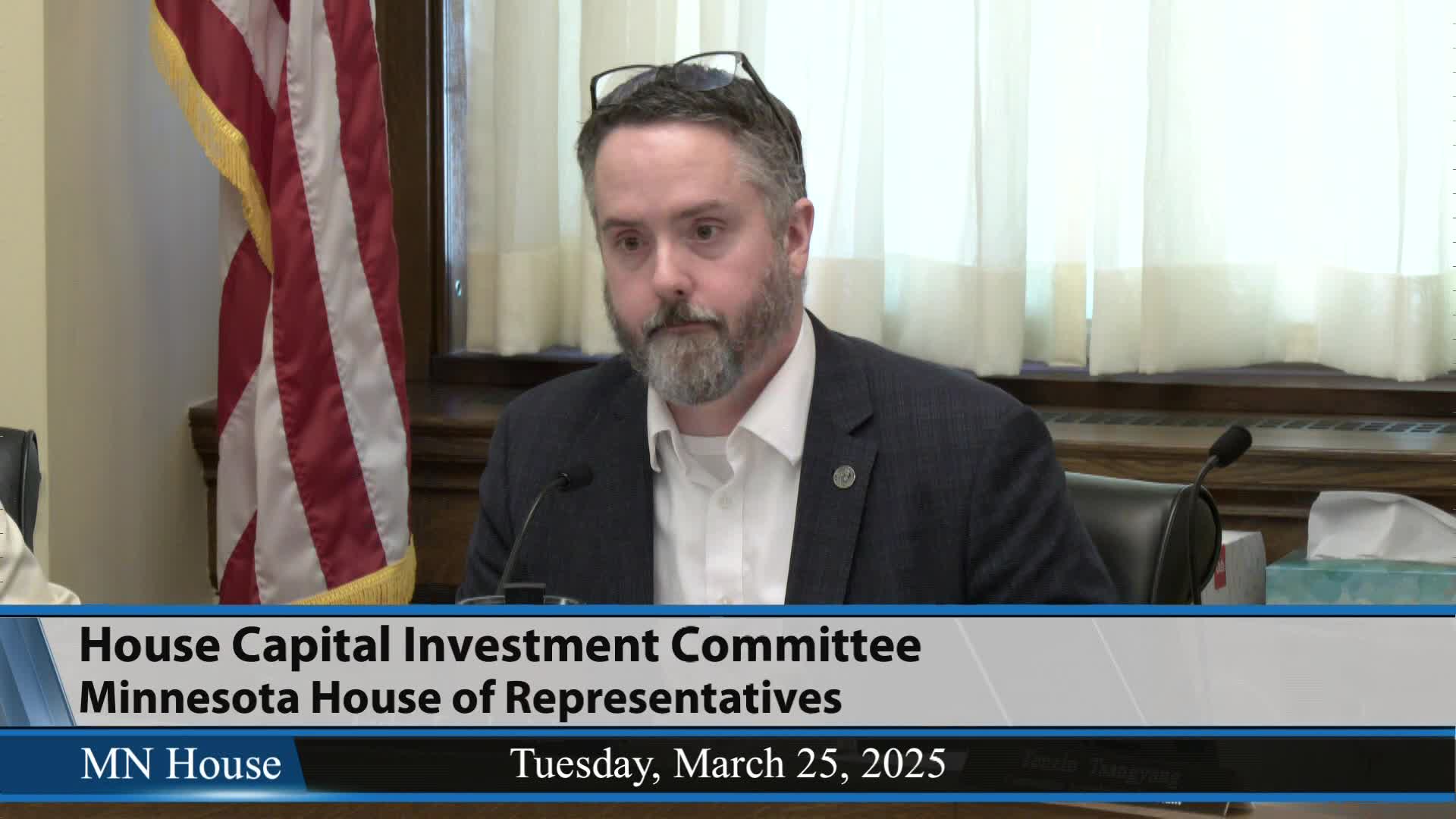
Capital Investment Committee hears broad housing infrastructure update and multiple bills; hearings informational only
Summary
Minnesota Housing Commissioner Jennifer Ho told the Capital Investment Committee on March 25 that housing infrastructure bonds remain a central tool for producing and preserving affordable homes across the state and that demand still far outstrips available funding.
Minnesota Housing Commissioner Jennifer Ho told the Capital Investment Committee on March 25 that housing infrastructure bonds remain a central tool for producing and preserving affordable homes across the state and that demand still far outstrips available funding.
Ho said the state’s housing infrastructure program has “impacted almost 10,000 units” between 2012 and 2024 and that roughly $800,000,000 of state-authorized resources have helped leverage about $1,800,000,000 in total development costs. “Housing infrastructure bonds are a unique Minnesota innovation,” Ho said, adding that the bonds leverage federal resources such as the HOME program and low-income housing tax credits.
The commissioner’s update framed a slate of informational bills that followed. Representative James Howard introduced House File 1141, a $400,000,000 housing infrastructure bond authorization; he said the request aims to “provide thousands of units” across Minnesota. Testimony supporting the bill came from Kelly Law of the Minnesota Consortium of Community Developers, who said the state is more than “100,000 units short of demand” and urged action to “preserve what we have and build more housing.”
Committee fiscal staff provided figures about the state’s debt service for housing appropriation bonds. Mr. Lee, fiscal staff, said annual debt service for the program “is about $38,000,000 a year” now and, after currently authorized but unissued bonds are sold, “it’ll grow to about 41 to 42,000,000 a year.” That figure was offered as context for lawmakers weighing new authorizations versus other funding approaches.
Several other housing proposals were presented on an informational basis: House File 1770, a proposal to invest in manufactured-home-cooperative infrastructure and conversions; House File 1489, a general obligation bonding request focused on public housing rehabilitation; House File 2639, which would create a revolving loan fund at Minnesota Housing for locally owned municipal housing held for at least 50 years; and House File 2619, a targeted housing infrastructure bond request to develop 24 units of supportive housing for youth through the nonprofit Face to Face. Testimony from municipal and nonprofit leaders described use cases and local demand.
Speakers highlighted examples of recent housing infrastructure awards to illustrate impact. Ho described preservation and supportive-housing projects selected in late 2024 and named specific developments: Bickham Court (Prespectives) in St. Louis Park, a roughly $8,600,000 investment to preserve 56 permanent supportive units; Cobb Cook Place in Hibbing, a $4,000,000 investment to build 52 homes including units for people with disabilities and those exiting homelessness; and a $712,000 investment in Woodlawn Terrace Cooperative in Richfield that connected a manufactured-home community to municipal water.
Speakers and testifiers emphasized that the consolidated request-for-proposals process will open in April and that funding availability will determine how far down the scoring list Minnesota Housing can fund projects. Ho warned that federal and other resources available in 2025 may be substantially lower than recent years: for multifamily awards, she said the combined state and federal resources that supported $330,000,000 in 2023–24 “in ’25 we expect that number could be as low as 30 to $45,000,000 in awards.” On the single-family side she estimated 2025 awards could fall from $174,000,000 (2023–24) to “as low as 15 to $20,000,000.”
Speakers from Greater Minnesota and housing nonprofits asked the committee to consider targeted tools for nonmetro areas. Chad Adams of Southwest Minnesota Housing Partnership and Chad Bouley of Central Minnesota Habitat for Humanity described strong local demand and projects that need small, reliable sources of capital that can be paired with local land, tax abatement or local infrastructure contributions.
All bills were heard on an informational basis; no committee votes or formal actions were taken at the March 25 hearing. Committee members asked technical questions about debt-service amounts, the scoring advantage of community land trusts and the capacity of manufactured-home cooperative conversions to produce housing efficiently.
Outlook: Minnesota Housing plans to issue HIB-eligible consolidated RFPs in April; Minnesota Management and Budget will issue related general obligation bonds in the fall when projects selected in past rounds begin their financing timelines. The committee’s discussion highlighted both strong demand for housing capital and uncertainty about how federal and state funding will line up in 2025.