
Committee narrows focus of tourism working group after prosecutor warns against gambling push
Get AI-powered insights, summaries, and transcripts
Subscribe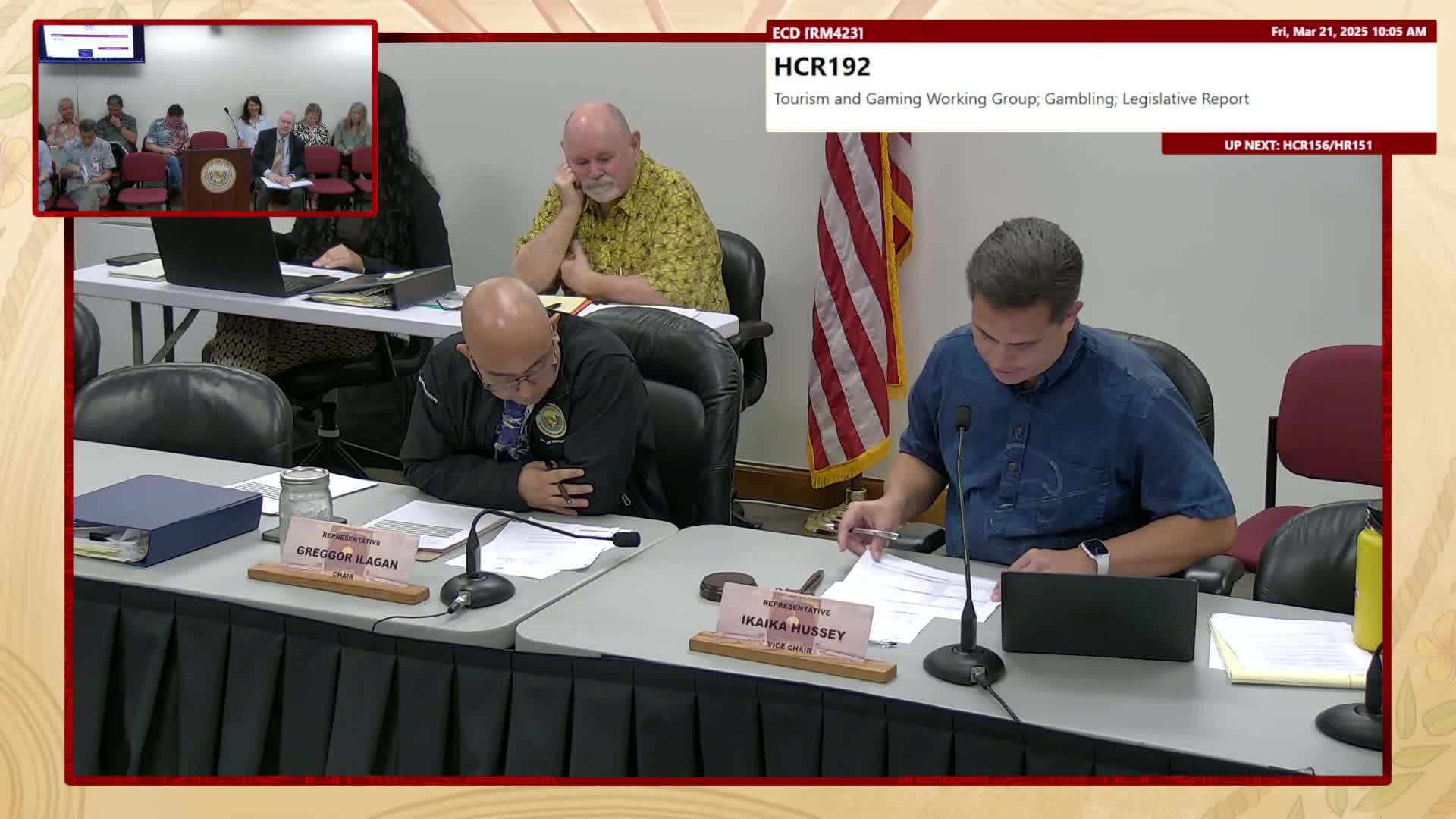
Summary
The House Committee on Economic Development amended HCR192 to shift emphasis from gaming to broader economic opportunities for Native Hawaiian communities, after testimony ranged from industry support to strong opposition from the Honolulu Prosecutor's Office.
The House Committee on Economic Development considered HCR192, a concurrent resolution requesting the Department of Business, Economic Development & Tourism (DBEDT) to establish a tourism and gaming working group to study and advise on related public policy.
The measure drew support from multiple business and development interests and concern from law-enforcement officials. DBEDT economic research administrator Eugene Tian said the department supports the measure "with some comment," and urged clearer assignment of staffing and communication responsibilities between the legislative chairs and DBEDT staff. HTA (Hawaii Tourism Authority) also "stood on" its written testimony in support.
The Honolulu Prosecutor's Office testified in strong opposition. An unidentified prosecutor representing the office told the committee, "Doing this HCR will send the message that you want gambling...I think it sends the wrong message to our kids," and warned that widespread gambling access risks indebtedness among vulnerable residents.
Private-sector speakers urged the committee to keep the investigation and stakeholder engagement broad. Stanford Carr, speaking for Aloha Halawa District Partners and as a representative of Stanford Carr Development, said developers of the Aloha Stadium and Entertainment District "strongly support this resolution" and requested an amendment allowing partners to "have a seat at the table." Erin Midby of Boyd Gaming said the working group would be an appropriate first step and would provide the research and analysis needed for future policy decisions.
Committee leadership recommended and adopted amendments to HCR192 that: (1) change the stated purpose from focusing solely on gaming to identifying economic opportunities for Native Hawaiian communities, with gaming retained as a possible topic rather than the central focus; (2) remove corporations as voting participants in the working group while allowing their participation in proceedings; and (3) clarify that participants may be the legislative chairs or the chairs' designees. Representative Tempo and Representative Matsumoto recorded reservations on the final voice vote; no named nays were recorded.
Why it matters: The amended resolution directs DBEDT and legislative leaders to convene stakeholders and evaluate economic-development options that could affect tourism policy, potential gaming proposals, and community-targeted investments. The debate highlighted the tension between economic-development interests and criminal-justice/public-safety concerns.
What happened next: The committee adopted the chair's recommended amendments and passed HCR192 with the reservations noted. The measure as amended will proceed according to regular legislative procedures.