Get Full Government Meeting Transcripts, Videos, & Alerts Forever!
Get email alerts on the Municipal Bonds Debt Capacity topic
No spam. Unsubscribe anytime.
Officials warn losing municipal bond tax exemption would raise borrowing costs, curb projects and hit housing and water programs
Summary
Advisers and state officials told the committee that proposals to remove federal tax exemption for municipal bonds would raise interest costs on state and local borrowing, reduce the number of feasible projects and increase costs for housing and drinking‑water and wastewater borrowers in Minnesota.
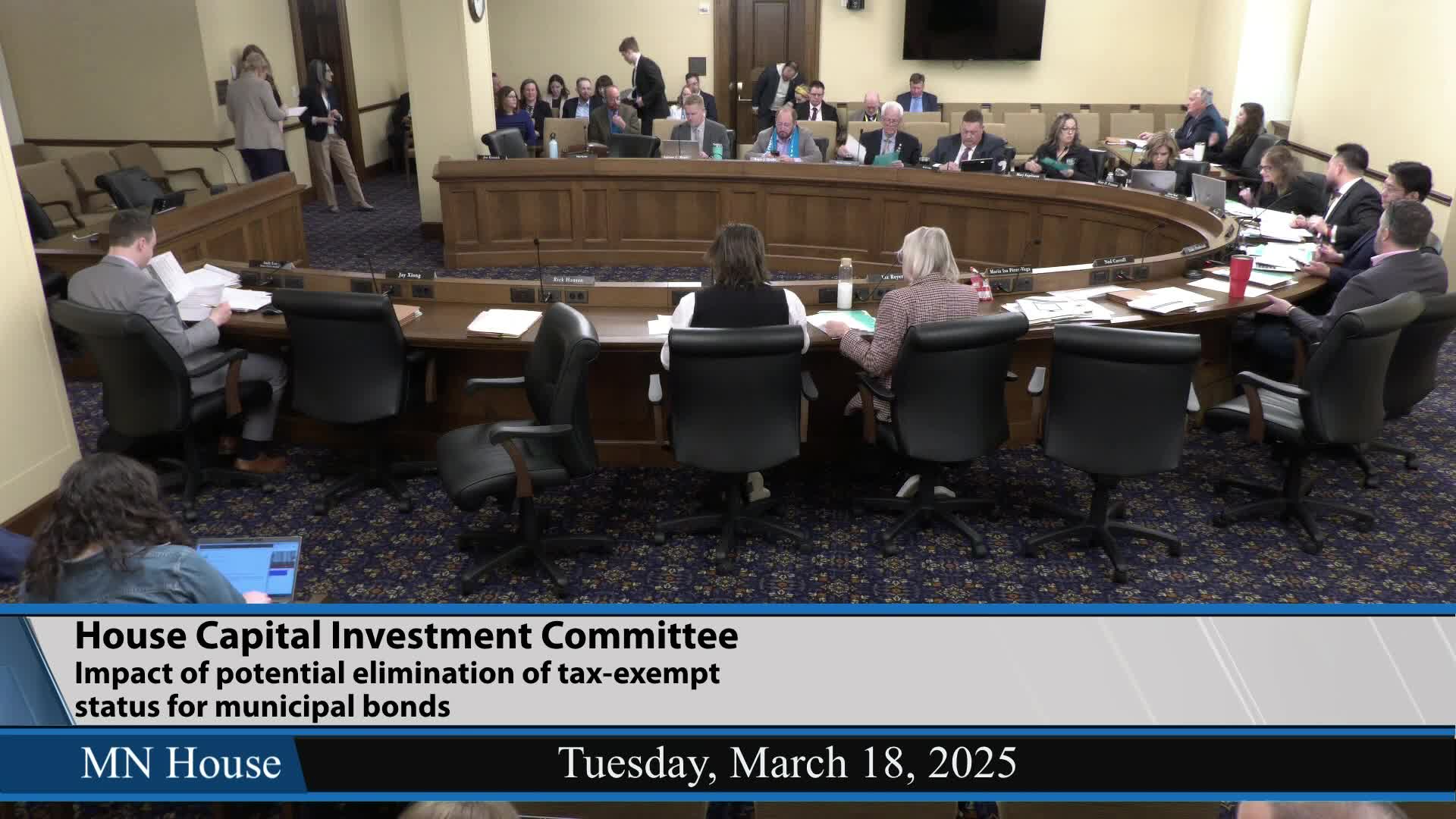
Municipal finance advisers, state budget officials and agency leaders told the Capital Investment Committee on March 18 that eliminating the federal tax exemption for municipal bonds would materially increase borrowing costs for Minnesota and diminish the number of projects that can be financed.
Jessica Cameron Mitchell, managing director and partner at PFM Financial Advisors LLC, said tax exemption functions as a federal subsidy that lowers interest costs for state and local issuers. “Borrowing for public infrastructure will be more expensive if municipal tax exemption is lost,” she said, and provided market comparisons showing taxable issues can raise overall debt service by double-digit percentages compared with tax-exempt issues in examples she reviewed.
Minnesota Management and Budget Assistant Commissioner Jen Hassimer told the committee the proposal has appeared in federal discussions about offsets for extending the 2017 Tax Cuts and Jobs Act and would “be a great cost to state and local governments.” She said Minnesota’s AAA ratings enabled the state to sell more than $1.3 billion last summer at interest rates of about 3.2% and that the state estimates interest rates on bonds could increase by about 1.5 percentage points or more if the exemption were removed.
Jennifer Ho, commissioner of Minnesota Housing, said private activity tax‑exempt bonds are a core financing tool for single‑family and multifamily programs. She said Minnesota Housing issued more than $500 million in tax‑exempt housing bonds and that preserving private-activity bond exemption remains a national lobbying priority for state housing agencies.
The new executive director of the Public Facilities Authority told the committee that PFA financed $226 million in 46 loans this fiscal year and that borrowers — who receive PFA loans at below-market rates and benefit from tax‑exempt financing — would face a substantially higher interest burden if bonds were taxable. The director provided an illustrative estimate that borrowers’ total interest paid on the loans would rise from about $53.4 million to $81.8 million without tax-exempt treatment, a $28.4 million increase, or roughly a 50% jump in interest costs for that portfolio.
Andrew Lee of House fiscal staff reviewed recent trunk-highway and GO authorizations and noted many trunk‑highway authorizations remain unsold and therefore factor into the state’s debt-management calculations. Lee said some trunk-highway authorizations are structured to be sold across multiple years and that currently a significant share of trunk-highway authorization remains to be issued, which affects the state’s third debt guideline measuring how quickly debt is repaid.
Assistant Commissioner Hassimer then presented the February debt‑capacity forecast. She reminded the committee that Minnesota’s debt guidelines measure net tax‑supported debt against personal income (guideline 1) and authorized-but-unissued debt (guideline 2), and require minimum principal repayment rates (guideline 3). Under current assumptions the state remains within guideline ratios, but Hassimer warned that higher borrowing or elevated interest rates would raise future annual debt‑service costs and that previously authorized but unsold debt (about $2.5 billion) will become more expensive if market rates or federal policy change.
Committee members asked clarifying questions about how authorized but unissued debt is managed and whether specific project authorizations can be extended; MMB staff said unsold authorizations are typically sold over a multi-year schedule and that not issuing authorized debt eventually forces cash‑flow constraints for projects that rely on those bonds.
Sources: Testimony from Jessica Cameron Mitchell (PFM), Jen Hassimer (MMB), Jennifer Ho (Minnesota Housing), Public Facilities Authority director, and House fiscal staff (Andrew Lee).