Get Full Government Meeting Transcripts, Videos, & Alerts Forever!
Get email alerts on the State Federal Funds Implementation topic
No spam. Unsubscribe anytime.
MMB says state has $12.3 billion in IIJA/IRA/CHIPS awards tracked and is pursuing direct-pay clean-energy credits
Summary
Minnesota Management and Budget officials told the capital committee on March 18 they are tracking $12.3 billion in federal IIJA/IRA/CHIPS awards and are prioritizing state match funds, direct-pay tax provisions and a state green bank to help entities capture those funds.
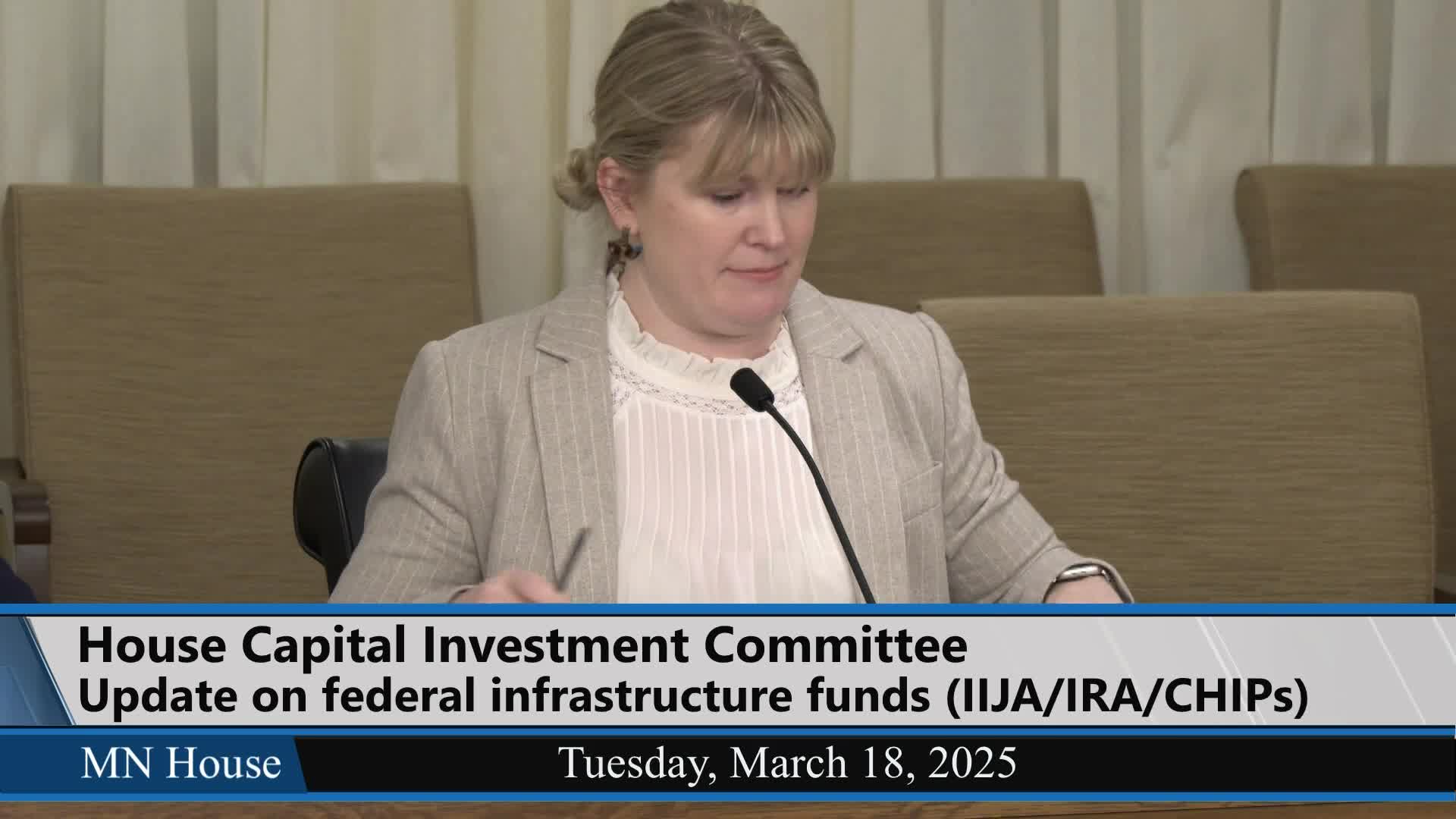
Leah Corey, enterprise director for federal funds implementation at Minnesota Management and Budget, told the capital committee on March 18 that the state is tracking $12.3 billion in federal infrastructure and clean-energy awards tied to the Infrastructure Investment and Jobs Act, the Inflation Reduction Act and CHIPS.
“Since the last time we were here, we have secured an additional $3 billion in funding that’s going to support 1,800 discrete projects across the state,” Corey said, adding that the $12.3 billion figure includes both announced and obligated awards as well as estimated formula allocations through fiscal year 2026.
Corey explained how MMB and partner agencies are organizing state efforts into four work streams: strategy development, opportunity promotion and coordinated pursuit, technical assistance and tools, and monitoring of federal investments. She said the enterprise is maintaining a public interactive dashboard with discrete project listings and a searchable opportunity tracker for open federal notice-of-funding opportunities.
She highlighted three state match programs that the 2023 legislature funded to help Minnesota compete for federal grants: an IIJA discretionary match administered by MnDOT ($185 million state match that the presentation says unlocked over $1 billion in federal funds); the State Competitiveness Fund administered by Commerce (about $17 million state investment that aided clean-energy grant pursuit and unlocked federal matches); and the Forward Fund administered by DEED (a $400 million state commitment, including about $250 million targeted to CHIPS-related activity). Corey said those state investments help local units of government and others meet federal match requirements.
Corey also outlined the state’s work on direct pay (a form of elective payment under IRA for tax‑exempt entities). She said direct-pay can reimburse a large share of eligible clean-energy, manufacturing, vehicle and fuel projects once a project is “put in service,” and noted that the state has filed paperwork for several projects and is awaiting manual IRS review. “An entity can receive up to 60 to 70% returned back in the form of a check,” she said.
Recognizing that tax‑exempt entities often lack upfront capital to put projects in service before claiming direct pay, Corey described a state financing tool: the Minnesota Climate Innovation Finance Authority (state green bank). She said the authority received a one-time seed of $45 million and has begun lending for projects such as community development and solar-plus-storage on public school buildings.
Corey gave additional detail on MMB’s accounting of the $12.3 billion: roughly $8.5 billion of that total flows directly to the enterprise (announced or obligated), about $3.6 billion of which has already been spent; roughly $1.5 billion is a future estimated allocation; and roughly $2.2 billion represents large awards that flow directly to local governments or other entities outside the enterprise’s systematic tracking.
She said the state is tracking about 40 open federal notice‑of‑funding opportunities and is finalizing a scope of work for 1:1 tax guidance to help eligible entities complete direct-pay filings.
Corey closed by encouraging local governments, nonprofits and other prospective applicants to use the state’s opportunity tracker and to contact MMB for technical assistance.
Sources: Testimony and slide materials provided by Leah Corey and Minnesota Management and Budget.