Get Full Government Meeting Transcripts, Videos, & Alerts Forever!
Get email alerts on the Water Infrastructure topic
No spam. Unsubscribe anytime.
Capital Investment Committee hears dozens of water and wastewater bonding requests from Minnesota cities and districts
Summary
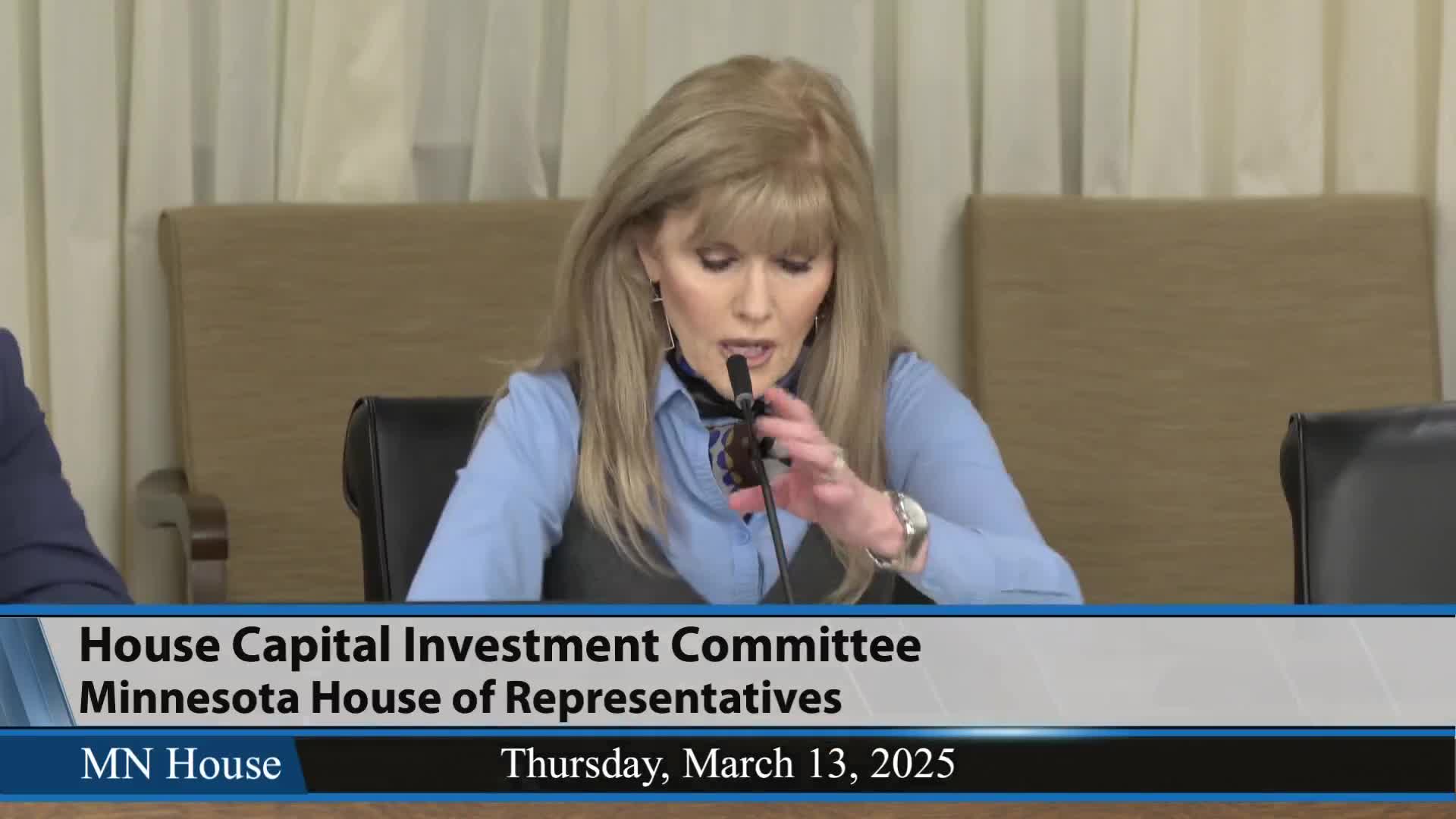
Capital Investment Committee members heard more than a dozen requests on March 11 for state bonding to repair or expand drinking-water, wastewater and stormwater infrastructure across Minnesota.
Capital Investment Committee members heard more than a dozen requests on March 11 for state bonding to repair or expand drinking-water, wastewater and stormwater infrastructure across Minnesota.
The informational hearing focused on projects that proponents say address public-health risks, regulatory compliance and failing on-site septic systems — from the city of Lafayette’s request for $1.893 million for a reverse-osmosis system to Brooklyn Park’s $12 million request to build a water tower to serve a planned Biotech Innovation District.
Committee context: The committee received short, five-minute presentations from municipal officials, joint powers boards, county representatives and townships. Most presenters described either contaminants (manganese, radium, chloride, nutrients and emerging contaminants), failing septic systems, or aging treatment and collection assets that they say local ratepayers cannot fully cover.
Key requests and details:
- East Bethel (House Bill 1904): Matt Look, city administrator for East Bethel, asked for $10.5 million in bonding to build water lines, a well tower and a water treatment plant after local wells showed tannins, radium, manganese and volatile organic compounds. "The wells in East Bethel have produced high levels of tannins, radium, manganese, and volatile organic compounds ... the schools reached out to the city," Look said, urging state help because the city lacks capacity for more local debt.
- Rush Lake / Shorewood Park Sanitary Sewer District (Chisago County): Becky Myers, representing the Shorewood Park Sanitary Sewer District, asked for $600,000 in state support (down from an original $2.2 million ask after federal funds were secured) to extend sewer around Rush Lake. The project is number 57 on the Minnesota Pollution Control Agency project priority list; presenters said many septic systems in the annexed area have been tagged as failing.
- Northern Township / Lake Bemidji (Beltrami County, House file 1528): Chris Lane, administrator for Northern Township, described a $20 million total project (with $6 million federal funds and $1 million committed locally) and requested $14 million in state bonding to serve the northern Lake Bemidji shoreline and protect headwaters of the Mississippi River. Lane said coordinating wastewater installation with planned County Road 20 renovations in 2026 would avoid redundant work and lower costs.
- Joint Powers Water (Albertville/Hanover/St. Michael, House file 1541): John Seifert, general manager for the joint powers water utility, and Adam Nafted, Albertville city administrator, described a roughly $21 million treatment upgrade to address manganese and radium in seven supply wells and requested $10 million in state bonding toward additional treatment capacity. Seifert said measured manganese and radium levels in source wells exceed recommended levels for infants and the general public.
- Monticello (House file 1748): Rachel Leonard, Monticello city administrator, requested an additional $10 million after the city previously received $11 million in 2023 and cited a new project estimate near $45 million. Leonard said all five municipal wells exceed Minnesota Department of Health recommended manganese concentrations and that the MDH has issued a health risk advisory.
- Lafayette (House file 448): Representative Schwartz and Mayor Kurt Talbert requested $1.893 million for a reverse-osmosis system after elevated disinfection byproducts and chloride issues were linked to softener discharge; presenters said the city of 504 residents also received a $1 million federal allocation.
- Jordan (House file 1536): Mayor Travis Fleming and City Administrator Tom Nikkanen asked for $6.25 million to replace an influent lift station, build a larger final clarifier and rehabilitate pretreatment infrastructure at the 24‑year-old Jordan wastewater facility; the request was itemized with $1 million for the lift station, $4 million for the final clarifier and $1.25 million for pretreatment work.
- South Haven / Salt Haven (House file 674): Melissa Stinson, city clerk (South Haven/Salt Haven), requested $3.5 million to complete street reconstruction and water/sewer work; she said earlier phases cost about $11 million and phase 3 needs roughly $4.1 million, noting that more than half of households are low- to moderate-income.
- West Union (House file 811): Council member Jim Bottleberg said 38 private septic systems in West Union are insufficient and asked for $1.9 million in legislative bonding to build a municipal wastewater system that would include collection, lift station, force main and treatment.
- Red Lake Falls (House file 1670): Representative Steve Gander requested $5.947 million for utility and street work; Mayor Alan Burtelrude explained the city has an older housing stock, high tax burden and water rates that exceed many peers.
- West Central Regional Water System (House file 1438): Lucas Spieth, board chair, described a regional pipeline proposal to serve many small towns dealing with arsenic and other contaminants and asked for $9.7 million to study, design and begin construction of a pipeline serving parts of three counties and multiple communities.
- Wrenshall / Pioneer Drive (House file 3000-series): Mayor Jeff Blum and Carlton County Commissioner Susan Zimzlani testified to failing sanitary sewer and non‑ADA sidewalks on Pioneer Drive, the main school access; the project total is $3 million with a request for $1.5 million to cover a regional share.
- Thompson Township (House file 1661): Nathan Barda, Thompson Township supervisor, sought $3.5 million for sewer and water mains, fire suppression lines and a new lift station in areas lacking municipal utilities; presenters warned household assessments otherwise could exceed $140 per month.
- Fairmont (House file 1714): Mayor Lee Bartz and public works director Matthew York asked for funding to open roughly 55–75 acres for residential development and address access limitations tied to Trunk Highway 15; the bill was presented as a scalable, shovel‑ready set of road and utility access projects.
- Aitkin (House file for Aitkin): Dave Clough (public utilities director) and consultants requested $5 million toward a larger project to replace aging plant components and add capacity to protect the Mississippi River watershed downstream.
- Brooklyn Park (House file 1942): Representative Mohamud Noor Vang (presenting), Mayor Hollis Winston and City Engineer Mark Culver requested $12 million to build a 2-million‑gallon water tower and associated infrastructure to support development of a 700‑acre Biotech Innovation District and to restore fire-flow pressure in the northwest part of the city.
- Rapids Dam / Invasive carp barrier and repair work: 3 Rivers Park District Superintendent Bo Carlson described deterioration of hydraulic cylinders on riser gates installed during the 2011–2016 reconstruction and estimated a $1.5 million cost to replace cylinders on all gates to restore the dam’s function as an invasive‑carp barrier; Carlson said the Minnesota Department of Natural Resources holds long‑term repair responsibility under a joint‑powers agreement but that the statewide dam repair fund is underfunded.
- St. Louis County / Rainy Lake region and Ash River: County Commissioner Mike Djukovich and Joint Powers board staff outlined complex, rock‑heavy conditions that raise construction costs and requested roughly $7 million to address failing systems that threaten recreation and local economies.
What presenters emphasized: Several presenters asked the committee to consider state bonding when local tax bases and small ratepayer populations cannot absorb large capital costs, or when coordination with planned road work would dramatically lower total costs. Presenters repeatedly cited Minnesota Pollution Control Agency project prioritization, Minnesota Department of Health advisories, and secured or pending federal funding (including EPA direct appropriations) that reduce but do not eliminate local needs.
Quotes from the hearing (selected, attributed):
- Matt Look, city administrator for East Bethel: "The wells in East Bethel have produced high levels of tannins, radium, manganese, and volatile organic compounds ... the schools reached out to the city."
- John Seifert, general manager, Joint Powers Water: "All 7 wells have high manganese level and several have higher radium levels. ... the safe level for consumption for our customers is 100 for infants and 300 for the rest of the general public." (paraphrased numbers were presented by Seifert in committee testimony.)
- Rachel Leonard, Monticello city administrator: "All of Monticello's wells exceed [Minnesota Department of Health] recommended concentrations of manganese ... the MDH has issued a health risk advisory for our community."
Committee actions and next steps: The hearing was informational; no committee votes were recorded. Multiple presenters asked staff to consider phasing, coordination with county road projects, or waiver/exemptions for local match requirements. Committee members asked several presenters about local matches, phasing options and whether federal funds were secured.
Why this matters: Testimony at the hearing illustrated the statewide scope of aging or failing drinking-water and wastewater systems — problems that range from contaminant removal needs in suburban wholesale systems to failing private septic fields in very small lake communities. Several presenters framed their requests as interventions to protect children's health, to meet state and federal regulatory obligations and to avoid much higher costs from delayed repairs.
Taper: The committee will continue informational hearings and later consider bonding language, priorities and fiscal tradeoffs. Presenters asked members to weigh public‑health risk, local tax capacity and opportunities to coordinate construction with other planned public works.