Get Full Government Meeting Transcripts, Videos, & Alerts Forever!
Get email alerts on the Federal Grants Funding Uncertainty topic
No spam. Unsubscribe anytime.
Federal funding freezes and reconciliation create uncertainty for Minnesota projects, NCSL official tells capital committee
Summary
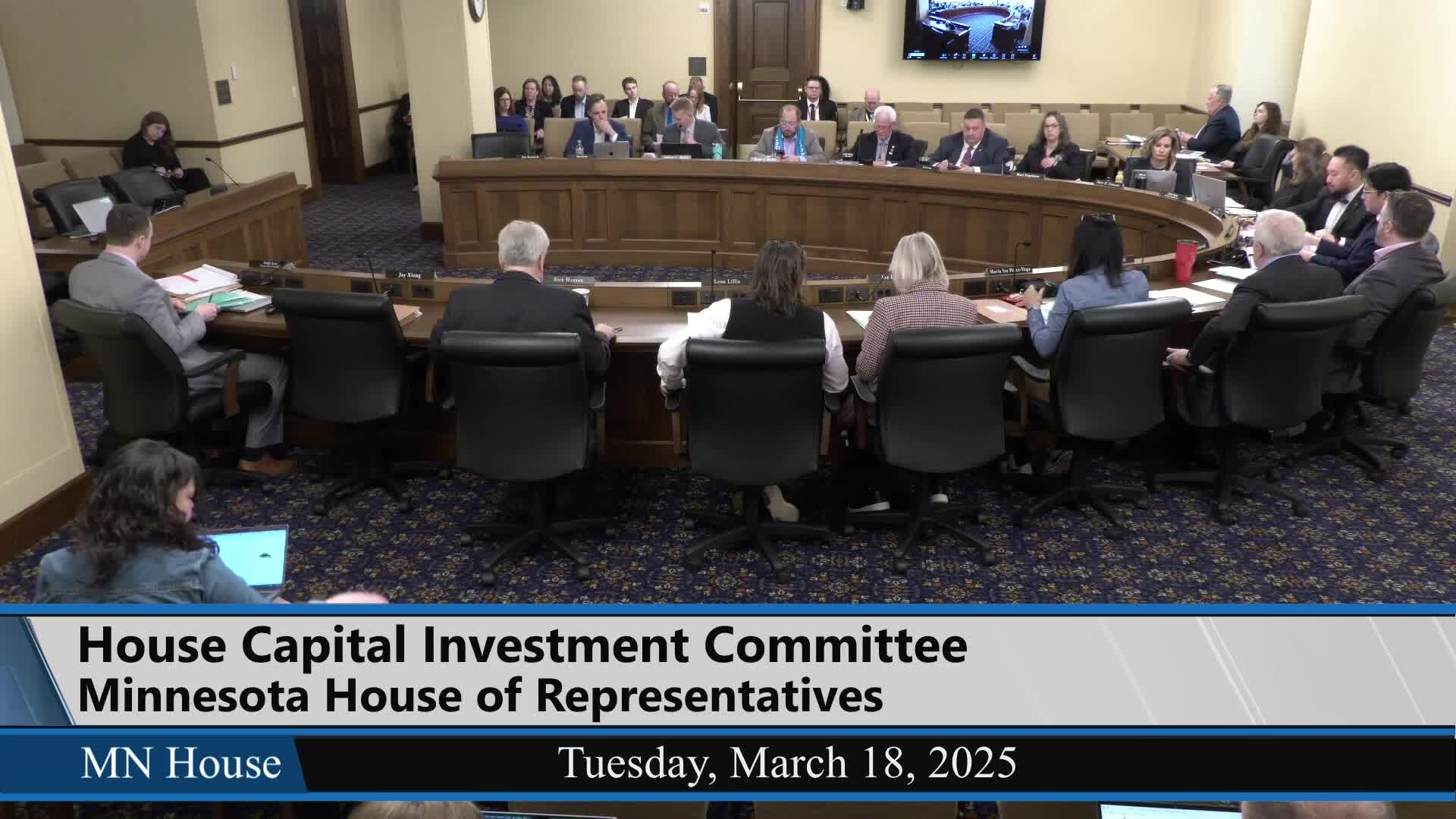
Brian Wankel, senior legislative director for budgets and revenue at the National Conference of State Legislatures, told the Minnesota House Capital Investment Committee on March 18 that overlapping federal actions have created planning uncertainty that could affect Fiscal Year 2026 federal funding for state projects.
Brian Wankel, senior legislative director for budgets and revenue at the National Conference of State Legislatures, told the Minnesota House Capital Investment Committee on March 18 that a collision of federal actions has created “uncertainty for states” about funding that could affect fiscal 2026 program flows.
Wankel said the uncertainty stems from concurrent federal budget reconciliation, executive-branch funding freezes and possible tax-law changes tied to discussion of extending the 2017 Tax Cuts and Jobs Act. “This is creating uncertainty for states,” he said, and noted that the Office of Management and Budget’s initial memo implementing funding freezes produced confusion when agency portals were shut and then the memo was withdrawn.
Why it matters: Committee members said the uncertainty has real consequences for Minnesota projects that expected federal awards. Chair Franzen and others cited examples the committee has tracked, including a Department of Transportation grant to Bemidji reported in the media as at risk and other locally significant projects such as repairs to Duluth’s Aerial Lift Bridge and Minneapolis’s Nicollet (Nicola) Bridge that rely on federal programs.
Wankel summarized the federal picture for legislators: House and Senate budget resolutions, reconciliation choices that could cut ten-year spending in the hundreds of billions in some areas, potential debt-limit negotiations and litigation over executive actions. He advised states to plan contingencies for late or reduced funding and pointed committee staff to obligation rates on federal grants as a key indicator of funds likely to remain available. “Most notably for this committee, I would highlight ‘unleashing American energy,’ a memo that immediately paused the disbursement of funds through IRA and IIJA,” Wankel said.
Committee members pressed Wankel on state-specific detail. Chair Franzen asked whether a state-by-state breakdown of Department of Transportation IIJA obligations was available; Wankel said he had not found a detailed state-by-state table in the packet but would try to locate one. Representative Perez Vega described a local example: a $25 million viaduct grant his district had received and later learned was under individual federal review; Wankel said the White House did not provide firm timelines for those reviews and that some projects had experienced “unexpected delays.”
Multiple members urged a coordinated state response: Wankel and Chair Franzen encouraged legislators to collect project lists so the committee and state agencies could seek updates from federal partners.
The committee also heard Wankel’s explanation of “obligated” versus “unobligated” federal funds: grants that are obligated involve a signed procurement or agreement and are harder for the federal government to rescind than announced but unobligated grants. He urged members to review obligation rates in evaluating vulnerability to rescission.
Votes at a glance: The committee approved the March 13 minutes at the start of the March 18 meeting. A member moved approval; the motion carried with two recorded “aye” responses and the chair stating the motion prevailed.
Looking ahead: Wankel recommended that states assemble project lists and coordinate with federal and state finance staff to track award statuses and stated that NCSL is urging the administration to provide states time to comply with any new directives.
Sources: Testimony and a slide packet provided to the committee by Brian Wankel and the National Conference of State Legislatures.