Get Full Government Meeting Transcripts, Videos, & Alerts Forever!
Get email alerts on the Water And Wastewater Infrastructure topic
No spam. Unsubscribe anytime.
Greater Minnesota cities ask state for bonding to fix aging water and wastewater systems
Summary
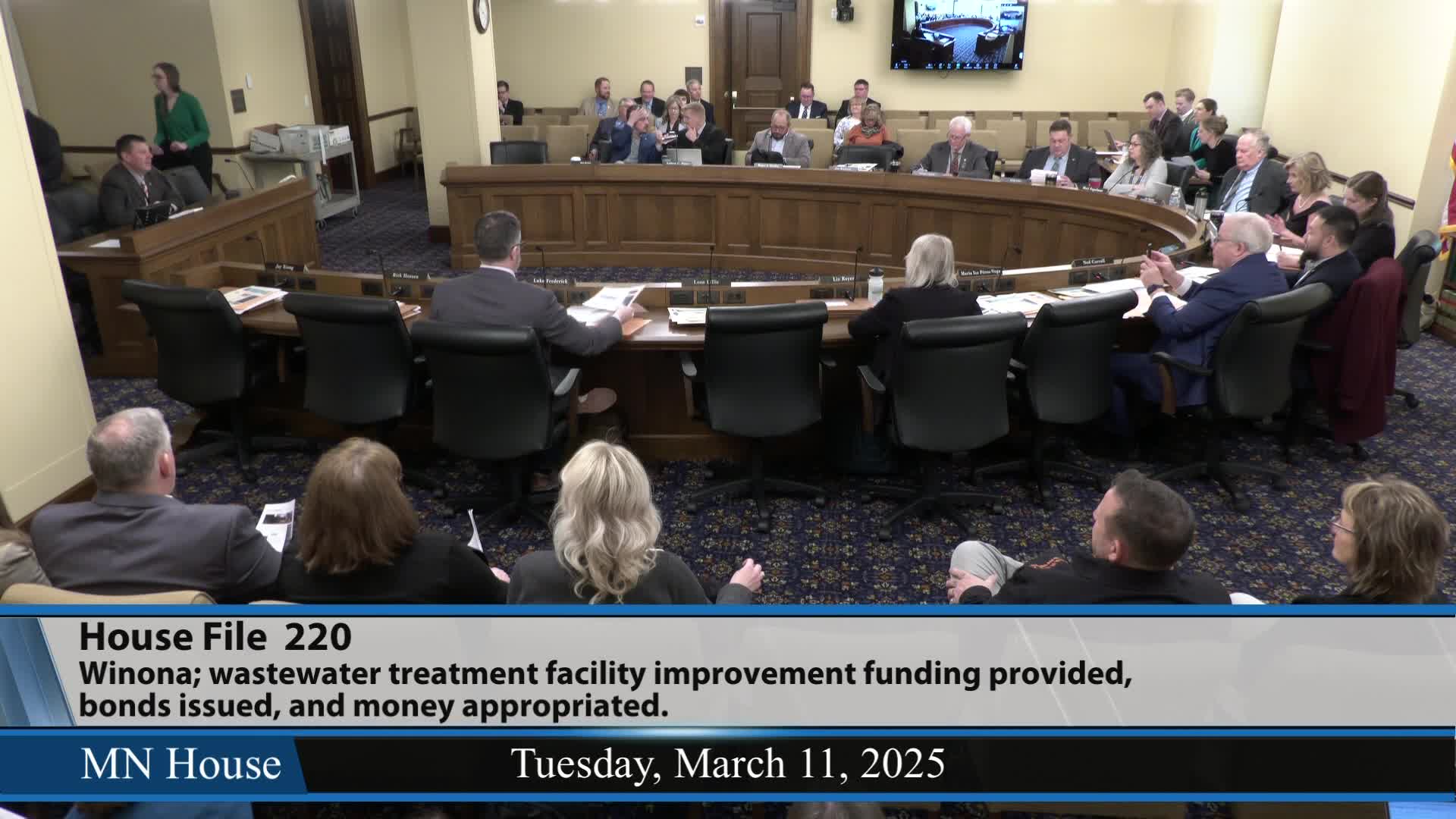
Representatives and local officials from more than a dozen Greater Minnesota communities told the House Capital Investment Committee on March 11 that aging water and sewer systems, new state nutrient limits and rising construction costs make state bonding essential to avoid steep rate increases and public-health risks.
Representatives and local officials from more than a dozen Greater Minnesota cities told the House Capital Investment Committee on March 11 that aging water and wastewater infrastructure and new state nutrient limits require state bonding support to avoid large utility rate increases, environmental harm and limits on local growth.
Committee members heard requests ranging from $563,000 for a failing sewer force main in Arden Hills to multi‑million dollar asks from the Alexandria Lake Area Sanitary District and Rochester. Many presenters said construction inflation and a tight contractor market have driven projects well above earlier estimates and that, without state help, local ratepayers — including many low‑income and fixed‑income households — would shoulder steep increases.
Why it matters: The committee is writing this year’s bonding bill, the typical vehicle for large municipal infrastructure grants. Several presenters tied their requests to state mandates: wastewater plants need to meet phosphorus and other nutrient limits set by the Minnesota Pollution Control Agency (MPCA) and said the costs of compliance are higher than previous estimates. Speakers urged the committee to consider bonding as one tool to protect affordability and support economic development.
Most prominent requests and local impacts
• Winona: Representative Repinski presented a $36 million wastewater treatment upgrade driven by MPCA phosphorus requirements; the city seeks $12 million in bonding. Brian DeBran, identified in testimony as a City of Winona official, told the committee the city must complete the project by 2028 and that “inflation of this type of work has doubled, if not 250% of where we first started.” City Manager Chad O’Bull warned that without substantial state funding the city would need to issue debt or push major rate increases that would hit residents on fixed incomes.
• Big Lake: Representative Meckland said Big Lake needs about $52.8 million to expand a wastewater plant that is at 90% capacity and requested $25 million in state aid. Mayor Paul Kinnear said the plant’s capacity limit threatens new housing and business development and that without aid residents could face about a 15% annual sewer rate increase (from roughly $52 to $83 per month); with state help he said the increase could be nearer 6% (about $61 per month).
• Hibbing: Testimony from Hibbing Public Utilities General Manager Luke Peterson described a multi‑year plan that Peterson said totals more than $87 million to modernize supply, treatment and more than 50 miles of distribution mains; he described immediate needs in the tens of millions and said the city can phase work but seeks significant state support to limit rate pressure.
• Alexandria Lake Area Sanitary District (ALASD): Executive Director Scott Gilbertson requested $25 million in bonding as part of an $85 million upgrade to meet stringent phosphorus limits and install membrane filtration. He said the district serves roughly 28,000 people across a regional system and warned that costs have grown substantially since earlier estimates.
• Rochester: Representative Andy Smith said Rochester plans a roughly $34.5 million project to increase sewer trunk capacity to allow roughly 1,000 developable acres for housing and jobs; the city asked for $17.25 million in state bonding and said the work can be segmented into planning, design and construction components.
• Smaller communities: The committee also heard requests from Arden Hills ($563,000 for a failing 65‑year‑old force main serving schools and Bethel University), Floodwood ($2 million for water and wastewater extension to a 127.5‑acre development parcel), Eveleth ($850,000 for predevelopment of a $12 million wastewater upgrade), Revere ($3.6 million to reconstruct streets and failing storm sewer for a city of 88), New Ulm ($4.021 million to finish a gravity sewer flow project and replace an 1897 cast‑iron water main), Lamberton ($1.95 million in phase 1 of a $7.3 million project to add wells and resiliency), Stephen ($8 million for water and sewer replacement after repeated breaks), and the Little Fork campground/ATV park ($2.5 million request toward a $5 million recreation project).
Common themes raised to the committee
• Rising costs: Multiple presenters said initial cost estimates have increased dramatically because of post‑pandemic inflation, material and labor shortages, and higher interest rates on bonding. Several communities reported project costs two to three times earlier estimates.
• Affordability: Presenters repeatedly flagged local affordability: some cities said a large share of property is tax‑exempt, many residents are low‑ or fixed‑income, and utility rate increases would be consequential. Eveleth and Winona cited poverty rates and recent local rate increases already taken.
• Phasing and timing: Many presenters described phasing challenges. Some projects (Winona, Big Lake, Eveleth, Litchfield/First District industrial pretreatment) cannot be easily phased without increasing costs or creating coordination problems. Arden Hills stressed urgency because a county road rebuild planned for 2026 could require ripping up new pavement if the force main is not replaced first.
• Funding mix and dependency: Speakers noted they are pursuing federal and PFA (Public Facilities Authority) funds and local borrowing but said state bonding often unlocks or complements other sources. Several speakers said PFA funds are constrained when bonding does not pass and that loan terms (20 vs. 40 years) affect local affordability.
What the committee recorded as formal outcomes: None. The hearing consisted of project presentations and member questions; no motions or votes were recorded during the transcript.
Looking ahead: Speakers asked the committee to factor construction cost escalation, MPCA nutrient deadlines, and local affordability into bonding decisions. Many presenters requested that the committee prioritize projects that both address public‑health risks and enable housing or economic development.