Get Full Government Meeting Transcripts, Videos, & Alerts Forever!
Get email alerts on the Water Infrastructure Bonding topic
No spam. Unsubscribe anytime.
Capital Investment Committee hears wave of water, sewer and levee funding requests from cities across Minnesota
Summary
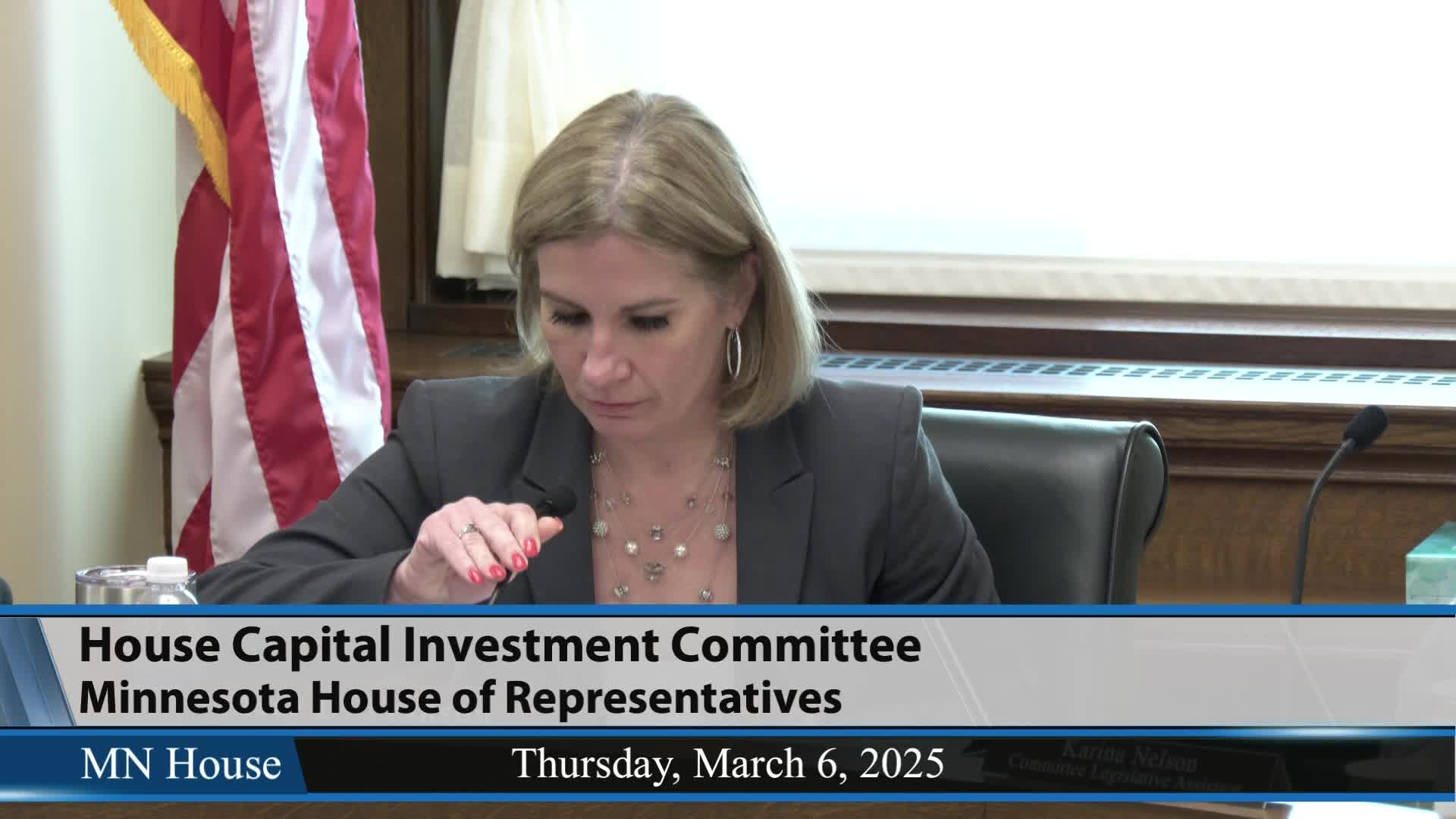
Capital Investment Committee members heard testimony on March 6, 2025, in St. Paul on more than a dozen bonding requests for water and wastewater projects, levee repairs and related infrastructure across Greater Minnesota and the Twin Cities metro area.
Capital Investment Committee members heard testimony on March 6, 2025, in St. Paul on more than a dozen bonding requests for water and wastewater projects, levee repairs and related infrastructure across Greater Minnesota and the Twin Cities metro area. Representative members and mayors from towns including Duluth, Albert Lea, Carver, Bloomington and several smaller cities described aging systems, regulatory pressure and public‑health concerns and asked the committee for state assistance.
The requests matter because many of the projects are large, urgent and tied to public‑safety or regulatory deadlines. Some communities said local tax bases and utility rates cannot cover the full cost. Committee members were repeatedly told that without state help projects would be delayed, utility rates would rise steeply or communities would remain at risk from floods, water contamination or capacity shortfalls.
The largest single requests include a Duluth regional water plant modernization (House File 972) that the city says carries a $42.4 million price tag with a proposed $21.2 million state share; Albert Lea’s multi‑phase wastewater upgrade (Representative Bennett) with a top ask of $37 million to complete remaining phases; and a $110 million North Sunborough regional sanitary project (House File 644) that supporters said needs half state funding to proceed. Other significant requests include $13 million for Bloomington’s North Central sanitary sewer project (House File 1280) and $14.1 million for Eagle Lake (House File 1045), with the state asked to cover roughly half of those costs.
Duluth -- regional treatment and aging plant
Eric Simonson, testifying for Duluth, said the Lakewood Water Treatment Facility serves Duluth and neighboring cities and that much of the system "is quite old." He told the committee the total construction and engineering cost is $42.4 million and the city is asking for $21.2 million in bonding assistance after rate increases and other local steps. Simonson said recent EPA enforcement accelerated the city's timeline for corrective work on filters, tanks and reservoirs.
Albert Lea -- phosphorus and regulated costs
Ian Rigg, city manager of Albert Lea, described regulatory requirements tied to phosphorus removal that have raised the cost of completing three remaining phases of his city's wastewater project. Rigg said the city is requesting $37 million to finish the work, but noted the work will also address resilience, future contaminants and protect roughly 1,600 local jobs that rely on the sewer system.
Regional and rural projects
Representative Steve Jacobs presented House File 644, a regional approach to replace multiple aging plants and consolidate discharge points for Goodhue, Pine Island, Wadena and other towns plus the Prairie Island community. Jacobs said the project would save taxpayers money by creating a single treatment point instead of multiple failing plants. Prairie Island representatives said the community supports the regional facility to enable future development of land they own near Rochester.
Carver levee and flood mitigation
Courtney Johnson, mayor of Carver, asked for $3.35 million toward a $13 million levee rehabilitation project intended to bring the locally built levee into FEMA certification after repeated breaches during 2024 flooding. "The flood threat in the city of Carver is not going away," Mayor Johnson said, adding the city had previously received $6 million in 2023 and other federal and local funds toward the project.
Small cities and phased requests
Committee members also heard from many smaller cities seeking targeted bonding to finish multi‑phase upgrades: New Germany asked for $8 million toward a $10.66 million wastewater expansion to lift an MPCA moratorium on new service; Russell requested $4 million to complete a $13.1 million final phase eliminating asbestos pipe and stopping overflows to the Redwood River; Wood Lake sought $4.525 million to close a funding gap on the final phase of a three‑phase $15.7 million project; Tracy asked for $12 million toward a $70 million set of water, sewer and stormwater upgrades; and Cottonwood requested $8 million for a phase 1 package focused on mains, force mains and water main work tied to a planned supplier change.
Public‑health and regulatory drivers
Speakers repeatedly cited public‑health advisories and regulatory limits as drivers. Jennifer Bromeland, city administrator for Eagle Lake, told the committee that "our water is not safe for infants to drink," and described families who said they were fearful of bathing or drinking the local water. Annika Bankston, director of water treatment and distribution for Minneapolis, described a 2.6‑mile transmission main installed in the 1880s that failed in December 2022 and led to a localized boil‑water advisory; Minneapolis seeks approximately $12.36 million to structural‑line that segment rather than conducting full open‑cut replacement.
Costs, local capacity and rate impacts
Multiple presenters gave cost breakdowns and described rate impacts if state aid is not available. The city of New Germany said its average residential water‑sewer bill is about $261.05 a month (versus $120–$130 nearby) and that sewer rates would need to rise about 85% without assistance. Albert Lea warned sewer bills could rise 200% without state support. Russell and Wood Lake both said typical monthly combined bills would exceed $200–$250 per household without bonding help, a level they described as unaffordable for large shares of their populations.
Committee process and next steps
No formal votes were taken during the hearing. Committee members asked technical and affordability questions; some suggested phasing projects if full funding is not immediately available. The committee chairman noted the next hearing date is March 11. Testifiers thanked the committee for listening and urged timely action to avoid further public‑health or environmental risks.
Ending: broad view
The hearing illustrated a statewide pattern: decades‑old water and sewer systems, tighter regulatory requirements and limited local ability to bear large capital costs are driving numerous bonding requests. Committee members will weigh those requests against the state's bonding capacity and other priorities in coming weeks. The hearing record runs to multiple individual bills and project packets submitted by cities.