Get Full Government Meeting Transcripts, Videos, & Alerts Forever!
Get email alerts on the Water Infrastructure topic
No spam. Unsubscribe anytime.
Capital Investment Committee hears dozens of water and sewer funding requests from Minnesota cities
Summary
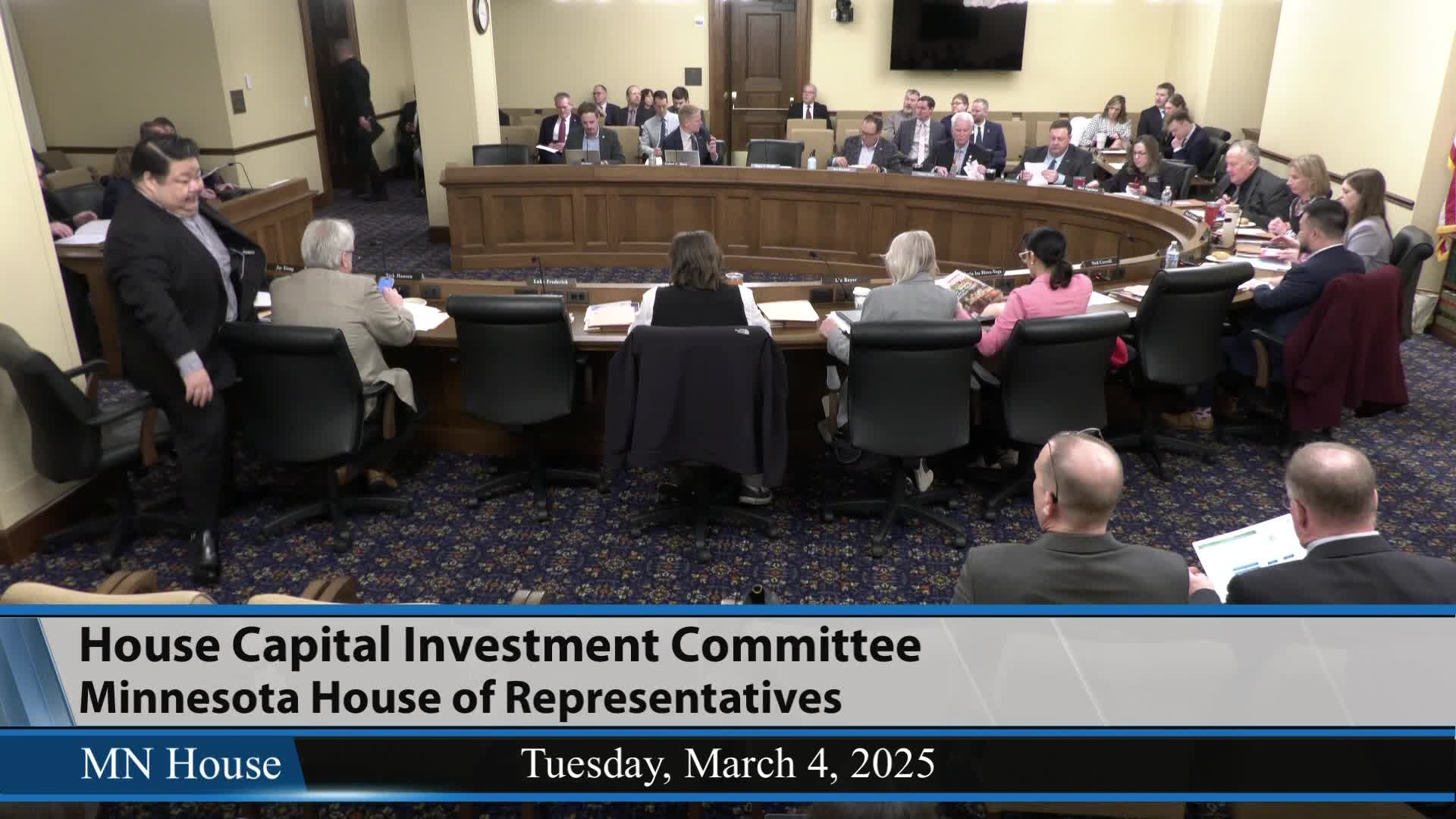
The House Capital Investment Committee met March 4 for an informational session on 17 capital requests, hearing presentations from more than a dozen Minnesota cities seeking state support for water and sewer projects.
The House Capital Investment Committee met March 4 for an informational session on 17 capital requests, hearing presentations from more than a dozen Minnesota cities seeking state support for water and sewer projects.
Committee Chair Fransen opened the meeting by saying every bill would be heard on an informational basis only and “laid over” for later action. Municipal officials and elected representatives described projects addressing aging pipes, inflow and infiltration (I&I), and treatment for contaminants including manganese, radium and PFAS.
Why it matters: Committee members heard repeated warnings that deferred infrastructure work has raised costs, shifted burdens to ratepayers, and in some places posed environmental risks to lakes and the Mississippi River. Several cities said assessments large enough to cover projects would be unaffordable for many households.
Major requests and details
- Mound (House File 406): Mayor Jason Holt told the committee his city needs a new water treatment plant to remove manganese, which Minnesota Health and the Public Facilities Authority treat as an emerging contaminant. He said a remaining price tag of roughly $30 million remains after prior appropriations and that a PFA grant this year would likely reduce that by about $3 million. “Clean drinking water is not just a fundamental necessity, it’s also a right that every Minnesotan deserves,” Holt said.
- Minnetrista (House File 408): Council member Kathleen Refkin said Minnetrista seeks $26,755,000 to build a treatment plant to remove manganese and iron. The city has contributed about $17 million to its water system since 2017 and plans to complete the plant in 2027. Officials said the cost, if shifted entirely to ratepayers, would raise annual water-related costs by about $1,200 per household for 20 years.
- Burnsville (no HF number provided in testimony): Mayor Elizabeth Kautz and Representative Kayla Berg requested $8,550,000 for upgrades at the Burnsville water treatment plant to add surface water treatment technologies, ion exchange or membrane filtration to remove radium and other contaminants, replace lines and upgrade electrical systems. “We are indeed, in desperate need of help,” Mayor Kautz said.
- St. Joseph (sewer main expansion): City Administrator David Murphy and City Engineer Randy Sabar presented a request to expand a trunk sewer that officials say would open roughly 2,100 acres for commercial, industrial and residential development. The city estimates the bonding ask has risen from $5.7 million last year to $6.2 million this year and said it stands ready to meet a local match.
- Laketown Township (House File 928): Chair Pete Paris said the township’s 1980s-era community wastewater systems (201 systems) are past expected life and far below current code. An engineer’s estimate put the total project cost at $25.4 million; Laketown proposed phasing and a DE amendment that would reduce the state request from $13 million to $6.4 million to fund Phase 1. Paris said residents on the system currently face assessments of $30,000–$35,000 each depending on area; without state funding, assessments could be far higher.
- Blue Earth (House File 730): Tim Stoner, general manager of Blue Earth Light & Water, asked for $7,000,000 (city materials also referenced $7.5 million) to complete a reverse-osmosis plant required by MPCA compliance. He said the city has raised rates over the last decade and that without assistance average monthly water and sewer bills would rise further.
- Lewisville (House File 731): Mayor Barb Pfeil requested up to $10,000,000 for citywide sewer, water and road reconstruction, describing earlier contractor failures that left the town with high bills and limited reserves. She said current utility bills average about $120 per month and that without aid bills could rise to $190 per month.
- Dayton (House Files 314 and 315): City officials described two related projects: a wellhead treatment plant to address elevated manganese and iron (project engineering estimates rose from $2.5 million in 2020 to about $8.5 million in 2023) and a water tower for the historic village to restore adequate pressure and fire flow. Officials said the well treatment should stabilize water quality for at least 20–25 years.
- Waseca (House Files 425 and 426): City manager Carl Sonnenberg described an ongoing I&I problem that, during heavy rain events, overwhelms sanitary sewers and has resulted in discharges to Clear Lake. The city seeks funding for sanitary sewer improvements and a replacement water tower (estimated total $7.5 million). He told members Waseca’s monthly sewer bills are regionally high and that federal and other grants have funded earlier phases.
- Brooklyn Park (House File 1017): Representative Sharon Vang and Mayor Hollis Winston asked for $4,500,000 for an upland water-main crossing beneath MnDOT facilities (Highway 610/169) to serve a planned Biotech Innovation District, a project city leaders say will support jobs and taxable development.
- Newport (House Files 652 and 761): Mayor Lori Elliott and city staff described substantial I&I where a single 3.1-inch rainstorm generated nearly 3 million gallons of flow treated as sewage; Newport’s projects are split into north and south phases. Officials said Metro Wastewater identifies Newport as a high-priority offender, that special assessments for priority Project 1 would be almost $10,000 per property, and that many households would be unable to bear that burden.
- South St. Paul (House File 1079): City Administrator Ryan Garcia described work tied to prior state direction after MDH identified elevated radium in Well 3 and to ongoing PFAS work at Well 4. The city requested $3,000,000 for pressure-control valves and related reliability improvements; Garcia said debt and recent borrowing for a radium treatment plant raised median residential bills roughly 23% in year one and another 10% the next year.
- St. Francis (House File 1056): City council member Kevin Robinson and staff said trunk water and wastewater lines built more than 50 years ago must be replaced before a planned MnDOT reconstruction of Highway 47 to avoid redoing new pavement later. The city requested $3,000,000 toward an $8,000,000 project.
- Scandia — Bliss neighbourhood (no HF given in testimony): Les Heen said the Bliss neighborhood system serves 79 homes and was built in the late 1980s. New MPCA nutrient rules (2021) require upgrades to remove nitrogen and phosphorus; city engineers estimate the cost now at about $2,000,000. Heen said residents currently pay about $128 per month, which could rise to roughly $565 per month if costs were borne solely by the neighborhood.
Discussion, phasing and local matches
Several presenters said projects could be phased to reduce immediate state ask; others said schedules and regulatory deadlines (MPCA compliance, MDH guidance, Met Council expectations) compress timetables. Cities repeatedly said they would meet local matches where feasible but that assessments at the household level would be unaffordable for lower-income residents.
Quorum and procedural notes
Chair Fransen opened the meeting noting a quorum and that all bills would be informational and “laid over.” The committee approved minutes from its Feb. 27 meeting by voice vote after Representative Jeong moved approval.
Looking ahead: Committee members and presenters noted the next Capital Investment Committee hearing is scheduled for March 6, when more bonding requests will be considered. Many presenters asked the committee to consider the social and environmental impacts of shifting costs entirely to local ratepayers.