Get Full Government Meeting Transcripts, Videos, & Alerts Forever!
Get email alerts on the Met Council Bonding topic
No spam. Unsubscribe anytime.
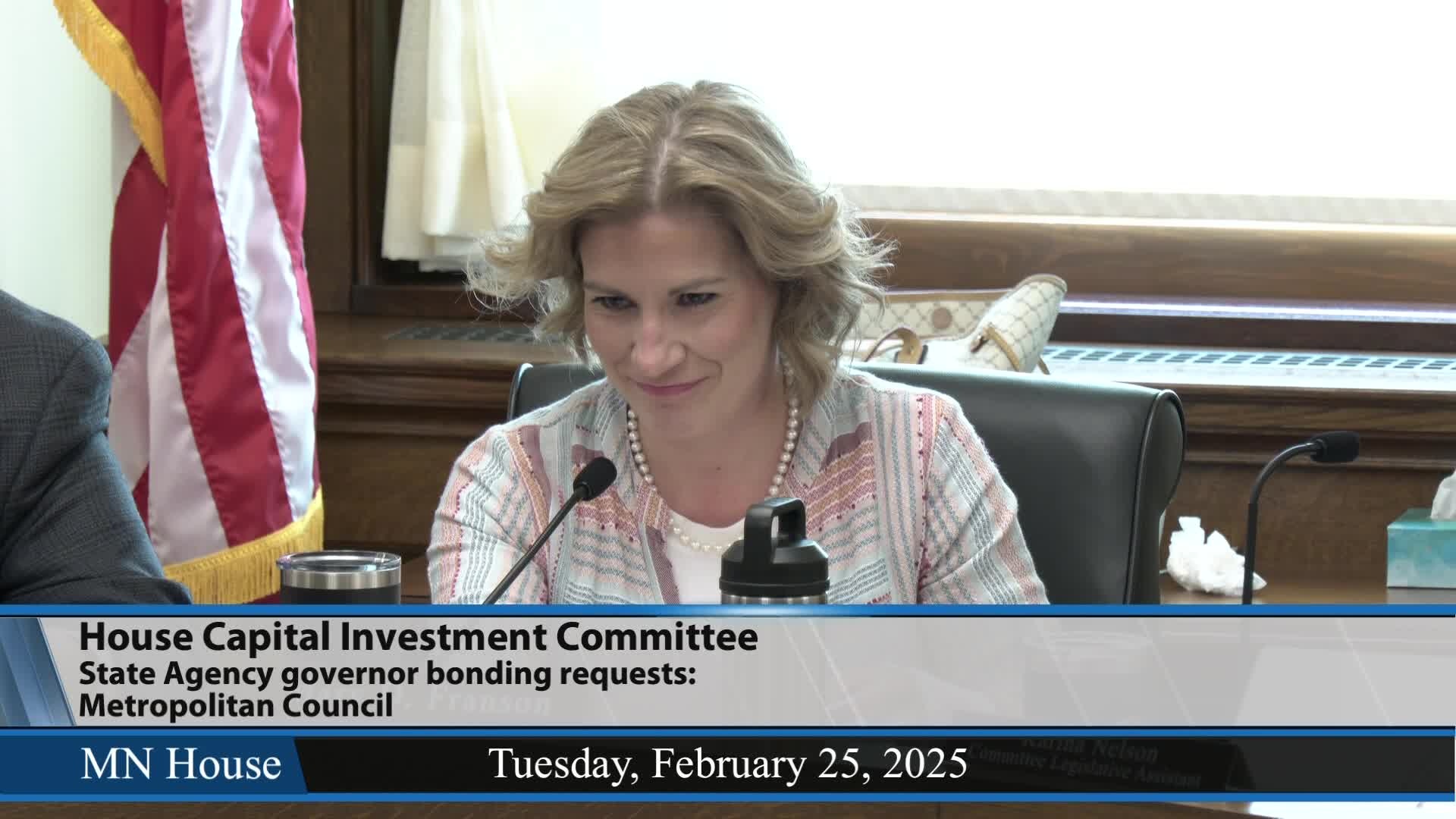
Metropolitan Council outlines $21.9M in governor recommendations for transit, wastewater and parks
Summary
Charlie Zelle, chair of the Metropolitan Council, told the Capital Investment Committee the governor recommended three capital items: $15 million for busway capital (to support the H Line), $4.6 million for wastewater inflow and infiltration grants, and $2.3 million for regional parks and trails.
Charlie Zelle, chair of the Metropolitan Council, told the Capital Investment Committee the governor recommended three capital items for the Met Council: a $15,000,000 busway capital program contribution, $4,600,000 for inflow and infiltration (I&I) grants for municipal wastewater systems, and $2,300,000 for regional parks and trails.
Zelle framed the $15 million as a key local match to secure federal Small Starts funding for the H Line, an arterial bus rapid transit (ABRT) corridor running roughly 17 miles from Minneapolis through St. Paul to Sunray Shopping Center. "We have already $60,000,000 secured, 25,000,000 of that is federal funds through our regional solicitation," Zelle said, and Met Council staff described the H Line project total in the presentation as requiring roughly $120 million to $150 million in overall funding.
On inflow and infiltration, Kyle Colvin, manager of wastewater planning at the Met Council, told the committee that past state offerings have been fully encumbered and that the program leverages a high level of local work: "Of that, 25,000,000, there's been approximately, or over 150,000,000 of local work," he said, describing about a 6:1 leverage ratio in previous rounds. Colvin said the program typically offers grants on a roughly 50% match basis and that municipal capacity to administer projects and contractor capacity are constraints the council monitors.
Representative Hansen and others pressed about the scale of the need versus the recommended appropriation, noting earlier estimates that public‑system mitigation could exceed $150,000,000 (in 2008 dollars) and that small annual appropriations can leave large systems underfunded. Colvin acknowledged the figure was a moving target and explained the council's continuous monitoring with sanitary flow meters that track excess I&I after storm events.
On regional parks and trails, Zelle noted the council's matching approach: the council's regional funds match $2 for every $3 of state bonding dollars. He said the $2.3 million governor recommendation would trigger approximately $1.53 million in regional matching funds and highlighted the system's scale: more than 55,000 acres and roughly 500 miles of trails with nearly 70 million annual visits across the network.
Committee members raised follow‑up questions about project sequencing, contractor and municipal administrative capacity, and how changes to commuter rail service (Northstar) might affect operations budgets and transit priorities. Zelle said savings from changes to commuter rail operations would free operating funds but that curtailing rail comes with costs that must be evaluated.
No bonding decisions were made at the hearing. Met Council officials offered to provide updates on corridor studies and program specifics after the meeting, and staff said grant rounds have been fully subscribed when funded.
Ending: The Met Council presented a three‑part capital package in the governor's recommendation, emphasizing federal match opportunities for transit, high leverage from prior I&I rounds, and continued regional investment in parks and trails. Committee members asked for additional cost, capacity and timeline details as the bonding process proceeds.