Get Full Government Meeting Transcripts, Videos, & Alerts Forever!
Get email alerts on the Water Infrastructure topic
No spam. Unsubscribe anytime.
Public Facilities Authority seeks $99 million to unlock federal water funds; proposes new emerging-contaminant grants
Summary
The Minnesota Public Facilities Authority told the Capital Investment Committee it needs about $39 million in state match to unlock $215 million in federal capitalization grants and proposed a new state emerging-contaminant grant program to supplement federal funds for PFAS and manganese remediation.
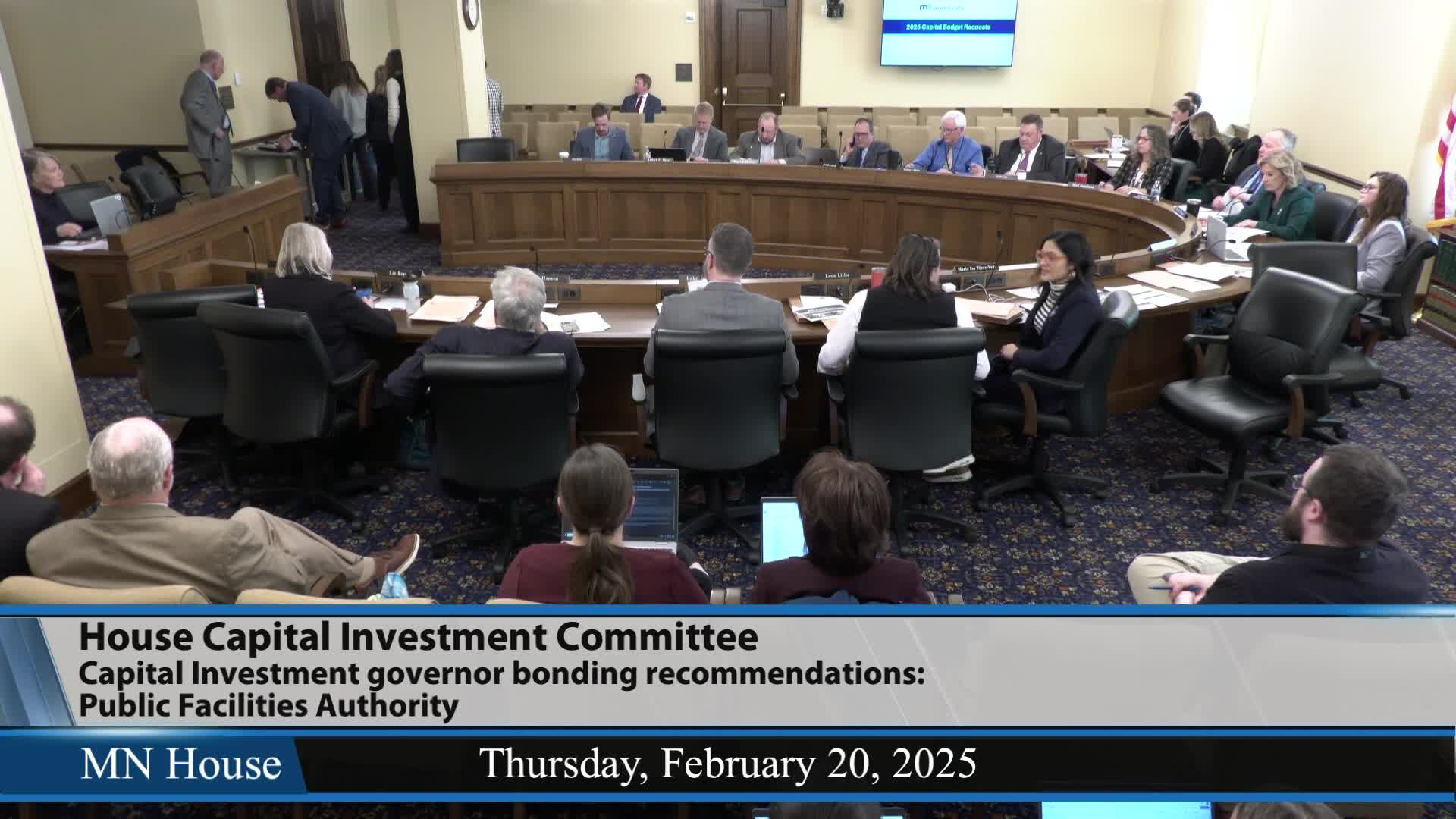
Karen Burkholtz, deputy director of the Minnesota Public Facilities Authority, told the Capital Investment Committee on Feb. 20 that the PFA's governor-requested capital package totals just over $99 million and would unlock federal funds for drinking water and clean water projects across Minnesota.
“By statute the clean water and drinking water revolving funds are supported by annual federal capitalization grants requiring 20% state match,” Burkholtz said. She said $39,000,000 in state match would unlock roughly $215,000,000 in federal funds.
Nut graf: the PFA manages low-interest loans and targeted grants for municipal water projects and noted a backlog of carryover projects that could not be advanced because last year's bonding bill did not pass. Burkholtz told the committee the PFA recently limited the 2025 intended use plans to carryover projects because state match for new federal capitalization grants was unavailable.
Burkholtz summarized four PFA programs and several statutory and policy requests: the clean- and drinking-water revolving funds (federal cap grants with a 20% state match), the Water Infrastructure Fund (WIF) grant program for affordability gap projects, the Point Source Implementation Grant (PSIG) program for pollutant-reduction components, and a proposed Emerging Contaminant (EC) grant program to supplement federal IIJA funds for PFAS, manganese and similar contaminants.
She said the PFA has awarded more than $6.09 billion in projects since 1989, including $5.22 billion in low-interest loans and $1.21 billion in grants, and that in fiscal 2024 the agency awarded $363,000,000 across 74 funding actions. So far in fiscal 2025 the agency awarded over $435,000,000 to 112 projects.
On policy changes, Burkholtz said the PFA is proposing increases to grant caps to reflect inflation and project complexity: raising WIF maximum grants from $5,000,000 to $10,000,000 and PSIG maximum grants from $7,000,000 to $12,000,000. She said the proposed EC program would provide up to 80% grants capped at $12,000,000 for eligible projects and that Minnesota expects roughly $120,000,000 in federal IIJA EC funding over five years; the PFA estimates $450,000,000 in total statewide costs to address all impacted systems.
Committee members asked about affordability criteria and whether the PFA will apply lead-service-line affordability rules to other programs. Representative Hansen cited Minnesota statute ‘‘4 4 6 a 0.072’’ (as read in the hearing) and asked that disadvantaged-community criteria be applied broadly; Burkholtz said the lead service-line program uses a disadvantaged-community calculation and that the PFA plans to return with further proposals and expects to seek additional funds in 2026.
Members also asked about a brief federal pause on disbursements after a White House executive order; Burkholtz said the pause lasted roughly 10 days until a federal court order and EPA notice clarified the status and that PFA has resumed normal grant applications and reimbursements.
Ending: Burkholtz closed by offering to supply additional details on program spend-down and timing; committee members signaled continued interest in affordability criteria, coordination among agencies and emerging-contaminant responses.