Get Full Government Meeting Transcripts, Videos, & Alerts Forever!
Get email alerts on the Zoo Veterinary Hospital topic
No spam. Unsubscribe anytime.
Minnesota Zoo asks state for bonding to build new veterinary hospital, address deferred maintenance
Summary
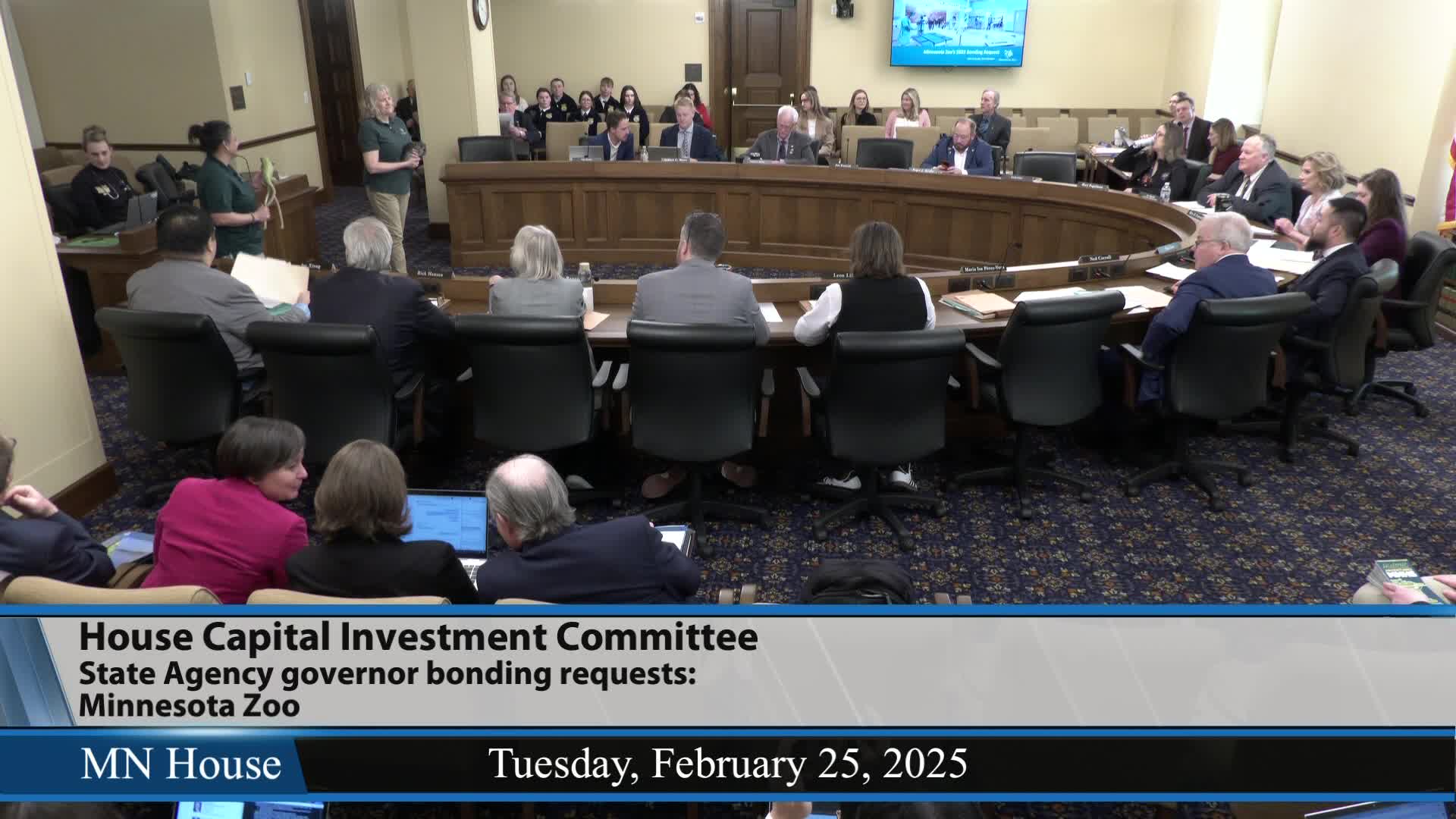
John Frawley, director of the Minnesota Zoo, told the Capital Investment Committee on Feb. 25 that the zoo is asking the state for capital support to replace an aging veterinary hospital and to address urgent asset‑preservation needs across the 50‑year campus.
John Frawley, director of the Minnesota Zoo, told the Capital Investment Committee on Feb. 25 that the zoo is asking the state for capital support to replace an aging veterinary hospital and to address urgent asset-preservation needs across the 50‑year campus.
Frawley said the zoo is a state agency operating in a public‑private partnership and that it receives roughly a third of its general operating funds from the state, with the remainder raised privately. "We are a state agency, public private partnership," Frawley said, noting the zoo hosted about 1,500,000 visitors last year and serves roughly 5,000 animals.
Dr. Rivas, head of veterinary programs at the Minnesota Zoo, described the current hospital as the institution's first building, built in 1975, and said it "lacks the essential infrastructure to meet USDA and other regulatory standards," creating safety and infection‑control concerns for animals and staff. She told the committee the current surgical and holding spaces are too small, lack proper ventilation and expose staff to hazardous working conditions.
Frawley described the proposed project as a modern hospital and wellness center with an indoor ambulance bay, larger surgical suites and expanded diagnostic capacity. He said the zoo envisions the facility also as a teaching hospital that would host veterinary students, interns and conferences and provide specialized care for partner organizations across the state.
On costs, the zoo's presentation described the full hospital project as a roughly $30,000,000 undertaking and said the zoo has raised about $9,000,000 privately toward that total. During the hearing staff cited a state request figure that was transcribed as $17,675,000; committee members pressed staff on budget priorities and timing. The zoo also presented a separate asset‑preservation ask for deferred maintenance across its campus, variously cited in the presentation at approximately $3.8 million.
Committee members asked how long the zoo can safely operate under current conditions. Frawley said the situation is urgent: staff regularly perform procedures in substandard spaces and an on‑site veterinarian previously sustained a concussion after slipping on ice while accessing supplies stored outdoors. He said construction would likely take about a year and a half, underscoring the urgency of funding timing.
Lawmakers pressed for detail on partnerships, fundraising and priorities within the asset‑preservation list. Dr. Rivas described partnerships with the University of Minnesota College of Veterinary Medicine and the Minnesota Veterinary Medical Association for training and specialist care; Representative Allen asked specifically how the zoo works with the university, and Rivas said the zoo hosts university residents and fourth‑year veterinary students for clinical rotations and research collaborations.
The zoo provided examples of high‑priority preservation work to the committee including boiler and heating systems that recently required an $850,000 emergency repair, and described the need to replace outdoor holding areas and improve loading and vehicle storage so ambulance vans can remain stocked and temperature‑stable.
No formal action or vote on bonding was taken at the hearing. Zoo officials said they will continue private fundraising and asked lawmakers to consider state bonding to complete the project and to fund critical infrastructure repairs.
Ending: The zoo left the committee with a presentation of a multi‑part request: a new veterinary hospital designed to serve the zoo and statewide veterinary partners, private fundraising that has reached about $9 million, and a package of deferred‑maintenance needs the zoo says are increasingly urgent. Committee members asked for further detail on exact dollar requests and sequencing as the bonding process continues.