Get Full Government Meeting Transcripts, Videos, & Alerts Forever!
Get email alerts on the Corrections Bonding topic
No spam. Unsubscribe anytime.
Corrections urges $65.5 million for asset preservation, seeks Rush City expansion to reduce idleness
Summary
Minnesota Department of Corrections officials told the Capital Investment Committee the agency faces a $732 million deferred maintenance backlog and requested $65.5 million in asset preservation funding and a separate expansion at Rush City to increase rehabilitative programming space.
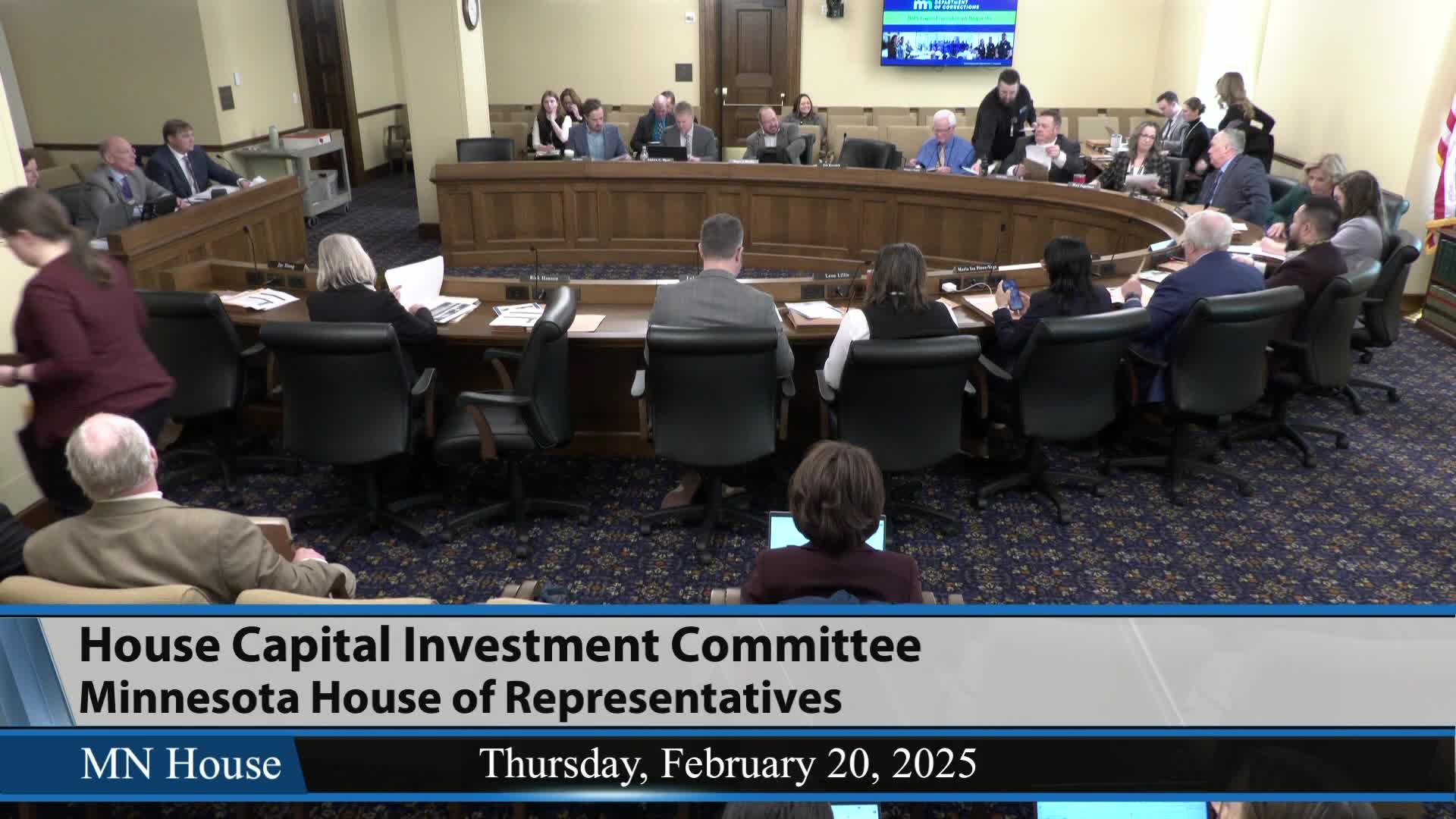
Paul Schnell, commissioner of the Minnesota Department of Corrections, told the Capital Investment Committee on Feb. 20 that the department faces substantial deferred maintenance and programming-space shortfalls and asked the committee to support the governor's bonding priorities for corrections.
The DOC asked the committee to approve $65,500,000 in asset preservation funding the governor recommended to complete about 40 critical projects, Commissioner Paul Schnell said. “This extensive infrastructure is critical to our mission and requires constant attention and upkeep,” Schnell said, noting the agency manages 11 prisons and more than 3,300 buildings covering over 7.5 million square feet.
The nut graf: the department says deferred maintenance and limited rehabilitative space undermine safety and recidivism-reduction efforts. The DOC reported a $732,000,000 deferred-maintenance backlog, with 16 buildings in crisis condition and 61 in poor condition; deferred maintenance in corrections represents about one-third of the total across state agencies, the presentation said.
Capital Resource Administrator Carl Hunt told the committee the requested $65.5 million would allow the DOC to complete 40 high-priority projects including water-treatment and distribution upgrades, roofing, life-safety improvements, security equipment and emergency generators. “We are forecasting 40 critical projects which can be completed with the governor's recommendation of 65,500,000 in asset preservation funding,” Hunt said.
Schnell and Hunt said deferred maintenance forces the department to divert resources to emergencies—broken pipes, roof failures—pushing planned work farther down the list. Hunt said the department currently has more than 175 projects on hold waiting for funding and that continued capital investment is “key to preventing future increases in deferred maintenance.”
Rush City expansion: the DOC also requested a separate capital appropriation to expand rehabilitative programming space at Minnesota Correctional Facility–Rush City. Schnell said Rush City was doubled-bunked before opening and that the design ultimately provides far less programming space than intended. “Today about a thousand men are incarcerated at Rush City, and one-fourth of them are entirely idle,” Schnell said. He said idleness reduces access to education, offender-specific treatment, substance-use disorder treatment, mental-health services and job training, and that participation in rehabilitative programming reduces the likelihood of returning to prison.
Committee members pressed for details. Hunt said the prior (2024) capital request for the Rush City priority was about $46,000,000 and that the current request had escalated by $11,000,000 because of inflation and a longer design/construction timeline. Schnell and Hunt described a plan for treatment space at Rush City that would serve about 30–35 participants in offender-specific treatment at any one time, with maximum program lengths of about 17 months depending on assessed risk.
Committee members also asked about staff safety, racial disparities and staffing diversity. Schnell said the DOC employs about 4,300 staff and houses roughly 8,300 people in its prisons and that 96% of the department's operating funding comes from the state's general fund. He said hiring and diversification efforts have improved since the last contract settlement and offered to provide numerical staff-diversity figures to members.
No formal committee action on the bonding requests occurred during this hearing. Committee members repeatedly urged passage of a bonding bill this session to address rising costs and the deferred-maintenance backlog.
Ending: Commissioners and staff left the committee with an offer to provide follow-up materials, including detail on federal testing and site visits; the committee moved on to a Public Facilities Authority briefing later in the agenda.