Get Full Government Meeting Transcripts, Videos, & Alerts Forever!
Get email alerts on the Dct Facilities topic
No spam. Unsubscribe anytime.
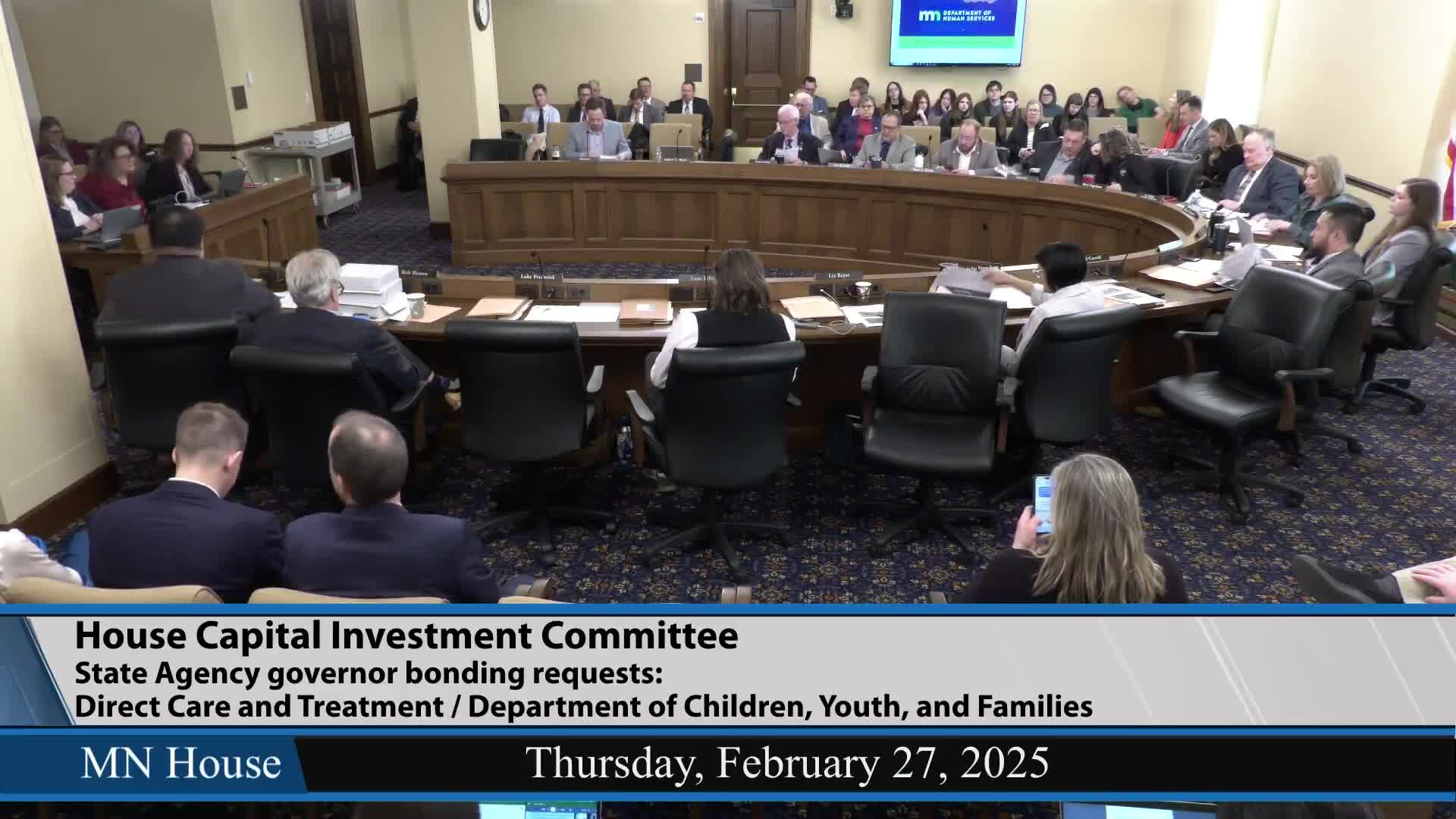
DHS Direct Care and Treatment seeks bonding for facility preservation; request includes St. Peter water/sewer work and early‑childhood facility grants
Summary
Direct Care and Treatment told lawmakers it seeks $11.43 million in asset preservation bonds and $15 million for St. Peter campus water, sanitary and storm sewer replacement; the governor also proposes $2.7 million for early‑childhood facility grants.
Nancy Freeman, chief operating officer for Direct Care and Treatment at the Department of Human Services, told the committee DCT owns roughly 3 million square feet of facilities across major campuses and 70‑plus group homes and that the agency’s deferred maintenance is estimated at more than $180 million.
"There will never be an absence of deferred maintenance balance for DCT," Freeman said, describing ongoing needs and noting the agency’s 10‑year plan estimates about $30 million per year are required to sustain the most critical work.
Freeman summarized two bonding requests in the governor’s package: $11,430,000 in bonds for asset preservation across DCT facilities, and $15,000,000 to replace and upgrade drinking water, sanitary and storm sewer infrastructure on the St. Peter campus. She said the St. Peter lower campus systems were constructed in the 1950s, are beyond useful life, and that previous design funding of $1,050,000 (2023) has been completed so the project could go to bid with additional appropriations.
Shaina Morse, Legislative Director for the Early Childhood Administration (Department of Children, Youth and Families), described the governor’s $2.7 million proposal to support early‑childhood facilities. Morse noted existing statute defines program parameters at section 142A.466 and explained grants would primarily support facilities owned by the state or political subdivisions, with project caps of $500,000 per project and up to $2,000,000 for multi‑program facilities; the governor also proposes lowering the local match from 50% to 25% to improve access. Historically, the program has funded school‑district and local government projects across Greater Minnesota and the metro.
Committee members asked about grant competitiveness, vacancy tracking for state buildings and details of DCT projects and savings. Freeman said asset preservation projects include energy and operating savings components and estimated total annual savings of about $500,000 from the listed projects.