Lifetime Citizen Portal Access — AI Briefings, Alerts & Unlimited Follows
DEED requests $4.5 million for Greater Minnesota and transportation economic development grants
Loading...
Summary
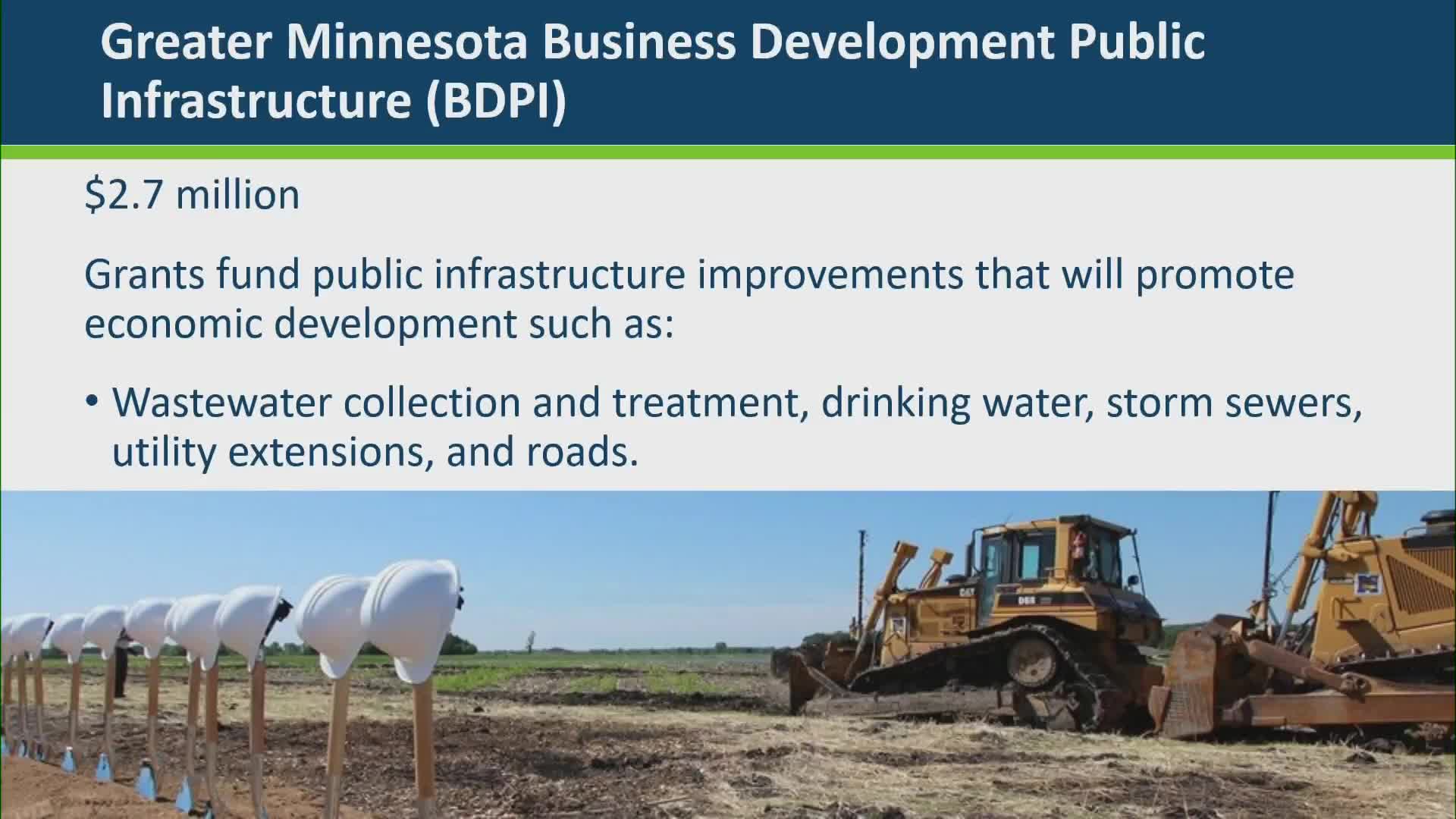
Kevin McKinnon of DEED told the Capital Investment Committee on Feb. 18 that the governor's capital recommendations include $2.7 million for the Greater Minnesota Business Development Public Infrastructure (BDPI) grant program and $1.8 million for the Transportation Economic Development Infrastructure (TEDI) program.
Kevin McKinnon, deputy commissioner for economic development and research at the Minnesota Department of Employment and Economic Development (DEED), told the Capital Investment Committee on Feb. 18 that the governor's capital recommendations include $2,700,000 for the Greater Minnesota Business Development Public Infrastructure (BDPI) grant program and $1,800,000 for the Transportation Economic Development Infrastructure (TEDI) program.
McKinnon said BDPI (established in 2002) provides grants to local units of government outside the seven‑county metro to support public infrastructure—wastewater treatment, utility extensions, roads—that enable industrial development. He said cities can be eligible for up to $2,000,000 over two years and that recent statutory changes allow up to 15% of acreage to be used for incidental, nonindustrial uses with DEED approval. DEED reported a current BDPI balance of about $5,000,000 and said it has completed roughly 200 grants since the program began; DEED accepts applications on a rolling basis and has four or five projects it expects to put under contract in the coming months.
On TEDI, McKinnon said DEED runs an annual RFP in partnership with MnDOT to fund transportation improvements that serve businesses. DEED described TEDI as eligible to cover land acquisition, construction and transportation works that improve safety and traffic flow; a recent TEDI example cited was a Dayton interchange project that received $1,000,000 from DEED and leveraged substantial private investment. McKinnon said TEDI's current balance is essentially zero (about $60,000) and that DEED has roughly $4,500,000 in a pipeline for projects in three communities.
Committee members asked whether DEED required local matching funds and whether grant recipients must show committed match prior to contracting. McKinnon said both BDPI and TEDI require match and that DEED reimburses on a reimbursement basis after work is performed and contracts executed. He also described why DEED did not include one other program (the statewide Innovative Business Development Public Infrastructure program) in this year's request: DEED had recently awarded remaining balances in that program and its balance was zero at the time agencies finalized governor recommendations.
No formal committee votes were taken on DEED's requests at the Feb. 18 hearing.