Get Full Government Meeting Transcripts, Videos, & Alerts Forever!
Get email alerts on the Transportation Capital topic
No spam. Unsubscribe anytime.
MnDOT requests bonds for failing railroad signals and port projects as federal grant uncertainty grows
Summary
MnDOT officials told the Capital Investment Committee on Feb. 18 that the governor's 2025 capital recommendations include $1.8 million in GO bonds for highway‑railroad crossing warning devices and $2.8 million for the Port Development Assistance program, and they warned that federal program pauses could jeopardize other transportation projects.
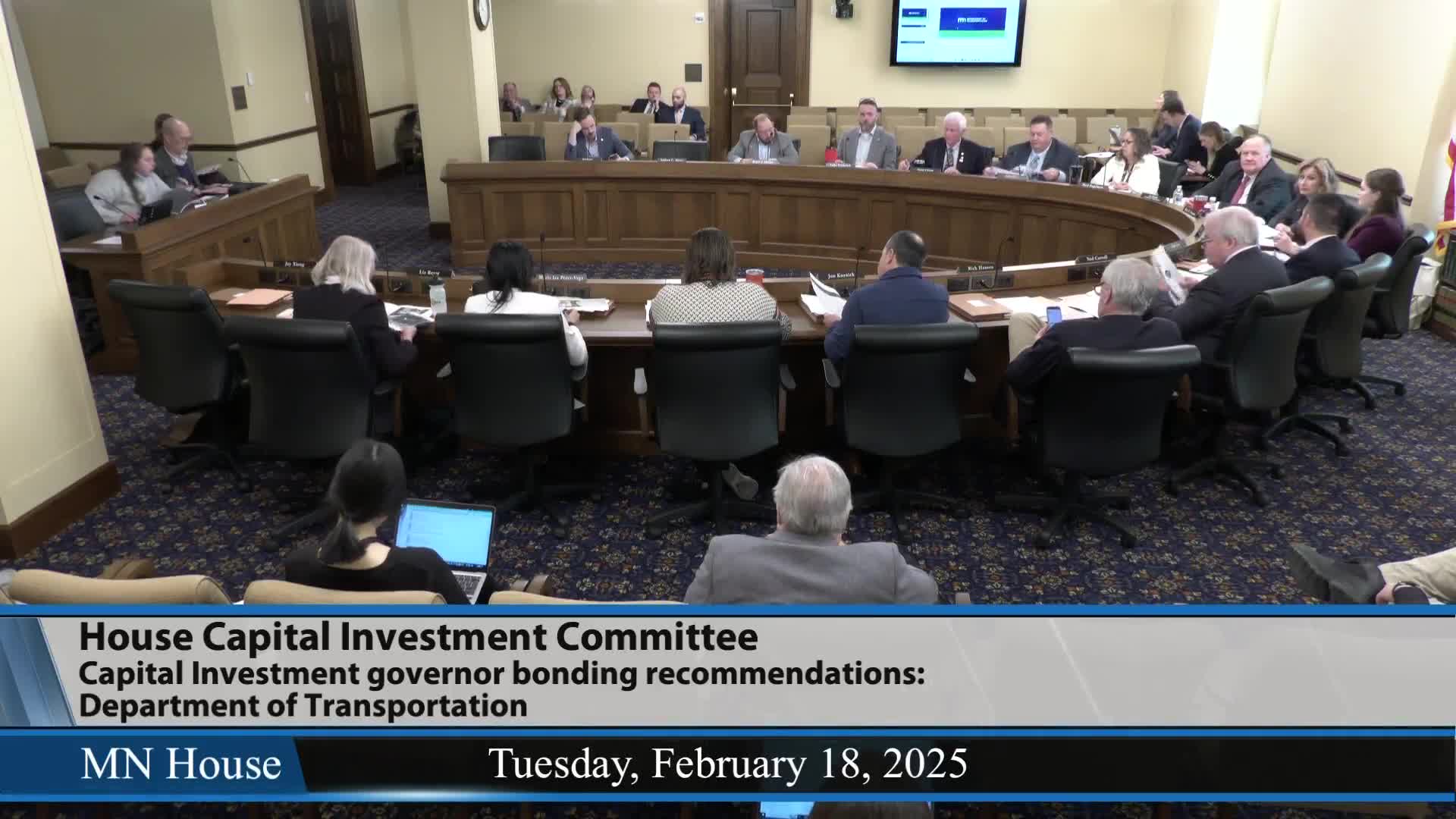
Taylor Besser Frederick, assistant budget director at the Minnesota Department of Transportation, and Eric Rudin of MnDOT government affairs told the Capital Investment Committee on Feb. 18 that the governor's 2025 capital recommendations include two MnDOT requests: $1,800,000 in general obligation (GO) bonds for highway‑railroad crossing warning devices and $2,800,000 in GO bonds for the Port Development Assistance program.
MnDOT said the crossing devices—signal arms and associated electronics—are critical to public safety and that roughly 750 signal systems are past their life cycle; MnDOT staff estimated the total replacement cost for all crossings to exceed $300,000,000. "The reliability of these gates is critical for public safety," Frederick said. MnDOT received $3,600,000 in GO bonds for this program in 2023, the agency said.
On ports, Rudin listed five publicly eligible Minnesota ports for the Port Development Assistance program: St. Paul, Duluth, Red Wing, Wabasha and Winona. He said funds from the program typically cannot be used to finance privately owned infrastructure unless there is a public component such as dredging or other public infrastructure work.
Committee members pressed MnDOT about federal funding announcements and a potential pause of some federal programs. Rudin said the department has seen notices affecting the National Electric Vehicle Infrastructure (NEVI) program, the Protect resilience program and the Carbon Reduction Program. "As of today, the NEVI formula funds have continued to flow... It's really funds that have not yet been obligated," he said, adding MnDOT now expects to lose about $4,000,000 in NEVI funds that had been anticipated but not yet obligated.
Representative Hansen and others asked whether bridge fencing projects to prevent suicides—such as the Washington Avenue Bridge in Minneapolis—could be funded through trunk highway programs or whether the state should establish a quicker response account for bridge retrofits. Rudin said MnDOT has provided technical assistance to Hennepin County and the University of Minnesota and that bridge retrofit costs can be large because permanent fencing can carry significant weight and sometimes requires structural work.
Minnesota Management and Budget capital budget coordinator Mary Ann Conboy explained how guideline 3 of the state's capital investment guidelines affects bonding. "Guideline 3 is that 40% of general obligation bonds shall be due within 5 years and 70% are due within 10 years," Conboy said; she noted the governor's recommendations include cash that does not count against guideline 3. Later, House Fiscal staffer Andrew Lee told the committee the state has significant outstanding trunk‑highway bond authorizations that MMB must assume will be sold in coming years, listing major outstanding amounts including $565,000,000 from 2023 and $348,000,000 from 2021.
Committee members also discussed large federal grant announcements made in late January and whether projects that received press announcements have signed grant agreements or obligated funds. MnDOT staff said that until a signed grant agreement and federal obligating action in the federal system (e.g., FTA/FHWA processes) are complete, the projects are not guaranteed. MnDOT said it is monitoring announcements such as the Robert Street viaduct and the Blatnik Bridge grant, and it has raised concerns with congressional delegations about major projects that would be difficult to build without federal grants.
No formal committee votes were recorded on MnDOT's capital requests during the Feb. 18 hearing.