
House economic development committee defers sweeping tax-relief bills after hours of testimony
Get AI-powered insights, summaries, and transcripts
Subscribe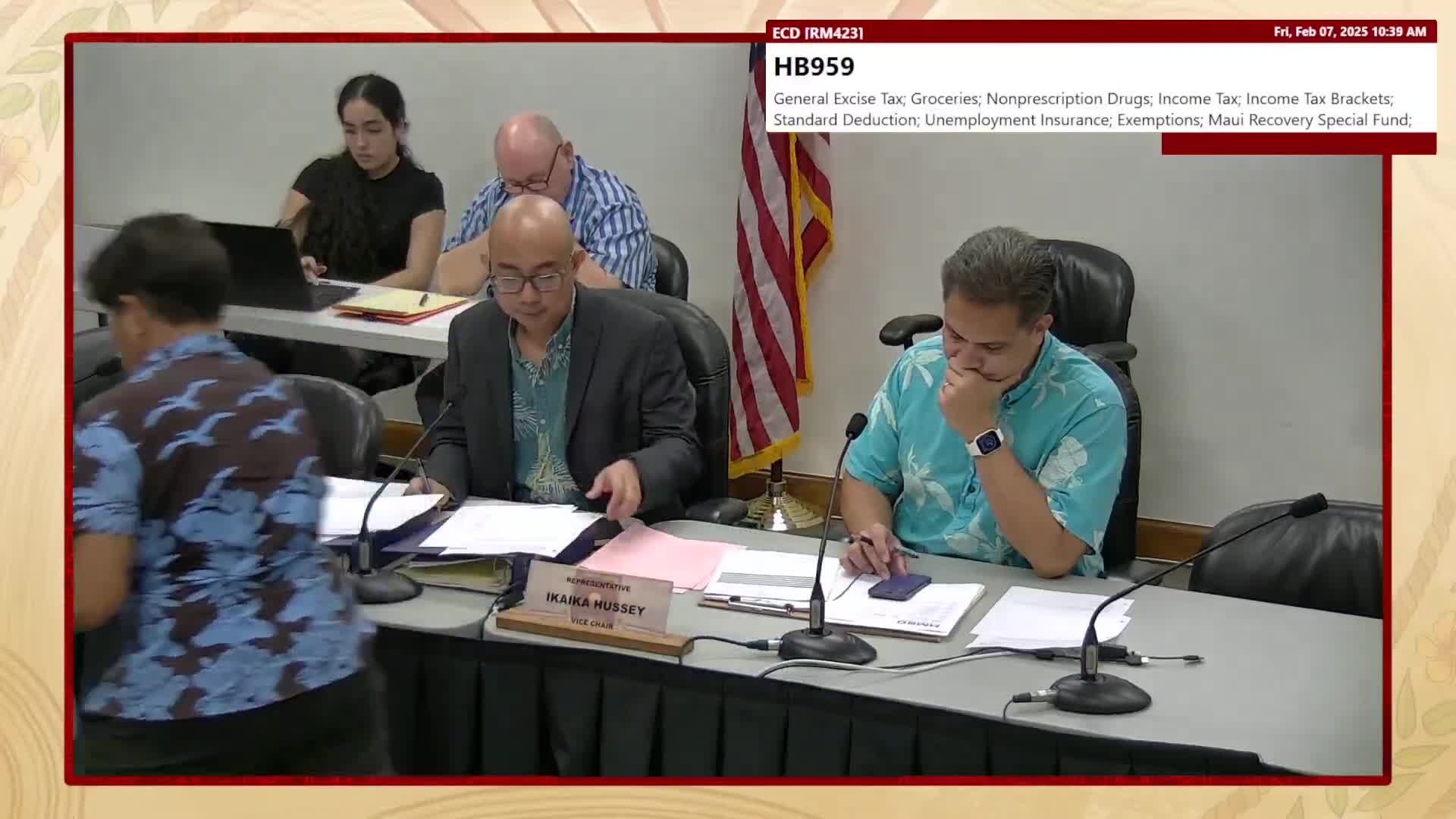
Summary
After hours of testimony from unions, advocacy groups and tax experts, the House Committee on Economic Development deferred HB959 and HB933 — sweeping bills proposing grocery and nonprescription drug GET exemptions and other tax changes — citing the need for more fiscal analysis and refinement.
The House Committee on Economic Development deferred two major tax bills, HB959 and HB933, after more than two hours of testimony from labor unions, social-service groups, business groups and tax analysts.
The committee, chaired by the committee chair, heard supporters say the bills would provide immediate relief to struggling families by exempting groceries and certain over-the-counter drugs from the general excise tax and by changing income-tax thresholds and other credits. Opponents and some fiscal commentators warned the proposed offset — a 50% increase in the GET over four years — would be regressive and could burden households and businesses.
“Hawaii's 1 of the most expensive places to live in The United States currently and opposes 1 of the highest tax burdens on low income households in the nation,” said Cody Sula of the Ironworkers Stabilization Fund, summarizing supporters’ testimony.
Tom Yamachika of the Tax Foundation of Hawaii urged caution: “Our main concern is with, raising the GET by 50%,” and he said a large GET increase would raise costs on essentials that remain taxable, such as utilities and many services.
Representatives of Hawaii Appleseed and Hawaii Children's Action Network told the committee they support tax relief targeted at low- and moderate-income households but said comprehensive fiscal analysis was needed so the public and lawmakers can understand who benefits and who bears the cost. Devin Thomas of Hawaii Appleseed said lack of fiscal notes made it hard to evaluate the bills’ net distributional effects.
Several labor and construction-union witnesses described migration and workforce shortages as linked to the high cost of living. “We have family members that moved up to the Mainland ... because they couldn't afford living here,” said Cliff Laboy of the Ironworkers Local 625 Stabilization Fund.
After the public testimony, the chair said the bills will be deferred for further work and additional fiscal analysis. The committee directed staff to seek additional economic modeling and to coordinate with parties who had submitted written testimony.
Because the committee did not vote to advance either measure, no final fiscal or statutory changes were adopted at the hearing. The chair said the deferral will allow time to obtain the additional modeling and to consider narrower or revised proposals.