Get Full Government Meeting Transcripts, Videos, & Alerts Forever!
Get email alerts on the Budget topic
No spam. Unsubscribe anytime.
Horseheads Central School District board narrows 2025-26 budget choices; directs inclusion of summer learning, curriculum work and one assistant principal
Summary
Board and district leaders reviewed a 2025-26 budget proposal, discussed reassigning intervention staff and teaching assistants, and directed staff to prepare a final budget that includes the Summer Learning Academy, curriculum work and one assistant principal while keeping the proposal largely cost-neutral.
The Horseheads Central School District Board of Education on April 10 reviewed a proposed 2025-26 budget that would reconfigure intervention staffing, reassign some teaching assistants and present the public with a levy option that ranges from a lower-impact plan to a higher-tax scenario depending on three added program priorities.
Board President Conklin opened the board’s budget meeting and turned the presentation over to Dr. Douglas, the district superintendent, who framed the discussion by saying the district is awaiting action on the New York state budget and that final state decisions will affect the district’s revenue picture. “We’re waiting on New York State. We’re waiting finalization of state budget by elected leaders,” Dr. Douglas said.
The administration proposed a manager-level expense increase of 3.22% while reporting district revenue growth of 1.68%. Dr. Douglas and finance staff said revenue projections reflect conservative assumptions about state aid and local assessment changes; the district previously began with a 3.68% target and reduced it to 3.22%, a change the administration described as roughly $477,000 of expense-side improvements.
Why it matters: the board must decide whether to include three discretionary additions — a Summer Learning Academy, curriculum work and up to three assistant principals — that would raise the local tax impact. The administration presented two broad levy scenarios: a lower-impact option and a higher-impact option that includes the three additions. The administration said the higher case would raise the local tax by about 11 cents per $100,000 of full value compared with the lower case, and characterized the higher scenario as a “conservative maximum” that might fall if assessment and pipeline numbers change between now and August.
Discussion and staffing changes
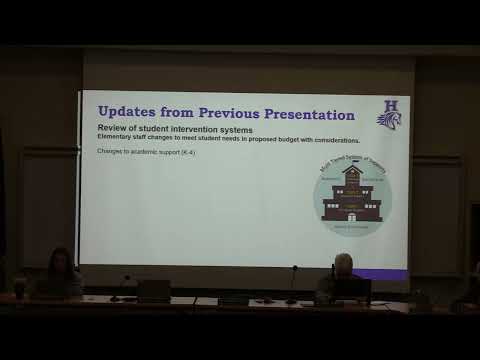
District staff proposed reconfiguring MTSS/RTI supports and moving some duties currently performed by RTI positions into classroom-focused teacher roles supported by teaching assistants (TAs). Katie (district finance/staff member) and Tony (district staff) described the proposal as cost-neutral through reassignments and vacancies rather than net new hires.
According to the administration, the current configuration includes two reading RTI teachers per elementary building (eight total) plus two RTI teachers who float among buildings (ten total RTI teachers). The proposal would increase the number of RTI teachers assigned to each building to four and reduce the number of TAs in those roles to one per building; the administration repeatedly emphasized that no one would lose employment as a result of the reassignments. Katie said keeping all existing TAs in RTI roles instead of reallocating them would cost “about $240,000.”
Board members pressed for clarity on service levels and student impact. Board member Dan asked whether the change would reduce services; Katie replied, “No. We get a high level of service,” and said the restructure would also allow the district to fill previously unattended needs. Several board members said they favored the reallocation so long as direct student supports remained strong.
Board direction on program additions and tax impact
After extended discussion, board members signaled support — by a show of hands — for including the Summer Learning Academy and curriculum work in the final proposal and for adding one assistant principal (a single additional administrator shared among buildings as a pilot) rather than two or three. Board member Christina and others said the tax increase per average-valued home would be modest; the administration illustrated the change as roughly $28 a year on a $350,000 house for the package of additions in the higher scenario.
Katie summarized the per-$100,000 impacts: roughly 1 cent for Bryn Mawr, 2 cents for the Summer Learning Academy and about 3 cents per assistant principal. The administration described the no-consideration scenario at about 58 cents per $100,000 of full value and the full-consideration (all three additions) scenario at about 69 cents per $100,000; adding only the Summer Learning Academy and curriculum work plus one assistant principal would sit between those figures. The administration cautioned the board that these figures are estimates and depend on final assessment and state aid updates.
Process, risks and next steps
Dr. Douglas and staff emphasized two contingencies: (1) the district’s revenue projections depend on the state budget and local assessment changes, and (2) the board’s final direction will determine the version presented to voters if the board decides to put a challenged budget on the ballot. The administration explained school budget vote rules: if a proposed budget is rejected twice, the district may be required to adopt a contingent budget with deeper cuts.
Dr. Douglas characterized the administration’s recommendation as seeking to avoid significant program cuts while remaining conservative on revenue assumptions. “We’re going to give you the best estimate from where we are as of right now with the most conservative view,” he said.
The board gave staff direction to prepare a final budget that includes the Summer Learning Academy, curriculum work and one assistant principal and to return with refined numbers at the board’s next meeting. The board did not take a formal vote on a final budget at this meeting.
Ending
District staff said they will refine debt-service and assessment estimates before the board’s next scheduled vote, and they warned that if voters reject the proposed budget, the district would face deeper, pre-specified reductions under a contingent budget. President Conklin closed the meeting and sought a motion to adjourn.