Get Full Government Meeting Transcripts, Videos, & Alerts Forever!
Get email alerts on the Drinking Water And Wastewater topic
No spam. Unsubscribe anytime.
MPCA outlines private-well remediation program, solid-waste grants and growing wastewater needs
Summary
The Minnesota Pollution Control Agency described a proposed program to connect contaminated private wells to municipal water, reviewed the agency’s capital assistance program for solid waste facilities, and warned the committee that wastewater infrastructure need has risen sharply.
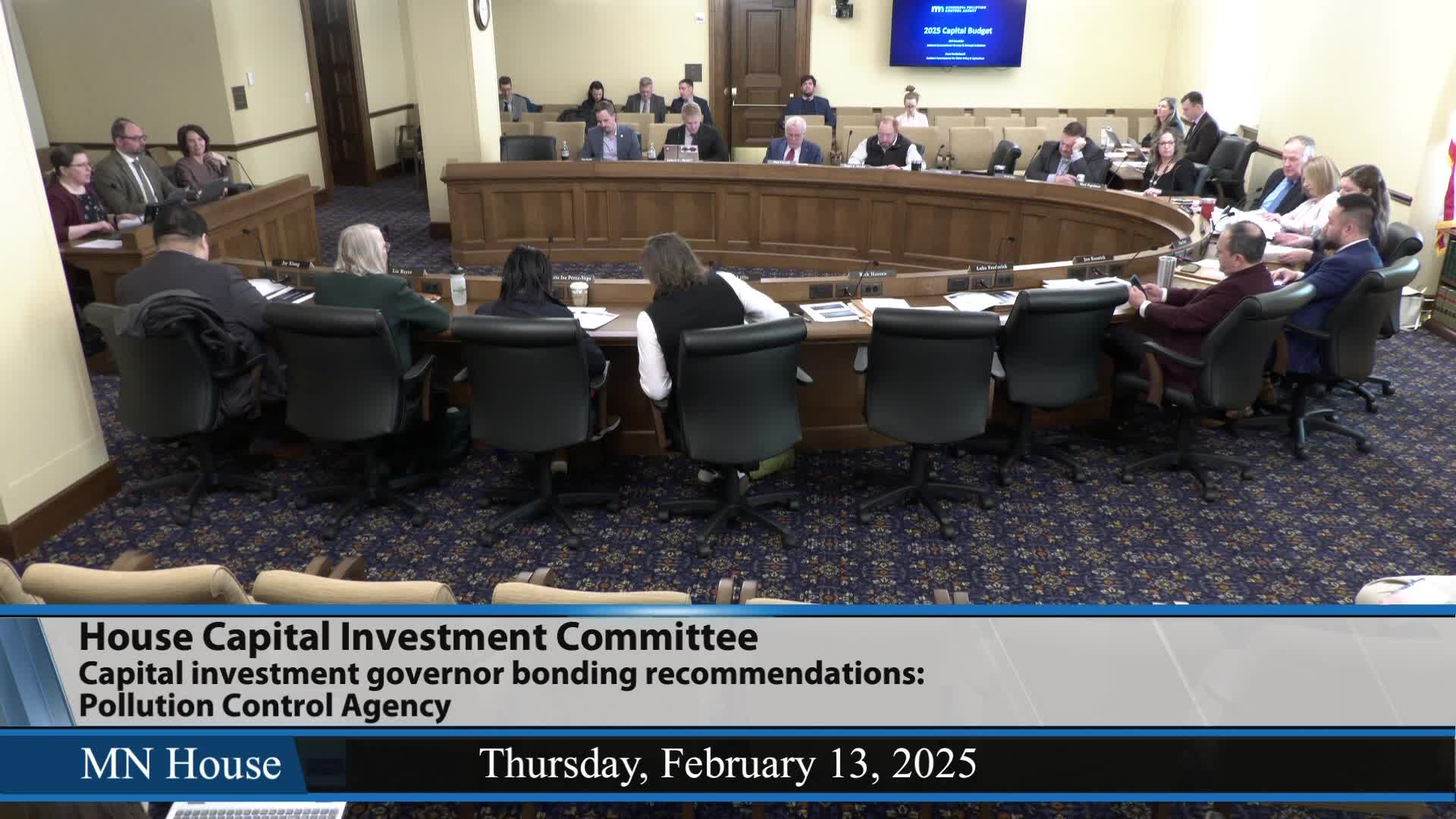
Officials from the Minnesota Pollution Control Agency briefed the Capital Investment Committee on Feb. 13 on an $8,000,000 request in the governor’s bonding bill and other capital priorities tied to drinking water contamination, solid-waste facilities and wastewater infrastructure.
Kirk Koudelka, assistant commissioner for Land and Strategic Initiatives, described a new MPCA program to address contaminated private wells and said the governor’s bill includes $8,000,000 aimed at the top priority on the agency’s emerging list: Red Oaks Phase 2. "This program would allow the agency to work with communities ... to provide a neighborhood connection," Koudelka said, describing a public main with homeowner laterals as a long-term remedy that is preferable to bottled water provision.
Nut graf: The MPCA framed the request as a response to localized contamination from PFAS and other contaminants that can render private wells unsafe. The agency said connection to municipal systems or other long-term fixes are more cost effective than continuing interim supplies and monitoring.
Koudelka said Red Oaks Phase 2 is estimated at $8,000,000 total: roughly $6,000,000 bond-eligible for infrastructure and about $2,000,000 in cash for laterals to homes (private-property lateral work is not bondable). He and other MPCA officials said the broader private-well program could require $30 million to $40 million over time as other neighborhoods (manufactured-home parks, small communities) move from feasibility to design.
On solid waste, Alexis Donath and Koudelka summarized the capital assistance program that helps counties build recycling centers, household hazardous waste facilities and reuse facilities. The program uses a match structure (for example, reuse facilities can receive 75% state funding, 25% local match) and is driven by a biennial solicitation tied to county solid-waste plans.
On wastewater and stormwater infrastructure, Assistant Commissioner Dana VanderBosch told the committee the project priority list currently includes about 315 projects totaling about $3.4 billion, and the 20-year estimate of need is roughly $6.5 billion. "The need is really only going to continue to grow," she said, noting that communities with limited local tax bases especially rely on state match and revolving funds. The MPCA said the agency scores and ranks wastewater and stormwater projects for inclusion on the PFA project priority list; the Minnesota Public Facilities Authority then manages financing packages and loans.
Discussion vs. decision: MPCA officials asked the committee to consider the new private-well program request and provided background on longer-term wastewater needs; no appropriation votes occurred at the hearing. Members asked for the project priority list (PPL) for local wastewater and stormwater projects and for more detail on how matching funds and scoring work; the MPCA agreed to provide those materials.
Ending: The MPCA said it will provide the committee with the PPL and related scoring information and will continue to coordinate with the Public Facilities Authority on project financing and rural community needs.