Get Full Government Meeting Transcripts, Videos, & Alerts Forever!
Get email alerts on the Public Safety Bonding topic
No spam. Unsubscribe anytime.
Minnesota public-safety agencies ask lawmakers for roughly $169 million for new BCA labs and consolidated State Patrol headquarters
Summary
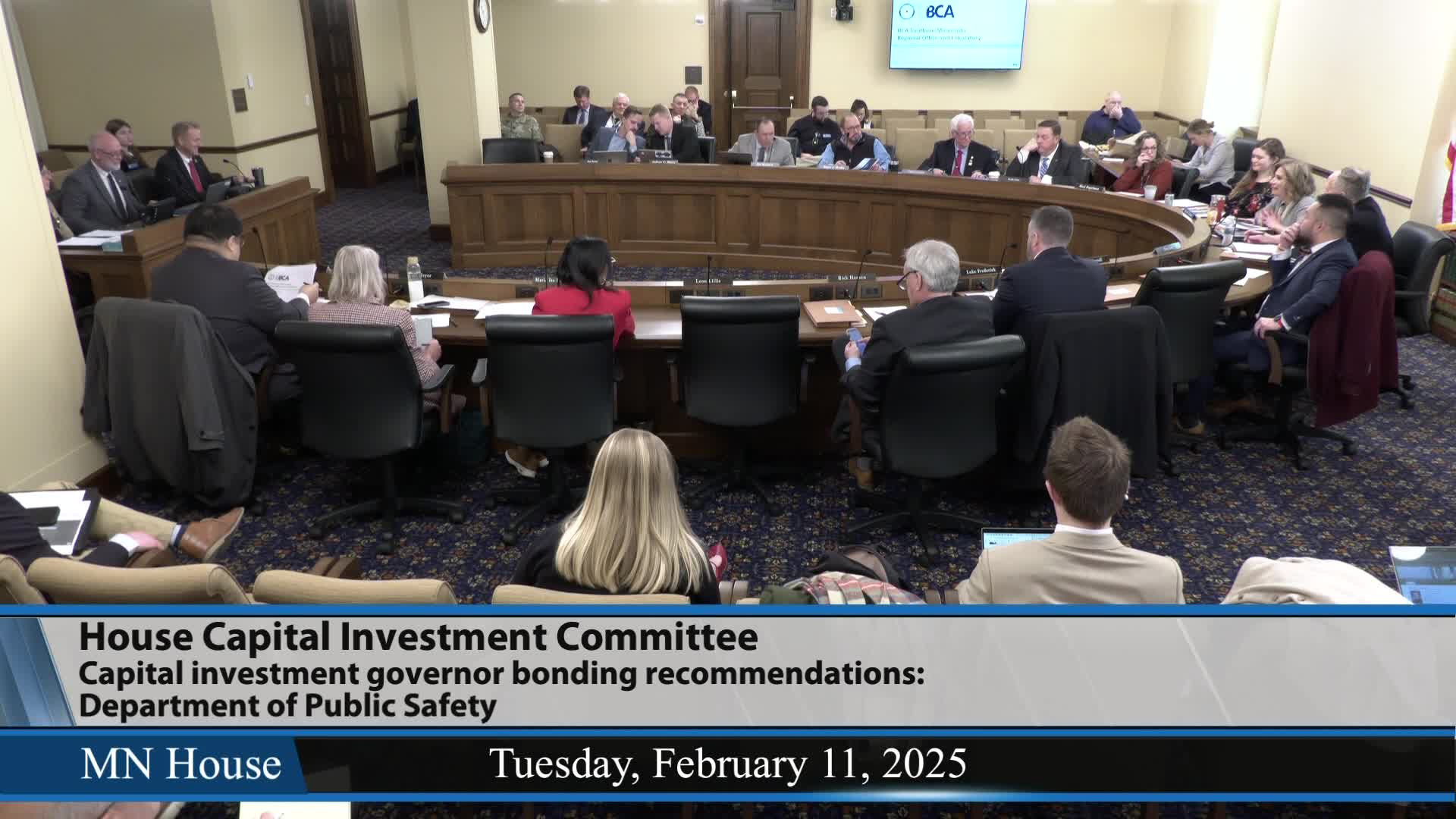
The Department of Public Safety asked the Capital Investment Committee on Feb. 11 for funding to build a new Southern Bureau of Criminal Apprehension (BCA) regional office and laboratory in Mankato, expand the Bemidji regional lab, and build a consolidated Minnesota State Patrol headquarters.
The Department of Public Safety asked the Capital Investment Committee on Feb. 11 for funding to build a new Southern Bureau of Criminal Apprehension (BCA) regional office and laboratory in Mankato, expand the Bemidji regional lab, and build a consolidated Minnesota State Patrol headquarters. The combined requests presented at Tuesday's hearing total about $169.3 million: $68.1 million for the Mankato BCA facility (an increase of about $20 million from an earlier $48 million request), roughly $4.2 million for Bemidji land acquisition and related work, and $97 million for State Patrol construction (with prior design funding of $22.5 million already provided).
The projects aim to reduce evidence turnaround times, add regional training capacity, create secure evidence-storage locations, and consolidate six State Patrol metro sites under a single modern headquarters. “Building a new lab at Mankato will help evidence turnaround throughout Minnesota,” Commissioner Bob Jacobson said as he introduced the agency’s capital proposals.
Why it matters: BCA officials told the committee laboratory demand has risen sharply over the last decade, driven by required sexual-assault kit testing, a large increase in digital evidence work, more drug evidence (including methamphetamine and opioids), and a surge in internet-crime reports. Drew Evans, superintendent of the BCA, said headquarters is over design capacity by about 175 staff and that the Mankato facility would be built to house roughly 50 staff immediately, with additional capacity for future needs. Evans said the department has converted every available office and is operating some forensic work out of spaces “that just shouldn’t be there.”
Evans said the new Southern regional facility would also serve as a regional training hub and would reduce travel time for forensic staff who now sometimes lose a day traveling to courts across Southern Minnesota. “We are working to have 90% of law enforcement within 60 miles of a regional training hub,” he said, adding the BCA trains about 6,000–9,000 law-enforcement students annually.
On costs and design: Evans told the committee the Mankato request grew by roughly $20 million since the last presentation after predesign work increased square footage and as construction costs rose. He said the project is near final design and is “truly shovel ready,” with final design expected by June 2025. He also said laboratory space has special mechanical and equipment needs that raise per‑square‑foot costs: specialized HVAC, redundant power, and expensive lab instruments (Evans noted some machines can cost $150,000 or more).
State Patrol consolidation and funding debate: Colonel Christina Bogojevic, chief of the Minnesota State Patrol, described plans to consolidate six outdated metro sites into a single headquarters to improve evidence storage, vehicle storage, training space and public access. She said prior funding of $22.5 million was appropriated for design and land acquisition; the current request is for roughly $97 million for construction (split into roughly $48.5 million in two biennia). Bogojevic showed photos of cramped offices, evidence stored outdoors and specialty vehicles kept outside because of a lack of secure garage space.
Several lawmakers pressed the agencies about funding sources. Representative John Kosnick sharply questioned the use of Trunk Highway Fund dollars for the State Patrol build, calling it “taking money out of roads and bridges” and urging alternatives to tapping highway funds. “There is no holy grail that shouldn’t be questioned in terms of our financing,” Kosnick said. Colonel Bogojevic and Commissioner Jacobson said they had heard concerns and were open to working with the committee on funding options; Jacobson said the governor’s proposal as submitted included trunk-highway funding but the department would pursue alternative approaches if directed.
Other committee members asked about phasing, training access and location. Evans said the BCA’s lab-driven needs make the Mankato build difficult to phase as a single building project, though earlier design and land-acquisition phases had been funded. Representative Fu Lee and others asked about site selection for the State Patrol headquarters; Colonel Bogojevic said the agency reviewed more than two dozen properties in the Twin Cities metro and had narrowed the list to two sites inside the I‑494 loop after an earlier offer was outbid.
What was not decided: This was a testimony hearing; no committee action or vote was taken on the bonding requests. Agency officials asked lawmakers for guidance on funding sources and said they will return with additional details and cost‑savings information if requested.
Quotation highlights: “When we build a project like this, the equipment is extremely expensive that goes in,” Drew Evans said, describing lab outfitting costs and specialized HVAC needs. Representative John Kosnick said using the trunk-highway fund for the State Patrol build “is very concerning” and urged alternative funding ideas.
Next steps: The requests will be considered in the committee’s bonding deliberations. Committee members signaled interest in further briefings on lease savings tied to consolidation, alternative funding paths for the State Patrol headquarters, and final design documents for the BCA projects.