Get Full Government Meeting Transcripts, Videos, & Alerts Forever!
Get email alerts on the Wetland Replacement And Crep topic
No spam. Unsubscribe anytime.
BWSR urges steady funding for wetland-replacement credits and CREP easements to keep local road projects moving
Summary
The Board of Water and Soil Resources told the committee that a stable funding source is needed for the local government roads wetland replacement program and for expanded CREP conservation easements, which leverage federal dollars to restore wetlands and protect marginal agricultural land.
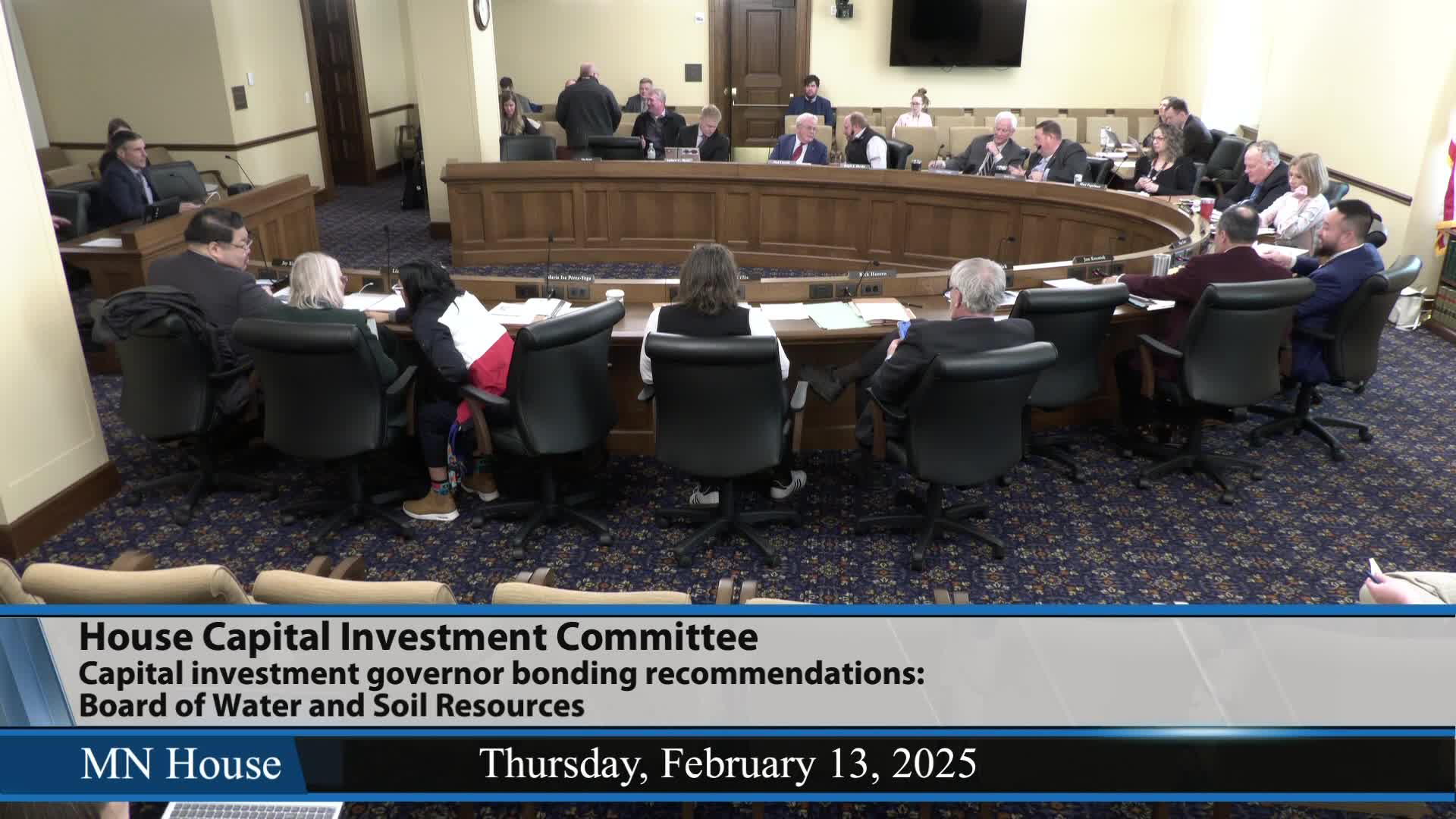
John Jasky, executive director of the Minnesota Board of Water and Soil Resources, and Andrea Fish, assistant director, told the Capital Investment Committee Feb. 13 that both the local government roads wetland replacement program and the state’s federal CREP (Conservation Reserve Enhancement Program) partnership need stable capital funding to ensure local road projects can meet permit requirements.
"In cases where local government road projects would interfere, impede or necessarily go over a wetland, an existing wetland, they are required to replace those wetland acres within the state," Fish said, describing the statutory mandate that underpins the local government roads wetland replacement program and the bank-service-area approach the program uses to supply mitigation credits.
Nut graf: BWSR officials said the primary problem is not the program design but the variability of funding. When local road projects must secure wetland replacement credits, a lack of predictable state funding that underwrites creation of credits can delay or jeopardize those road projects. The agency and a stakeholder work group recommended retaining a stable bonding mechanism to fund the program, provided it remains reliable.
Fish told the committee it can take 8–10 years to develop wetland credits from site identification through construction, monitoring and credit release, so she favors having an 8–10 year supply of credits available in each bank service area to avoid forcing local governments to buy credits from distant areas at higher cost. Jasky said a recently extended federal agreement expands CREP eligibility to additional counties and increases the number of acres that can be enrolled; the state match currently shows roughly a 3-to-7 state-to-federal ratio in the most recent agreement.
Jasky described the state-federal leveraging the program has produced: about $175,000,000 in state funds historically has leveraged about $350,000,000 in federal contributions for conservation easements in Minnesota. He told members the CREP agreement is tied to the federal farm bill and that enrollment is about halfway to the acreage limit in the current agreement.
Discussion vs. decision: BWSR asked the committee to consider a stable funding approach; the agency and a stakeholder group recommended continued use of state bonding if the mechanism is stable. No committee vote occurred at the hearing. Several members asked BWSR to share the work-group findings and the agency agreed to provide the report and related materials.
Ending: BWSR officials said they will provide the committee the work-group findings and a history of state and federal funding used in CREP and RIM projects to help legislators consider longer-term funding alternatives for the wetland-replacement program.