Get Full Government Meeting Transcripts, Videos, & Alerts Forever!
Get email alerts on the School Budget topic
No spam. Unsubscribe anytime.
Port Washington board begins budget work sessions with $1.3 million gap, seeks options to stay under 3.39% tax cap
Summary
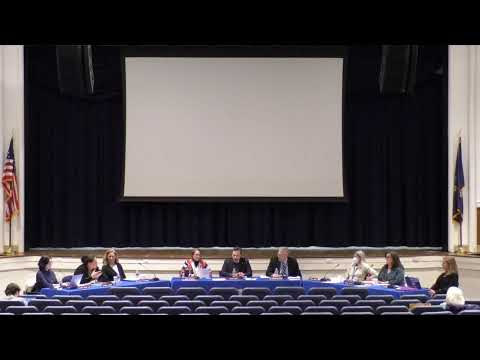
Port Washington, N.Y. — The Port Washington Union Free School District Board of Education opened the first of three budget work sessions Feb. 11, with district staff reporting a roughly $1,300,000 gap between projected expenditures and revenues and recommending options to stay within a 3.39% tax levy limit.
Port Washington, N.Y. — The Port Washington Union Free School District Board of Education opened the first of three budget work sessions Feb. 11, with district staff reporting a roughly $1,300,000 gap between projected expenditures and revenues and recommending options to stay within a 3.39% tax levy limit.
"Our goal tonight is to begin the conversation with the board about how the budget development process has been taking place and where we see it heading over the next few months," said Miss Manuel, who led the presentation. She told trustees the board will meet in two further budget sessions before adopting a proposed budget on April 22 and holding the public hearing May 6 ahead of the May 20 vote.
The district attributed most of the current shortfall to a decrease in anticipated state aid; Manuel said "state aid for our district . . . has decreased for this year by about a million dollars," and that the district's full valuation increases have lowered aid ratios. She said the district's tax base growth factor from the state Office of Real Property Services is 1.17 percent, producing a tax levy limit of about 3.39 percent for 2025–26.
Superintendent Dr. Shields provided enrollment context during the meeting: "currently, our enrollment is 5,345 students. But . . . if we take out our Pre-K, it's 5,273 students in our kindergarten through twelfth grade," an increase of 20 students over last year.
District staff outlined three priority areas staff will use to shape budget choices: health and safety (including air-quality work, AED replacement and radio upgrades), instructional program needs (professional development for math and literacy, next-generation science materials, course offerings and class-size review) and operational efficiencies (bringing more bus runs and HVAC maintenance in-house, preventive maintenance and long-range digital device planning).
Manuel said the district currently shows "about $1,300,000 gap between our expenditures and our revenues," and that staff will return March 11 with specific prioritized options. The district's objective, she said, is to "stay at the tax cap of 3.39 while enhancing our program for our students." The presentation noted the governor's budget proposal as the current aid estimate but cautioned the Legislature could alter numbers.
Budget committee members and trustees asked for additional detail on the estimates and on potential program impacts. Trustees were told some line items remain to be refined (for example, rates for the teacher retirement system), and staff said they expect adjustments that may reduce the gap.
Two recommended items related to budget and planning were presented for inclusion on upcoming agendas: a proposal to hire a grant writer through Capital Region BOCES for an initial 75 hours at about $9,800, intended to identify potential state, federal and foundation grants; and a recommendation to place a NYSERDA-related resolution on a future agenda that would commit the district to a 25 percent local share of an energy study (district portion cited as $18,000) related to zero-emission bus planning. Both recommendations were described as coming from the budget committee for board consideration at future meetings rather than as actions decided at the Feb. 11 session.
Board members and staff also reported outreach to state elected officials seeking additional state aid or capital support. Trustees said they will draft a letter to state education officials and the governor to explain regional aid concerns and asked staff to circulate potential language for board review.
Votes and routine actions at the meeting included adoption of the Feb. 11 agenda; motions to recess and later reconvene from executive session; approval of committee and prior meeting minutes; and approval of a consent agenda. All roll-call motions reported in open session passed unanimously. Staff said the budget process will continue at the board's next public meeting on March 11.
The board did not adopt a proposed budget on Feb. 11; staff described the presentation as the start of deliberations and said formal adoption is scheduled for April 22, with the public vote May 20.
Votes at a glance
- Motion to adopt the Feb. 11, 2025 agenda — Mover: Adam Smith; Second: Deborah Brooks; result: approved, 5–0 (recorded when first convening before executive session).
- Motion to recess to executive session (to discuss potential litigation, employment of a particular person and seek legal advice) — Mover: Adam Smith; Second: Nanette Milconian; result: approved, 5–0.
- Motion to reconvene in public session — Mover: Adam Smith; Second: Nanette Milconian; result: approved, 6–0.
- Motion to approve minutes for multiple committee and board meetings (listed aloud at the Feb. 11 meeting) — Mover: Board president (Adam Smith); Second: Deborah Brooks; result: approved, 6–0.
- Motion to approve consent agenda items (13.10.1 through 13.6.0.2 as read on the record) — Mover: Adam Smith; Second: Deborah Brooks; result: approved, 6–0.
- Motion to recess to executive session for contract negotiations at the meeting's close — Mover: Adam Smith; Second: Julie Epstein; result: approved, 6–0.
Why it matters
The presentation framed the budget as an unfolding process tied to final state aid numbers and local revenue limits; with state aid down compared with prior-year estimates, the district must choose whether to use the available levy room, reduce services, or find efficiencies and outside funds. Trustees and staff emphasized they will return with prioritized options and community-facing proposals before the April adoption.
What's next
Staff will return March 11 with specific budget priorities and options aimed at closing the current roughly $1.3 million gap while attempting to keep the proposed levy within the tax cap. The grant-writer and NYSERDA items were scheduled to appear on upcoming agendas for formal board consideration.