Get Full Government Meeting Transcripts, Videos, & Alerts Forever!
Get email alerts on the Education Enrollment And Assessment topic
No spam. Unsubscribe anytime.
Lancaster BOE: Enrollment projections steady; district reports gains in test participation and college-credit programs
Summary
District staff told the Board that official beginning enrollment is roughly stable year to year, kindergarten registration will set final counts for 2025–26, and Comprehensive District Education Plan data shows improved participation and proficiency on several state assessments and increased dual‑enrollment/AP participation.
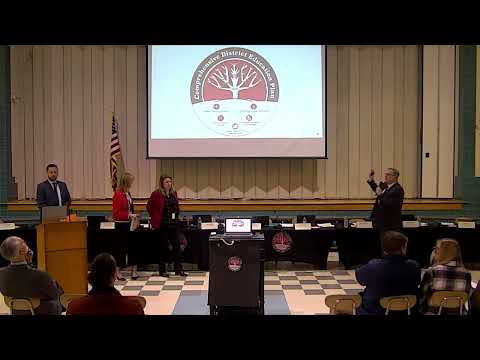
At a Lancaster Central School District Board of Education meeting, district staff presented enrollment projections and a first-of-two-year report on the district’s Comprehensive District Education Plan (CDEP), with officials saying overall enrollment is stable and academic participation and proficiency measures have improved in several grades and subjects.
The presentations matter because enrollment drives staffing and building planning, and the CDEP data shapes curriculum, intervention and college-credit offerings that affect students across K–12. District leaders emphasized that projections are estimates and that kindergarten registration and summer movement will refine final counts for the 2025–26 school year.
Mr. Kreisman (staff member) told the board the district uses annual census cards, town housing-development data, pre-K enrollment and preschool-committee data to model projections. “These are just projections. These are our best guesses,” he said. He reported the district’s official beginning enrollment (OBE) in September 2020–21 was 5,312 and in September 2024–25 was 5,332 — an increase of about 20 students — and said the district has shown no significant long-term increases or drops in K–12 population.
District staff asked the board to treat projections as planning estimates. Kindergarten registration was described as the next major data point: registration opens after the February break, with kindergarten screening in May and June and possible additional summer movement as families relocate.
The presentation included enrollment subcounts that feed program planning: 277 students attend in-district parochial schools (Our Lady of Blessed Sacrament; St. Mary’s Elementary; St. Mary’s High School; Chesterton Academy); 156 attend private or parochial schools outside Lancaster; 22 are enrolled in charter schools; 110 students receive special education services outside the district (71 in agency placements); 39 participate in BOCES programs; and 137 students currently receive homebound or parent-taught homeschooling.
On the CDEP data, Dr. Karen Marchioli (Director of Elementary Education), Bethany Hanke (Assistant Principal, Williams Street School), John Tresmont (Assistant Principal, Lancaster Middle School) and Sarah Whitmire (Director of Secondary Education) presented participation and proficiency trends. Third-grade participation in the state 3–8 assessments rose from about 60% in 2019 to 94% in 2024; the district’s stated participation goal is 95%.
The presenters cautioned that participation rates affect how representative proficiency percentages are, particularly in upper grades where fewer students take the 3–8 exams. Hanke noted that reading assessments require higher-level comprehension and computer literacy for some items, and Marchioli and Hanke said the district continues to use universal screeners, common formative assessments and professional development (including BOCES support) to align instruction and interpret results.
Math programming highlighted expansion of access to Algebra I in eighth grade: the district reported the highest percentage of eighth-grade students taking Algebra I this year (44%). Administrators described math labs and accelerated-class alternatives designed to broaden access while providing supports; the district reported district-level Algebra I proficiency and pass rates that exceed regional and state comparators. For science, the district continues to increase middle-school Living Environment participation and reported sustained proficiency above regional and state averages on science assessments.
At the high school level, the district reported strong Regents results and high participation in dual-enrollment and Advanced Placement (AP) programs: ELA Regents proficiency was reported at 96.1% for 2024, many students participate in at least one dual-enrollment course before graduation, and the share of AP exams scoring 3 or higher has risen to roughly 80% of exams taken in recent years.
District staff credited teachers, families and “the consistent support of the board of education” for progress and said a follow-up action-plan presentation will be provided in summer. No board-level policy votes or program adoptions were made as part of the presentation; staff framed the material as an informational update and planning input for future decisions.
Looking ahead, officials said final enrollment counts for staffing and building assignments will firm after kindergarten registration and summer movement, and the second part of the CDEP report — the action plan tied to these data — will appear at a later meeting.