Get Full Government Meeting Transcripts, Videos, & Alerts Forever!
Get email alerts on the Public Health Mosquito Control topic
No spam. Unsubscribe anytime.
Metropolitan Mosquito Control District previews 2025 season; expands drone treatment in Dakota County
Summary
Metropolitan Mosquito Control District officials told Dakota County commissioners they expect a busy season for certain species, will expand drone treatments and continue larval‑focused control funded largely by the district levy.
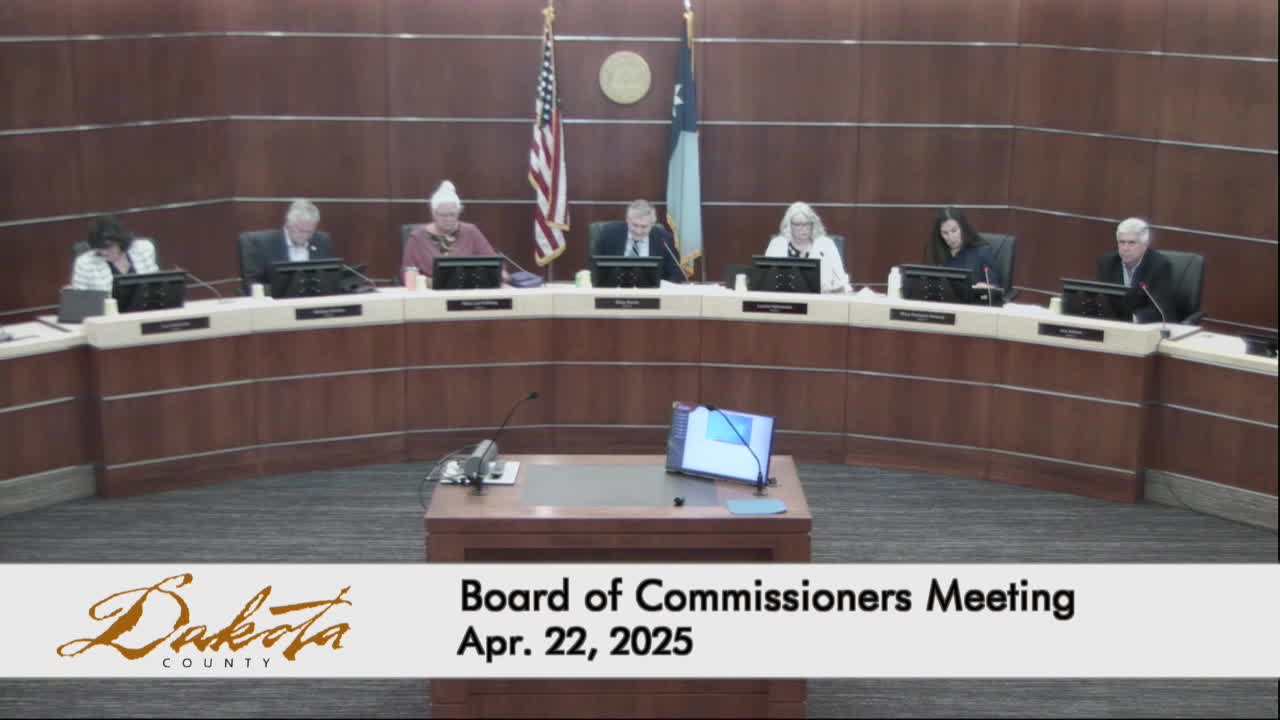
Metropolitan Mosquito Control District (MMCD) officials briefed the Dakota County Board of Commissioners on April 22, 2025, outlining surveillance results, program priorities and planned operational changes for the 2025 mosquito season.
Daniel Huff, MMCD executive director, and Alex Carlson, public affairs manager, told the board the district prioritizes larval control—treating mosquito larvae in standing water—as the most effective, environmentally specific way to reduce disease‑carrying mosquitoes. Huff said MMCD had sampled larva from about 400 Dakota County wetlands by mid‑week and had already treated more than 1,500 acres for larvae.
MMCD described its surveillance program: staff sample wetlands with dippers, set about 200 adult mosquito traps each week across the district, and use volunteer human‑bait sampling and a centralized entomology lab to identify species and test for vector‑borne pathogens such as West Nile virus. Officials said larval control products are targeted to mosquito larvae and have minimal non‑target impacts.
The district presented 2024 program figures and 2025 planning assumptions. MMCD reported more than 260,000 acres treated for larvae system‑wide in 2024 and roughly 2,000 acres of adult treatments. For Dakota County specifically, MMCD said the 2025 levy is $2,698,000—an increase of $76,000 from the prior year—and noted the median household in the district pays about $11 per year for mosquito control.
Operational changes for 2025 include wider use of unmanned aircraft systems (drones) for treatment in small‑to‑medium wetlands that are difficult to access on foot and too small for helicopter work. MMCD said drone treatment sites in Dakota County currently cover about 80 acres; officials said doubling drone capacity is likely after the district secures a dedicated drone. The district also signaled a shift in its tire‑recycling approach: rather than door‑to‑door pickups, MMCD will host free tire drop‑off days (first announced as June 11 for Dakota County) and partner with city cleanup events to consolidate collection and reduce staff travel time.
On expected mosquito activity, MMCD said the National Weather Service was forecasting a drier summer for June–August 2025, which tends to reduce some species. However, MMCD noted they anticipate a roughly fourfold increase in cattail‑dependent mosquitoes that overwinter as larvae and typically emerge around the July Fourth holiday; staff said they are prioritizing treatment to limit nuisance impacts during summer gatherings.
Commissioners thanked MMCD for outreach, noted the district’s evidence‑based focus on disease vectors and praised public information tools including interactive online maps, weekly updates and helicopter/DNA schedules. Commissioners also asked about ticks; MMCD staff said tick activity is harder to forecast because of a three‑year life cycle but that entomologists currently expect a typical season.
MMCD invited residents to sign up for email alerts, review interactive maps showing treatment history and to participate in community outreach events. Officials said MMCD will continue to coordinate with cities on adult spraying requests for large public events and will post helicopter and drone schedules online.