Get Full Government Meeting Transcripts, Videos, & Alerts Forever!
Get email alerts on the Environmental Chloride Reduction topic
No spam. Unsubscribe anytime.
Dakota County board authorizes chloride‑reduction program to curb road salt impacts
Summary
Board authorized a county program to reduce chloride pollution from de‑icing, following a staff presentation on impaired waters and available outreach tools.
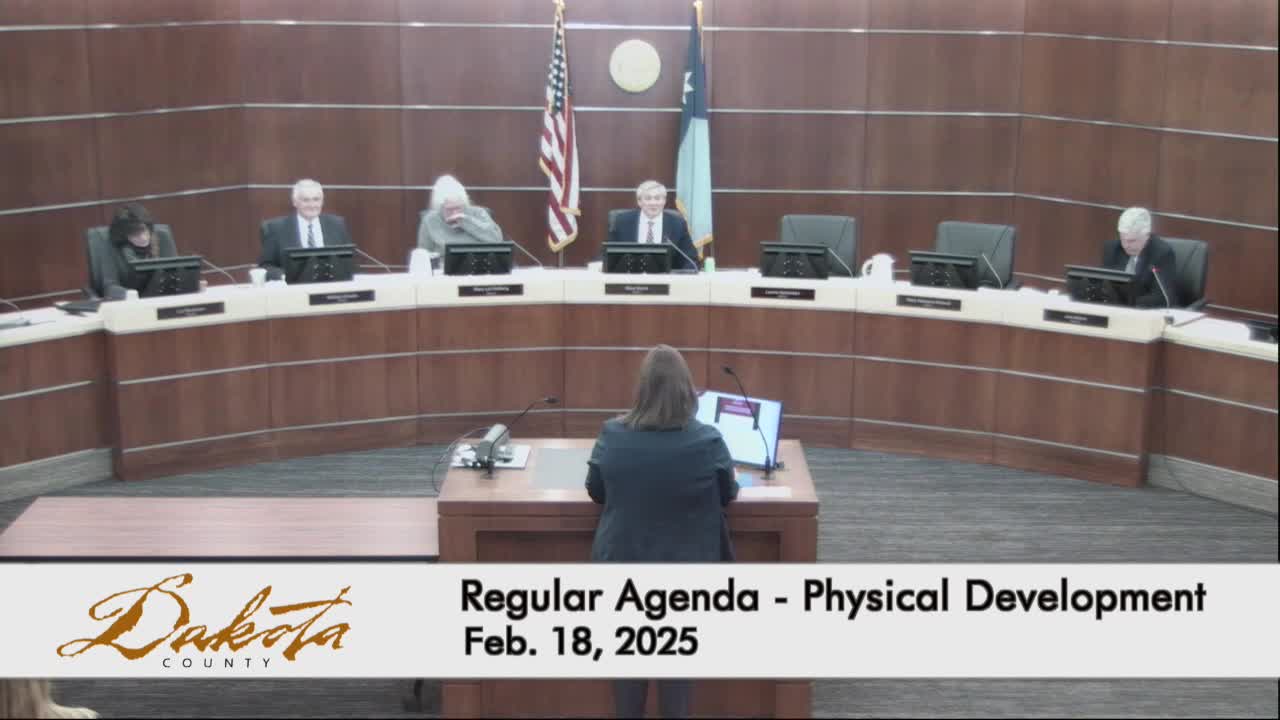
The Dakota County Board on Feb. 18 voted to authorize implementation of a county chloride reduction program aimed at reducing salt and chloride runoff from sidewalks, parking lots and other non‑road surfaces.
Valerie Nepple, groundwater protection unit supervisor, told commissioners that chloride is a long‑lasting pollutant with ecological and infrastructure impacts, noting in the presentation that “one spoon of salt pollutes up to five gallons of water.” Nepple pointed to Minnesota Pollution Control Agency (MPCA) mapping showing several county water bodies at high risk for chloride impacts and one waterbody — Thompson Lake in West St. Paul — listed as impaired for chloride.
The proposed program adapts an existing Hennepin County/Capitol Region Watershed District model (branded as a low‑salt/no‑salt stewardship program), and will focus on outreach, education, recognition and technical assistance for property owners and managers — for example, faith communities, schools, homeowner associations and commercial properties — to adopt smart‑salting best practices. The county said staff will implement the program using existing personnel (with a named staff member, Carter Anderson, assigned to lead startup work) and a minimal incentives budget built into currently approved operating funds.
Commissioners asked about alternatives to rock salt and whether the program aimed to eliminate salt use. Nepple and staff emphasized the program’s focus is reduction and best practices — not eliminating salt — and mentioned alternatives that are sometimes used for walkways (for example, sand or “chicken grit”), and that smart‑salting certification programs exist through the MPCA for contractors and public staff.
A motion to authorize implementation of the Dakota County chloride reduction program was moved and seconded; the board approved the motion on a roll call vote.
Next steps noted by staff include developing outreach materials, leveraging partner resources and piloting recognition and incentive offerings for participating properties.