
Vermont working group debates open-meeting gaps, proposes best-practices guide
Get AI-powered insights, summaries, and transcripts
Sign Up Free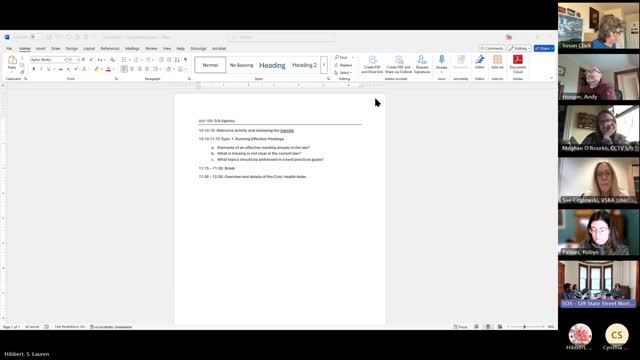
Summary
Participants at a Secretary of State convening discussed where Vermont's open meeting law provides clear requirements and where local bodies need practical guidance, centering on recordings, hybrid access, public comment rules and confusion over which local bodies are decision-making.
A statewide working group convened by the Secretary of State's office on running effective public meetings focused on clarifying the Open Meeting Law and drafting a best-practices guide to help local bodies run accessible hybrid meetings.
The discussion matters because municipal practices vary widely: some towns post recordings and minutes online while others require request to the town clerk, hybrid meeting tools and chat functions are handled inconsistently, and communities and boards disagree about which local bodies should treat themselves as "decision making" versus advisory.
Lauren (staff member, Secretary of State's office) opened the discussion by asking participants to identify "elements of an effective meeting that are already in the law, what's missing or not clear in the current law" and to propose items for a best-practices guide. "The law changed significantly," Lauren said, and added that some statutory requirements remain unsettled in practice.
Speakers raised recurring operational issues: whether and how audio/video recordings must be posted, how chat should be used in hybrid meetings, who should staff and run meeting technology, and how bodies should set rules for public comment. Sue Soglowski, executive director of the Vermont School Boards Association, said of statutory protections: "There needs to be notice of public hearings. That's... and the hearings need to be accessible to the public." Andy Hooper of the Middlebury Select Board and Megan O'Rourke of CCTV/Centers for Media and Democracy described different local practices for camera setups, livestreams and staffed technical support.
Participants noted confusion about the statute's classification of local bodies. Several speakers described planning commissions as a common gray area. "We advise that you treat yourself as a decision making body," Lauren said, noting that doing so reduces legal risk when authority is unclear. The group discussed S.59 and related legislative amendments under consideration that change statutory terminology (for example, removing the phrase "non-advisory" and recasting categories as "public bodies" and "advisory bodies").
The group also discussed accessibility concerns beyond technology: language access, ADA accommodations and the need to explain meeting process and decorum so that residents unfamiliar with formal procedures feel able to participate. Cynthia (participant, citizen advocate) and others recommended public-facing orientation materials and "welcome" guides for new residents to reduce intimidation.
No formal votes were taken. Directions arising from the discussion included gathering existing resources, distributing slide materials used in prior trainings, and drafting a best-practices guide that the Secretary of State's office will host. Lauren asked participants to email resources and promised to compile materials and share a draft of the guide and slide deck.
Participants agreed on several candidate best-practice recommendations to be refined and written into the guide: require posted audio at a minimum, clarify tech roles and responsibilities (a designated technologist), define chat usage for hybrid meetings (disable or restrict to technical messages unless read aloud during public comment), set transparent rules for public comment timing and content, and encourage bodies that are unsure of their status to operate as decision-making bodies. The group also suggested building tools to help communities prioritize agenda items that are essential for municipal operations (warrants, payroll, time-sensitive approvals) versus topics primarily of public interest.
Next steps: the Secretary of State's office will collect resources and examples, the working group will continue drafting best-practices language, and staff will monitor the ongoing legislative changes to the Open Meeting Law before recommending statutory amendments. Participants flagged training, facilitation guidance, and sample "welcome to the town" materials as priority deliverables.
Less critical details: participants agreed to hold at least one future in-person meeting when schedules permit and to circulate the slide deck used in recent trainings. The office will also follow up with the Vermont League of Cities and Towns and the Town Clerks Association to broaden participation.