Get Full Government Meeting Transcripts, Videos, & Alerts Forever!
Get email alerts on the District Academic Goals topic
No spam. Unsubscribe anytime.
District 25 deputy superintendent lays out priorities on reading, math, arts and attendance
Summary
Deputy superintendent outlined draft goals tied to English‑language learners, reading instruction, middle‑school math curriculum, social‑emotional learning and chronic absenteeism; arts funding and a large teacher recruitment fair were also reported.
The deputy superintendent for New York City Geographic District 25 delivered a report to the district parent advisory council on April evening outlining draft District Comprehensive Education Plan goals for next school year, focusing on reading proficiency, supports for English‑language learners, implementation of Amplify Math in middle schools, expansion of social‑emotional learning and a push to lower chronic absenteeism.
The plan centers first on “strengthening instruction inside of our classrooms” by using foundational programs Heggerty and the HMH curriculum and by monitoring results from I‑Ready diagnostics, the deputy superintendent said. He reported mid‑year I‑Ready results showing about 48% of students at or above grade level districtwide, and 62.4% when students identified as English learners are removed from the calculation. He attributed some gains to use of decodable texts and phonics instruction and said the district is working to move students from decoding to comprehension of more complex texts.
“Now what we paid attention to quite significantly this year was around building those decoding skills of our ELs,” the deputy superintendent said, adding that the district will refine percentages and targets after end‑of‑year diagnostics and state results.
Why this matters: District 25 contains a large share of multilingual students; the deputy superintendent said nearly 6,600 children who speak languages other than English are in the district and described English learners as a key subgroup for goal setting. The report said the district will tighten stand‑alone English‑language instruction for students classified as entering or emerging to ensure they receive the required additional periods of EL service.
On math, the deputy superintendent said the district has selected Amplify Math primarily for grades 6–8 and will encourage departmentalized elementary teams to adopt it where appropriate, emphasizing fidelity to the program’s instructional shifts. He asked DPACC members for feedback as schools finalize preliminary goals, which he said he must certify as aligned to the budget in July.
The report also covered social‑emotional learning: the district intends to deepen implementation of the MindUP program, including more regular use of the program’s conversation‑starter activities to build student relationships. The deputy superintendent said some classroom community agreements are not being used consistently and that tweaks will be made to the SEL curriculum to increase effectiveness.
Arts and extracurriculars received attention as well: the deputy superintendent said he secured arts funding to provide assemblies and limited Broadway tickets for some schools through partners including Flushing Town Hall and Arts Connection. He described plans for two community arts days and said five schools were selected via a randomized process to receive tickets to shows such as Betty Boop, Operation Mincemeat and Buena Vista; an Aladdin trip will be tied to an attendance incentive for schools with 90%–100% attendance.
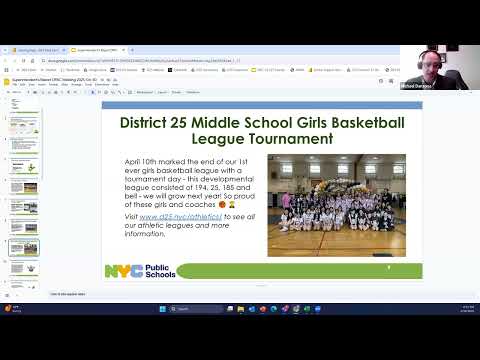
The district is continuing after‑school and athletic initiatives: the deputy superintendent highlighted a district bocce league for middle schools, a pilot girls‑basketball middle‑school league, cheer expos and elementary all‑star basketball events.
On assessments and calendars, he listed testing windows: ELA computer‑based testing ran April 22–May 2 for most grades, with paper‑based sessions for some students in grades 3 and 7; math for grades 4–6 and 8 was beginning in May; and science computer‑based testing was scheduled for May 16 for grades 5 and 8. He described family workshops on I‑Ready (June 17) and diagnostic supports for early grades.
Attendance and staffing: the deputy superintendent said District 25’s chronic absenteeism rate remained high at about 18% despite being one of the better rates citywide. He stressed supports rather than requiring attendance when children are ill. He also reported on a recent recruitment fair at Bell Academy 169 with about 500 registrants and a waiting list of roughly 170, intended to help fill openings in special education, arts, science and math.
Parents and teachers in the meeting praised early foundational work. One participant who identified herself as a pre‑K teacher and parent said introducing phonics materials in pre‑K “makes a huge difference,” a comment the deputy superintendent acknowledged and said the district will consider in planning. The deputy superintendent asked DPACC members to review slides and offer feedback as preliminary goals are finalized in June and certified in July.
The deputy superintendent characterized the items as preliminary and subject to change when final diagnostics and state data are available; he asked for stakeholder input and said he will revise targets after end‑of‑year results.