Get Full Government Meeting Transcripts, Videos, & Alerts Forever!
Get email alerts on the Municipal Budget Taxes topic
No spam. Unsubscribe anytime.
Waynesboro budget hearing draws long public turn against proposed property tax increase
Summary
City staff presented a proposed FY2026 budget built on a recommended tax rate of $0.89 per $100 of assessed value; dozens of residents at a public hearing urged the council not to raise rates after recent reassessments, while some speakers supported funding for schools and public safety.
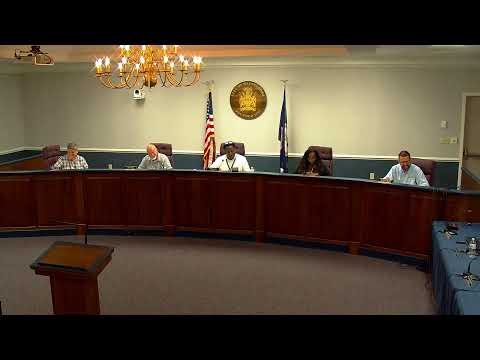
Waynesboro held a public hearing April 28 on a proposed fiscal 2026 budget that is balanced on a recommended property tax rate of $0.89 per $100 of assessed value, and dozens of residents urged the City Council not to raise taxes after recent reassessments.
City staff presented the budget’s major drivers and trade-offs. "The slides that I present tonight are again very high level and tend to focus on the key changes and key decision points in the recommended budget," city staff member Mister Ham said before opening the public hearing. Ham told the council the advertised budget assumes an 89¢ rate and that work to adopt a different rate would require corresponding changes on the expenditure side. "The public hearing this evening is based on a budget with a recommended tax rate of 89¢," he said.
The nut graf: the council is weighing a 12¢ increase from the current 77¢ rate advertised by staff (other illustrative rates were discussed but not under formal consideration) at a moment of widespread reassessments that many residents say already raised their tax bills sharply. Staff says the extra revenue would fund recurring costs including school contributions, employee compensation adjustments, public safety staffing and debt service for planned school work.
Details from staff
Mister Ham summarized the budget increases the city considers largely non-discretionary, including a formula-driven school contribution (presented as an $840,000 increase), completion of previously adopted employee compensation changes for a full 12 months, Comprehensive Services Act-driven social services costs, and increases to VDOT-maintained street funding tied to lane miles. Staff recommended a phased pay-scale adjustment and new positions: six firefighters (three to start the fiscal year and three midyear), two police department positions (one sworn, one civilian), two sheriff’s deputies for courthouse security, and one information-technology position. The draft also proposes creating a debt-service fund for the next phase of Waynesboro High School improvements, additional support for the Waynesboro First Aid Crew, and a new Community Vitality Fund to support local nonprofits.
Enterprise funds and stormwater
City staff member Mister McCormick reviewed enterprise funds (water, sewer, refuse, stormwater), saying no rate increases were required except for stormwater. McCormick said the water and sewer funds are being prepared for upcoming debt issuances and recommended engaging consultants to conduct multi-year rate studies for water, sewer and refuse to inform later budgets; the stormwater rate study would likely follow the city’s permit renewal.
Public comment: opposition and support
More than three dozen residents addressed the council during the tax/budget public hearing. Many described the combined effect of reassessments and a higher tax rate as unaffordable, especially for seniors and fixed-income households.
Resident Richard Carlson said, "I stand in objection to the property tax increase this year. An assessed value increase of 13.5% in property assessed value is a significant increase in the value of our homes." Several other speakers gave similar accounts of large assessment increases: Marcia Hatch said her assessment rose 15% in one year; Ken Keller said his assessment increased 18%; Nicholas Hutsko said his assessment rose 27.35%; and Jane Anderson said her taxes rose 66.38% since she moved to Waynesboro.
Speakers opposed to the increase raised questions about whether new commercial development and higher assessments were already generating revenue the city could use instead of raising rates, and they asked for greater transparency and a town-hall style forum before a final decision. Several residents called for spending restraint and for the city to seek alternative revenues.
Other residents urged the council to fund schools, public safety and community services. Laura Rigan, a Waynesboro teacher and member of the Waynesboro Education Association, urged support for the budget to complete the next phase of improvements at Waynesboro High School, saying the science wing and HVAC need renewal and that delays have increased costs. "We need a new science wing," she said, adding that the building’s condition and the time elapsed since earlier phases make additional spending unavoidable.
Nonprofit and social service testimony included Larry Stauper, chair of the LifeWorks Project, which operates the River City Breadbasket. Stauper said federal support for food banks is decreasing and that a Community Vitality Fund would help local nonprofits serve elderly, disabled and low-income households; he urged the council to adopt the fund proposal.
Actions taken at the meeting
- The council adopted the meeting agenda at the start of the session (vote recorded as 5–0).
- The consent agenda was approved later in the meeting (vote recorded as 5–0).
- The mayor recommended tabling any formal introduction of the tax ordinance until the budget work session scheduled for April 29 at 7 p.m.; a motion to do so was made and seconded and the council proceeded to hold the public hearing but planned to take formal action at the work session.
- Item 9, amending stormwater utility code sections to change the stormwater fee, was introduced on motion and second; the item will appear on a subsequent meeting agenda for formal adoption.
- Item 10, introduction of the annual appropriation ordinance for fiscal year ending 6/30/2026, was tabled to align with the tax-rate discussion; the council directed that it track with the tax-rate consideration at the April 29 work session.
Discussion vs. decision
Staff framed several spending items as commitments or near-term needs (school formula increase, compensation ongoing costs, required debt-service planning). The council did not adopt a final tax rate at this meeting: the public hearing was held and the council agreed to continue formal action at the April 29 budget work session. Several policy choices were left open, including whether to reduce discretionary expenditures instead of adopting the advertised rate and the size and scope of the Community Vitality Fund.
What’s next
The council will take up formal introduction and possible adoption of the tax ordinance and the budget at a budget work session on April 29, 2025, and the council indicated the stormwater ordinance will return to a future meeting for adoption. Staff recommended further rate studies for enterprise funds to guide multi-year planning.
Ending
The public hearing drew sustained comment from long-time residents worried about steep assessment jumps and fixed incomes, alongside residents and nonprofit leaders who urged investment in schools, public safety and community services. The council postponed a final vote to allow additional deliberation at the April 29 budget work session.