Get Full Government Meeting Transcripts, Videos, & Alerts Forever!
Get email alerts on the School Finance topic
No spam. Unsubscribe anytime.
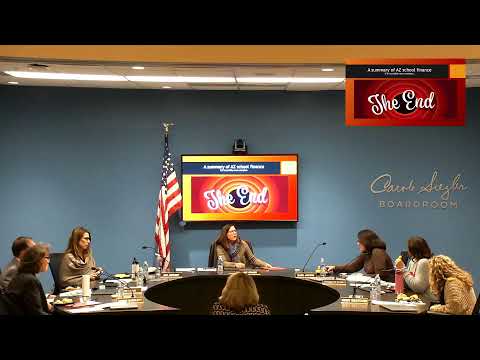
Catalina Foothills board receives primer on Arizona school finance, budget trade-offs
Summary
At a Jan. 28 study session, a presenter reviewed Arizona school finance basics — equalization aid, overrides, bonds, ADM and special funds — highlighting how local tax base, voter-approved overrides and state formulas shape the district—s upcoming budget.
Dr. Cammarazell, a presenter invited to the Catalina Foothills Unified School District governing board—s Jan. 28 study session, summarized how Arizona—s school-finance system determines what the district can budget and why voters— decisions on overrides and bonds matter for local spending.
The presentation focused on the mechanics that most directly affect Catalina Foothills— budget planning: the state—s equalization formula, local assessed valuation and tax rates, voter-approved maintenance-and-operations (M&O) and capital overrides, bond issuances and average daily membership (ADM), the metric used to set most operating revenue.
Why it matters: those elements together drive how much local revenue the district can raise, what the state makes up through equalization aid, and which programs the district can sustain. The board will use those inputs when administrators bring the straw budget and staffing proposals this spring.
Key points presented and discussed
- Equalization and local share: The presenter described the equalization formula adopted in 1980–81 that aims to equalize district ability to raise operating revenue. Using a two-district hypothetical, she showed a property-rich district covering roughly 60% of a $5 million budget from local taxes and a property-poor district covering about 30%, with the state making up the remainder.
- Net assessed valuation and tax rate this year: Catalina Foothills— net assessed valuation was presented as a little over $750 million and the district—s combined primary and secondary tax rate as $4.75. The presenter cautioned that a higher assessed value does not necessarily reduce a taxpayer—s dollar obligation because assessed-value changes and other factors influence final tax bills.
- Overrides and bonds: The district has three voter-approved local options that exceed the state budget limit: bonds, a capital override (currently $2 million a year for seven years), and an M&O override. The district—s M&O override is 13.3% (historically chosen to avoid a tax-rate increase) and generates roughly $4.5 million annually. The board—s most recent bond authorization — approved by voters on Nov. 8, 2022 — was $38.5 million. The presenter noted a commonly used tax-rate threshold of $0.66 (66 cents) the district tries not to exceed when selling bonds.
- Election and administrative costs: The presentation noted that running elections has a direct cost to the district; the Jan. 28 discussion cited an approximate per-election cost of $37,000, which is budgeted in M&O in election years.
- Prop 123 and state trust land distributions: The presenter reviewed Proposition 123 (2016), which increased state trust land revenue distributions to schools and has a 10-year structure. Catalina Foothills— share for the current year was cited at about $350,000, and the statewide distribution for the year was reported as $75 million.
- Capital funding litigation and history: The presenter summarized a long history of capital-funding dissatisfaction in Arizona, including a 1994 state Supreme Court ruling that required a new capital funding approach and a 1998 program to correct facility deficiencies. She noted a more recent lawsuit challenging the capital-funding model; a ruling was expected early in the year but had not been reported at the session.
- Average daily membership (ADM): The presenter explained ADM is a cumulative enrollment measure over the first 100 school days and is the primary driver of state operating revenue. The statutory base support level cited in the session was $5,013 per full-time equivalent student. The talk covered weighting (group A and group B weights) for students such as preschool, K–8, high school and special-education categories; some weights are additive.
- Transportation and other constrained revenues: The presentation noted the district receives roughly $1.062 million in state transportation funding for the year but that local transportation costs run roughly double the revenue. The director explained the formula ties funding to average daily route miles per eligible student (elementary defined as residence more than one mile from school, grades K–8 in Arizona). Open-enrollment students who use the bus add riders but generally do not increase transportation funding.
- Major funds and earmarked revenues: The presenter summarized the district—s most relevant budget buckets: Maintenance & Operations (M&O), Classroom Site Fund (CSF) and the Instructional Improvement Fund (IIF). The CSF (sales-tax backed) was shown as a roughly $7 million revenue source used largely for teacher compensation (base pay and performance pay). The IIF (funded from Indian gaming distributions) was shown at about $758,000 and is used for staffing tied to instructional improvement, dropout prevention and K–3 reading supports.
- Capital-to-operating transfers and the straw budget: The presenter described how the district can transfer district additional assistance (DAA, capital) to M&O and back in limited ways and how administrators use a multi-page straw-budget tool (personnel line item detail, site allocations, contingency) to translate these inputs into a proposed budget. Personnel costs make up roughly 70–75% of the M&O budget, so initial board-level budget commitments (teacher salary schedule and benefits) will fix most of the spending baseline.
Direct quote from the presenter: "[Arizona school finance] is often described as deeply flawed and unfair. I agree," attributed to Dr. Cammarazell during her opening summary of the system.
What the board will see next and calendar items
Administrators signaled the board will review the straw budget and the administrative budget proposal in April (personnel page and certified salary schedule), with further budget revision cycles possible before formal adoption. The statutory timeline cited by the presenter: public hearing on a proposed budget on or before July 5, budget adoption on or before July 15, and possible revisions by Sept. 15, Dec. 15 and May 15 as allowed.
Unresolved items and constraints discussed
- The presenter said the capital-funding lawsuit outcome remained pending at the time of the session.
- Enrollment dynamics and ADM timing: students who enroll after the first 100 days do not increase ADM funding for that year; the presenter emphasized ADM is enrollment-based, not attendance-based.
- Early learning center funding: the presenter said the district—s Valley View early-learning center is tuition-based and the state does not provide the per-pupil base support ($5,013) for general-education preschool; only preschool students with disabilities receive state funding.
Ending
Board members and staff thanked the presenter for a condensed review, and administrators said slides and notes would be posted in the board book for later reference. The board paused for a short break before the regular meeting scheduled to begin at 6:30 p.m.