Get Full Government Meeting Transcripts, Videos, & Alerts Forever!
Get email alerts on the Education Budget Staffing topic
No spam. Unsubscribe anytime.
Anchorage School District finance panel backs $560-per-student interim plan to restore staff
Summary
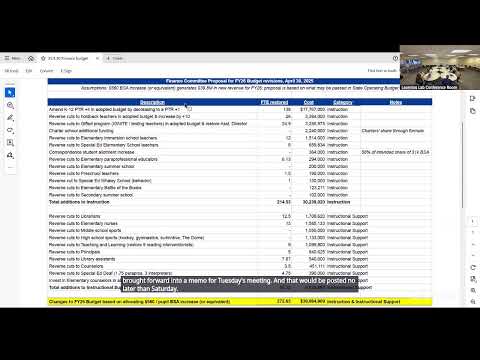
The Anchorage School District Finance Committee on Wednesday signaled support for a plan that would revise the district's proposed FY26 budget to allocate $560 per pupil — approximately $39.8 million under current enrollment projections — to restore teaching positions and student supports if state funding in House Bill 57 is realized.
The Anchorage School District Finance Committee on Wednesday signaled support for a plan that would revise the district's proposed FY26 budget to allocate $560 per pupil — approximately $39.8 million under current enrollment projections — to restore teaching positions and student supports if state funding in House Bill 57 is realized.
The plan is designed as an interim, targeted response to staffing shortfalls in schools and would reverse many of the cuts in the district's proposed budget. Committee chair Kelly Lessons said the document presented at the special meeting is “a first look at what we might do” with the state money and described the proposal as an initial attempt “to stop some of the bleeding.”
Why it matters: The committee framed the proposal as immediate triage to reduce harmful classroom disruptions and to limit layoffs or displacements for educators while the state operating budget and elements of HB 57 are finalized. Members and district leaders repeatedly cautioned that the proposal depends on uncertain state revenue and could require revision if the final enacted budget differs from current legislative action.
Key elements and scale - The committee’s working plan centers on $560 per student (referred to repeatedly as “$560 BSA” in the meeting). At that level the district estimates allocating about $39,800,000 in new revenue to restore staff. Kelly Lessons described the figure as a proportional trimming of an earlier $1,000-per-student amendment the board passed in February. - The draft would move the district’s staffing formula from the previously proposed PTR-plus-4 to PTR-plus-1, restoring teachers and instructional support positions rather than administrative allocations. - Specific restorations discussed include: reversing cuts to 24.9 teacher FTE (teachers only), restoring 12 elementary immersion teachers, restoring special-education elementary teacher cuts, restoring elementary summer school and secondary summer school, reinstating librarians and elementary nurses, restoring middle school sports and select high school athletics (hockey, gymnastics, swimming and diving), restoring nine reading interventionists (not the full ten proposed earlier), and investments in counselors, library assistants, interpreters and preschool special-education staff. - The document presented groups most of the spending under instruction and instructional support rather than administration; staff said the change would increase the proportion of the budget going to classroom instruction.
Discussion, risk and limits Committee members and district leaders emphasized uncertainty. Superintendent Bridal told the meeting, “I want the public to be very clear that this is different than that. This is a revenue projection. ... What we're talking about is assuming that we're going to have more money in our budget than assigned into law. ... This is a calculated and managed risk.”
Board members noted a range of possible final outcomes: HB 57 includes a proposed $700-per-student increase in some drafts, but the committee chose $560 as a cautious working assumption that they believe is more likely to be realized and less likely to leave the district without resources if the legislature or governor changes the final package. Member Jacobs summarized the approach as scaling down the board’s prior $1,000 proposal to a figure the committee felt it could reasonably count on.
Members also discussed trade-offs and future exposure: Member Higgins warned that spending available dollars now would reduce reserves and could create a larger cliff in the following year if additional state funding does not materialize, while other members said the priority was avoiding layoffs and restoring classroom services.
Decision and next steps The finance committee gave general consent to prepare a recommendation to the full board to revise the district’s proposed FY26 budget consistent with the $560-per-student spending plan and to include conforming technical edits and an explanatory communications plan. Committee members indicated the item would be brought to the board at the Tuesday meeting following the special session; no formal roll-call motion or recorded vote was taken in the committee meeting transcript (the committee characterized the outcome as consensus and five of seven board members in the room expressed support).
District staff described operational steps that would follow a board adoption: beginning work to unwind involuntary transfers and displacements where possible, reopening hiring to fill restored positions, and notifying affected staff. The superintendent and HR staff cautioned that some displaced employees may not return to the same school because some positions were eliminated earlier due to enrollment declines.
What was not decided The committee explicitly deferred allocation decisions that depend on the final state operating budget and elements of HB 57 (transportation increases, reading grants, CTE multiplier changes). Members said any additional funds beyond the $560-per-student assumption would be considered later, and that the full recommendation would include a commitment to revisit the budget after the state picture is finalized.
Context and background The finance committee framed the action as a response to a larger legislative debate over the Base Student Allocation (BSA) and statewide education funding. Members noted the board had previously passed a $1,000-per-student amendment in February and that the Alaska Association of School Boards and the legislative finance division had advocated larger BSA adjustments tied to inflation. The committee described the current plan as an interim measure to stabilize schools while legislators finish the operating budget process.
A copy of the committee’s working document and the recommendation memo will be posted ahead of the full board meeting; the committee asked staff to include clear language explaining the proposal’s contingent nature and the communications plan for notifying employees and families.