Get Full Government Meeting Transcripts, Videos, & Alerts Forever!
Get email alerts on the Academies And Cte topic
No spam. Unsubscribe anytime.
Anchorage School District details Academies expansion, dual-credit partnerships and timeline amid budget strain
Summary
District staff told the school board on April 24 that expansion of the Academies of Anchorage will proceed gradually, supported by federal grant reorganization that created six teaching positions; major schedule changes are not expected for three to five years and dual-credit work with UAA will continue despite budget uncertainty.
John Prince, senior director of teaching and learning for the Anchorage School District, briefed the board at its April 24 communications meeting on progress and near-term plans for the Academies of Anchorage program, dual-credit partnerships and the district’s master-plan revision process.
Prince said the district has “reorganized the grant that we received from the federal government, and created six teaching positions” to help principals keep programs that might otherwise be cut. He added that any major high-school bell‑schedule changes are not expected “for 3 to 5 years” because of funding and staffing needs.
The briefing explained why the Academies effort matters: district leaders want more students to complete career and technical education (CTE) programs and to graduate prepared for college, the military or the workforce. The Academies work, Prince said, is intended to expand access beyond King Tech’s current capacity and to provide a consistent set of exploratory and credentialing opportunities for freshmen.
District staff described specific dual-credit and CTE offerings tied to University of Alaska Anchorage (UAA) agreements, including certified nursing assistant (CNA) pathways, aviation maintenance, EMT, welding and some Project Lead The Way engineering courses. Mary Jo Finley, dean of graduate studies at UAA, and Larissa Wright Elson, the district’s coordinator for CCL (college and career) work, were identified as continuing partners in those efforts.
The district also said it has folded one business‑academy program into Alaska Middle College to preserve dual‑credit opportunities for about 40 juniors and seniors who otherwise lost a local coordinator in recent budget reductions. Staff said they are renewing articulation agreements with UAA for multiple King Tech courses so students can earn college credit while in high school.
Prince told the board the district reorganized its federal grant funding to create the equivalent of six full‑time teaching positions (six FTEs) that principals can use to avoid cutting programs. He said that reallocation has given “principals flexibility” to keep classes that otherwise might disappear under current budget constraints.
Board members pressed staff about how the Academies plan will be funded after the federal grant period ends. Prince and other staff emphasized that state funding formulas are separate from federal grant funds and that long‑term expansion will require the board to show evidence—such as increased CTE completions and graduation rates—that the programming produces measurable results before asking for additional local or state investment.
On planning and timeline, staff said the Academies steering committee will continue meeting, with a scheduled committee update April 25. The district hopes to complete substantive revisions to the Academies master plan during a quieter summer window and present a draft to the board in August or September, but staff cautioned that the document is large and will require family engagement and input from multiple tactic teams before finalization.
Staff also described a revised freshman course, renamed College and Career Exploration (including personal finance), designed to introduce students to career and post‑secondary options and help them assess work values and preferences. Prince said the course is “not a prerequisite for a pathway” but “a really important part of the program” that helps students identify and rule out future choices.
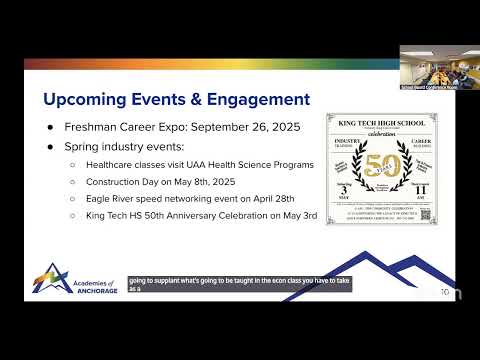
Staff highlighted upcoming events tied to Academies work, including King Tech’s 50th anniversary celebration May 3 and a freshman career expo set for Sept. 26. They asked the board to help communicate current opportunities to families, noting many parents are still unaware of King Tech and other pathway options.
Why this matters: the Academies work ties to board goals on graduation and CTE completion. District leaders told the board they are trying to keep existing programs intact while scaling access and preserving dual‑credit pathways, but several staff cautioned that sustained expansion depends on funding that may not be available when current grants end.
Prince and other staff recommended a phased, pragmatic approach—continue credentialing and dual‑credit partnerships, preserve programs through reallocated grant FTEs, and pursue a deliberate master‑plan revision that includes family engagement.
Board members and staff agreed to continue steering‑committee work and to return with more concrete data on CTE completions and graduation metrics the district would use to seek longer‑term funding.
Ending: District staff said they will present updated master‑plan materials when steering‑committee input and family‑engagement feedback are complete and recommended that the board use the summer months for review and a possible August or September presentation to the full board.