Get Full Government Meeting Transcripts, Videos, & Alerts Forever!
Get email alerts on the Property Tax Waiver topic
No spam. Unsubscribe anytime.
Niagara Falls council waives city taxes so nonprofit Norlick can take eight city parcels
Summary
On Jan. 22 the Niagara City Council voted to forgive unpaid city property taxes on eight city-owned parcels so nonprofit Norlick will accept title; residents and some council members questioned fairness and transparency.
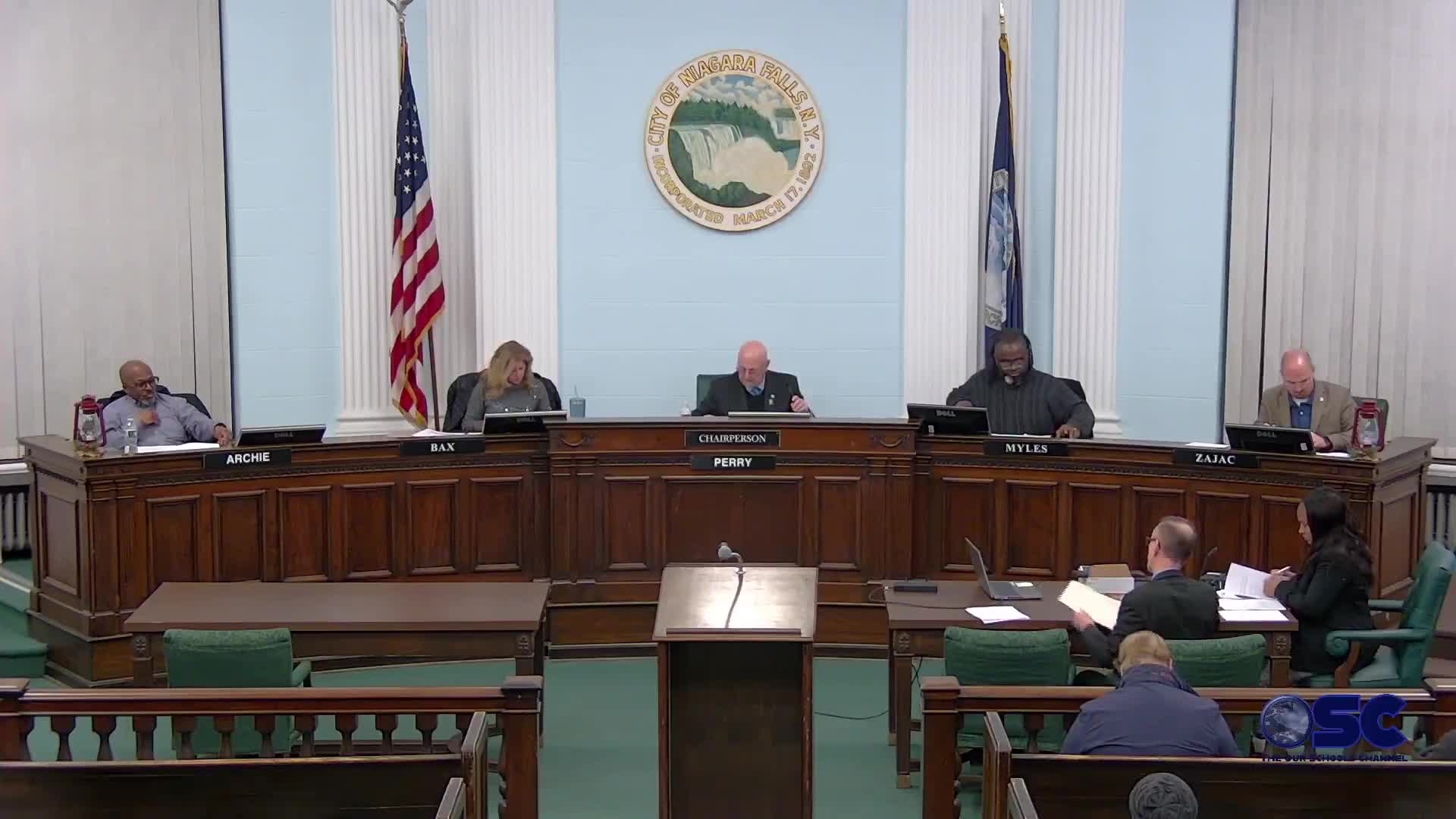
Niagara Falls City Council voted 4-1 on Jan. 22 to waive unpaid city property taxes on eight city-owned parcels and authorize the mayor to execute documents transferring the properties to Norlick, a not-for-profit organization, the council said.
Council members approved the waiver after the acting corporation counsel told the council Norlick had only recently learned the parcels carried unpaid city, school and county taxes and said it would not proceed with the transfer unless the city forgave its portion of the indebtedness. The motion referenced a mayor’s recommendation memo dated Jan. 15, 2025.
The ordinance's supporters said the nonprofit will rehabilitate idle properties and place them back on the tax rolls when sold to qualifying buyers. “Norlick realized that there were a host of unpaid taxes, city, school, and county. And that's when they approached us and said, we can't go forward with this deal, if we're going to be assuming these tax burdens that we didn't expect to have,” the acting corporation counsel said during debate.
Opponents said waiving city taxes for a nonprofit that will rehabilitate and resell properties risks appearing to prioritize organizations over residents who must pay taxes to buy city property. “It seems like cherry picking of agents, cherry picking of who's the contractors, and cherry picking of who gets the tax breaks,” resident Tanya Barone told the council during public comment, noting concerns that individual residents are not being offered similar relief.
Council members said Norlick operates in a manner similar to other land-reuse organizations: it uses grants and contractor rehabilitation, markets rehabilitated houses to potential buyers—often first-time homeowners—and returns the property to the tax rolls when buyers take title. The acting corporation counsel also advised the council that Norlick is organized as a not-for-profit and does not operate primarily for profit.
The council recorded the motion as carried, 4-1. The council did not specify in its meeting record whether any portion of county or school taxes would be forgiven; the motion addressed unpaid city property taxes and authorized mayoral execution of transfer documents as outlined in the Jan. 15, 2025 mayor’s memo.
The council and several residents urged greater transparency about which city-owned properties are available for purchase and how the city decides to refer parcels to nonprofit developers. Supporters said the city has declining inventories of idle, foreclosed properties—the acting corporation counsel noted some of the parcels were foreclosed in February 2010—and that rehabilitation via a nonprofit can return properties to productive use more quickly than leaving them vacant.
The council left open where Norlick will place any proceeds from sales; one council member noted, as is typical for similar entities, proceeds often fund additional acquisitions and rehabs, rather than being distributed as profit. Norlick’s procedures for selecting buyers were described during the meeting as competitive applications handled by the nonprofit; the council advised residents to consult Norlick’s website for additional details.
The council’s action authorizes the immediate forgiveness of unpaid city taxes for the eight listed city parcels and transfers to Norlick as described in the Jan. 15 mayor’s recommendation memo. The mayor’s office and Norlick were not recorded as providing new details at the meeting about the specific properties’ addresses or timelines for rehabilitation.
The council’s vote does not indicate forgiveness of county or school tax liabilities; the motion and the administration’s explanation addressed unpaid city property taxes only. Several council members said they would consider future programs structured specifically to help residents obtain and rehabilitate city-owned properties.