Get Full Government Meeting Transcripts, Videos, & Alerts Forever!
Get email alerts on the Strategic Communications topic
No spam. Unsubscribe anytime.
Consultants present communications plan after city survey finds residents want more outreach
Summary
Consultants for Vineyard City presented a strategic communications plan informed by a scientific survey of 206 residents that found a majority want more city communication and prefer email and social media channels.
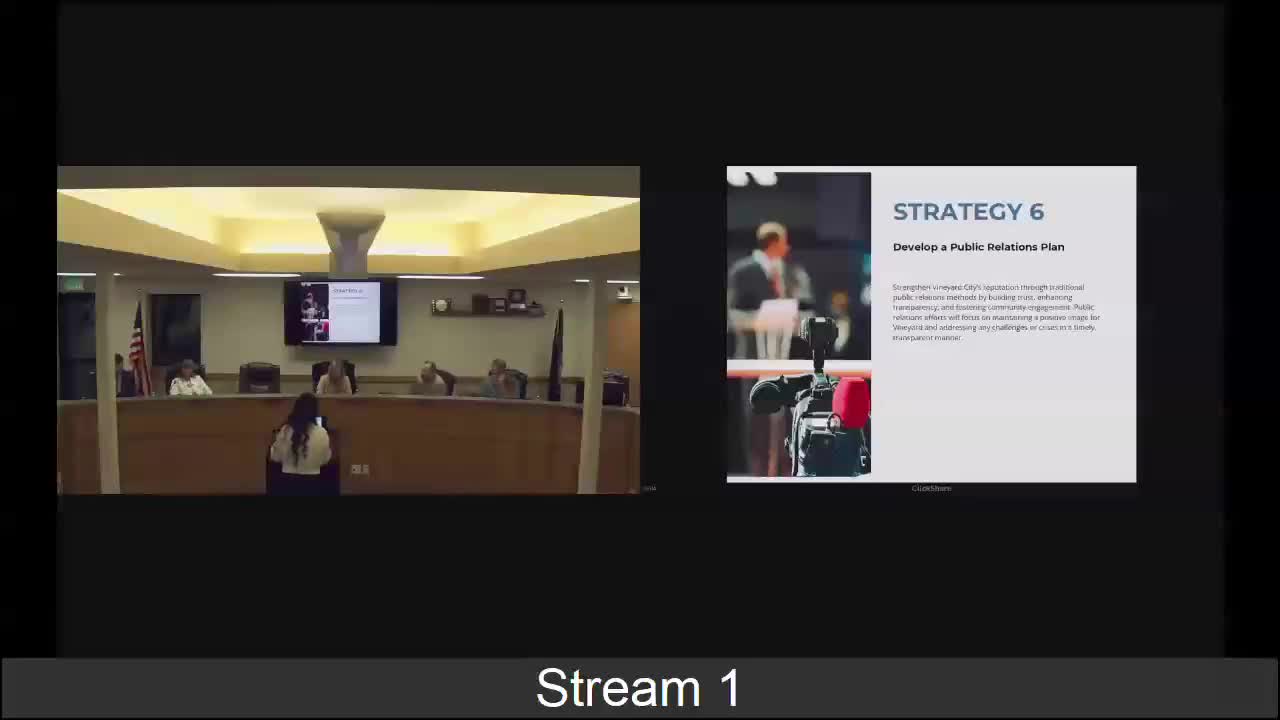
Consultants from X Factor and Y2 Analytics presented a strategic communications plan to the Vineyard City Council on Feb. 26 after fielding a citywide survey of residents.
Kyrene Gibbs, a researcher with Y2 Analytics, told the council that the survey was carried out June 5–July 21 and that invitations were sent by email, text and postcard. "We conducted a scientific survey of Vineyard residents last summer," Gibbs said. She reported 206 completed responses, and said that produced a margin of error of about 6.8 percentage points for aggregated estimates.
The consultants said the research focused on communication patterns and preferences and that an appendix of additional issue sentiment would be circulated to council members. Murielle Social Mille, a consultant with X Factor, said the plan pairs the quantitative research with stakeholder interviews and analytics to produce measurable goals, audience segmentation and an implementation calendar.
"The primary goal we identified for the communications plan is engaging residents and businesses to foster a sense of community, build trust, and enhance social cohesion," Social Mille said.
Why it matters: the survey found a majority of respondents want more communication from the city. Consultants said social media is the most-used channel, but a plurality of residents prefer direct email updates; fewer than half of respondents had visited the city's website. The plan therefore emphasizes maximizing existing digital channels (social accounts, email newsletters, the city app) and instituting a communications policy to standardize timing and tone across city platforms.
Council members asked for the raw survey data and clarification on methodology. Gibbs said the survey invitations were sent to roughly 3,000 addresses and yielded 206 completed responses; she confirmed a 90% confidence level figure was discussed and reiterated the 6.8 percentage-point margin of error for aggregated estimates at a 95% confidence standard.
Consultants also outlined a SWOT assessment and recommended measures including a communications policy, an implementation calendar, audience-targeted messaging, and staff training for digital tools. Kimberly Rivers of X Factor summarized the practical tactics the plan would guide staff to deploy and said the document is intended to institutionalize consistent, proactive communications.
Council members and staff agreed to circulate the full report and appendix for review; consultants said they would follow up by email on specific questions.
The council moved on to other agenda items after the presentation; staff said the full survey report and plan would be provided to council members for further review.