Get Full Government Meeting Transcripts, Videos, & Alerts Forever!
Get email alerts on the Transportation Speed Limits topic
No spam. Unsubscribe anytime.
County study recommends citywide speed limit of 25 mph for Poughkeepsie streets
Summary
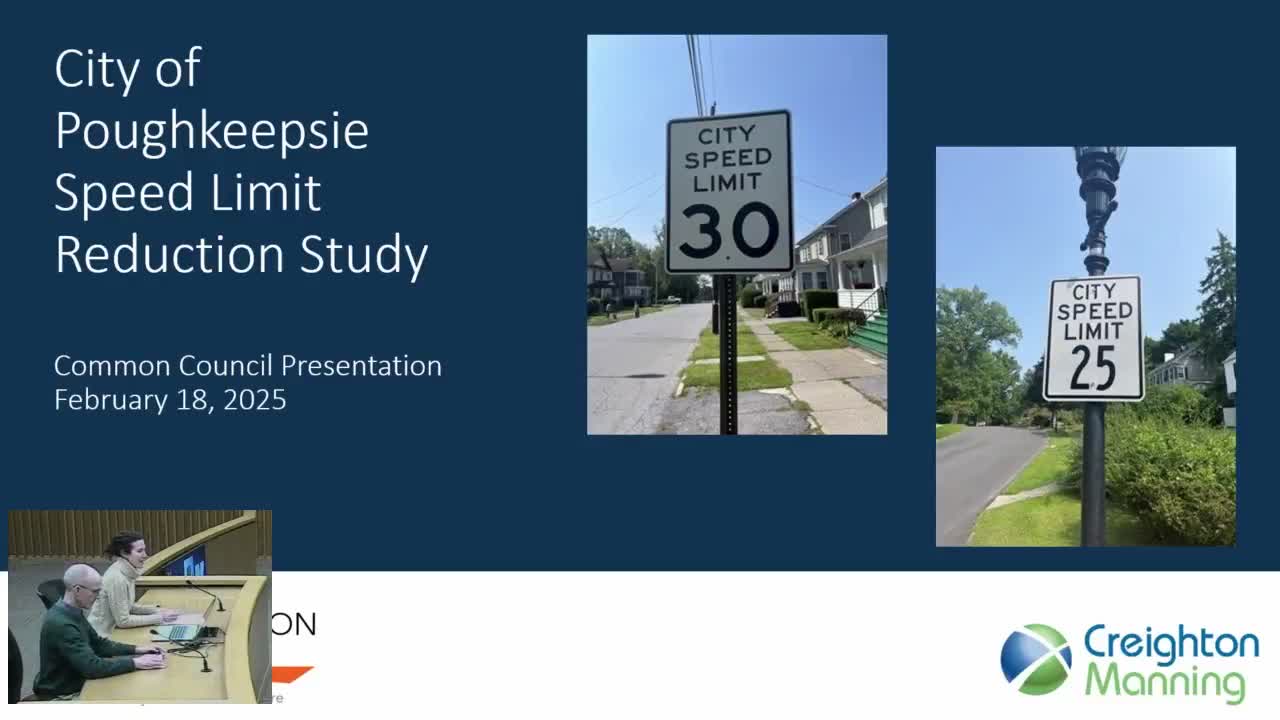
A county transportation study presented to the Poughkeepsie Common Council on Feb. 18 found that most city streets could be justified for a reduced local speed limit of 25 miles per hour.
A county transportation study presented to the Poughkeepsie Common Council on Feb. 18 found that most city streets could be justified for a reduced local speed limit of 25 miles per hour.
Emily Dozier, a senior planner with the Dutchess County Transportation Council, told the council the mayor and city administrator asked the council to consider reducing the citywide speed limit from 30 to 25 on local streets. “The mayor and city administrator asked us to take a look at reducing the citywide speed limit from 30 miles an hour to 25,” Dozier said, explaining that state law now allows cities to adopt a lower citywide limit on local streets and that an engineering study is required to support such a change.
The study, supported by consultant Creighton Manning, reviewed lane widths, traffic volumes, measured speeds (including 85th-percentile speeds), crash locations and land use. Dozier said most city streets are low-volume, narrow and serve local purposes — conditions that the analysis found compatible with a 25 mph limit. The study identified a small set of higher-class or higher-speed streets where an exemption could be considered, listing Academy Street, Wilbur and Cedar as potential exceptions.
Why it matters: lower speed limits on local streets are intended to reduce crash severity and make walking, biking and bus travel safer, particularly near concentrated activity on and around Main Street, where the study found clusters of crashes near Market Street.
Council discussion and next steps: Council members asked for additional detail on the crash counts and the exact locations and dates of the speed measurements. Council Member Grant asked, “Do you have a number of how many accidents actually happened in those yellow areas?” Dozier said she did not have the number at the meeting but offered to provide crash counts from the county crash database. Grant also raised the timing and location of speed counts on Academy Street, noting a recent stop-sign installation that could affect measured speeds; Dozier said the counts likely predate that change and that the data app would show exact sensor locations and dates.
Dozier and the consultant offered three options: keep the current 30 mph citywide limit; change to 25 mph citywide; or adopt 25 mph citywide while exempting a few higher-speed or collector streets. The presenters also recommended a sign plan (inventorying the roughly 80 existing speed-limit signs the team found), public education, coordination with police for enforcement, and possible use of traffic-calming measures where speeds are high.
Mayor Yvonne Flowers noted local interest in traffic-calming measures near schools and said the city planned to consult peer municipalities such as Albany about their experience with speed humps and enforcement. Dozier offered to share the traffic-data app and the sign-inventory map with council staff.
The council did not vote on any change at the meeting. Dozier said the next formal steps would be for the council to state a preference, for staff to develop a detailed sign plan and for the council to adopt a local law to amend the city code if it chooses to move forward.