Get Full Government Meeting Transcripts, Videos, & Alerts Forever!
Get email alerts on the Water Sewer Rates topic
No spam. Unsubscribe anytime.
Leslie staff present ordinance to raise sewer per-thousand rate, codify shutoff and fees
Summary
At an April 7 public hearing the City of Leslie reviewed an Arkansas Rural Water rate study and a proposed ordinance that would raise sewer charges, set new fees and deposits, codify a shutoff timeline and require ongoing reserves under Act 605; the ordinance will be presented to the council for action.
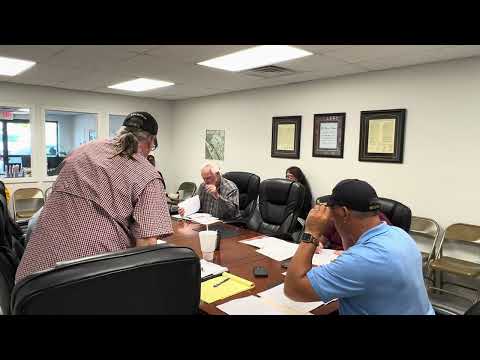
City staff held a public hearing on April 7 at 6 p.m. in Leslie to review a rate study by Arkansas Rural Water and a proposed ordinance that would raise sewer charges and codify customer-service policies required under Act 605.
City staff said the rate study found current water rates are sufficient but sewer revenues fall short. The ordinance proposed raising the monthly sewer base for the first 1,000 gallons from $20.25 to $24.50 and increasing the sewer per-thousand charge from $3.92 to $6.50. Staff told attendees the ordinance also ties future municipal increases to supplier increases by applying the supplier’s increase plus 2 percent to the city’s rates, and establishes an effective date for the new rates.
The ordinance text discussed at the hearing sets the water base for most customers at $41.61 with a per-thousand charge of $9.57 (business base shown as $43.50 in the materials). The measure also would require the city to place 5 percent of gross water sales into a repair-and-replacement (R&R) account, and it specifies that new rates and customer-service rules would go into effect May 1, 2025 (staff said the statutory deadline to have rates in place is July 1). The proposal codifies a standard billing and shutoff process: bills mailed around the first of the month, due by the 15th, a 10 percent late fee assessed on the 16th, and disconnection if bills are not paid in full by the 16th of the following month.
The ordinance would change deposit and fee amounts: a security (mirror) deposit increased from $150 to $200; delinquent reconnection charge of $30 (normal business hours), $50 for after-hours reconnection; a $20 field-collection fee; and a typical $30 returned-check fee. The draft also lists tapping fees: $800 for a 3/4-inch service, $1,000 for a 1-inch service and $21,200 for a 2-inch line, and states sewer-service connection fees of $600. (These tapping and connection figures were presented in the staff handout and read into the record.)
City staff addressed several operational points raised at the hearing. Staff reported the system’s current water loss is about 45 percent and said the city is prioritizing replacement of asbestos-cement water lines and other problem sections. Staff described recent meter upgrades (funded in part by CARES and other sources) and said the new meters are far more sensitive and in some cases show higher usage simply because they capture flows older meters did not.
Speakers at the hearing discussed affordability concerns for residents on fixed incomes and for apartment complexes. The draft ordinance treats apartment complexes as billed through a single master meter: the minimum monthly charge would be calculated as $41.61 multiplied by the number of units, with additional consumption billed at $9.57 per thousand gallons.
Staff said the city has two outstanding bonds on sewer plants (bonds continuing through 2044), and the R&R account already has paid for at least two repair items that avoided borrowing. Staff also described efforts to seek grants and an environmental/smoke-test sewer study to locate infiltration and illegal connections; the city is pursuing engineering work with ESI and a potential study by a firm recommended by Arkansas Rural Water.
No formal council vote on the ordinance occurred during the hearing; staff said the draft ordinance would be presented to the City Council later that evening. Public commenters asked for consideration of low-income households and noted programs such as the now-expired LIHWAP, and staff reiterated that exceptions to shutoff may be made on a case-by-case basis at the city treasurer’s discretion.
The hearing closed after general questions about rates, meter accuracy and the sewer system’s infiltration problems; staff invited attendees to remain for the council meeting where the ordinance will be considered.