Get Full Government Meeting Transcripts, Videos, & Alerts Forever!
Get email alerts on the Pools And Fees topic
No spam. Unsubscribe anytime.
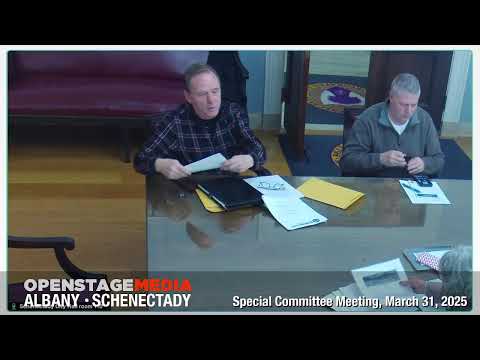
Schenectady committee weighs pool fee rules, recommends residents-only access for 2025 season
Summary
City parks staff and the Health & Recreation committee discussed whether to charge nonresidents, how to implement kiosks or season passes, and data needs to decide a permanent fee structure. The committee leaned toward a residents-only rule for this season and will collect usage data for 2026 decisions.
Schenectady City’s Health & Recreation committee discussed whether to charge nonresidents for pool use and how to implement a payment system, ultimately moving toward a residents-only rule for the coming season while deferring a nonresident fee decision to a later budget cycle. The committee held the discussion as a follow-up to prior meetings about pool rules, staffing and equipment needs.
Committee members and parks staff said the city lacks the data and operational capacity to stand up a paid-entry system in time for the 2025 season. A parks official said the city’s short, weather-dependent pool season—about nine weeks—makes it unlikely that a nonresident fee would fully offset operating costs. "We would not be collecting fees that are going to offset the cost of our pool," the Parks Director said during the meeting.
The committee chair said members had previously agreed that city residents should not pay to use the pools and that the primary question remained whether to allow nonresidents with a fee. "I think we were all pretty much in agreement that residents would not be paying a fee," a Committee member said. Committee members and staff agreed to defer any roll‑out of a paid-entry system until they can collect usage data this season and present a recommendation ahead of the 2026 budget process.
Discussion focused on three operational approaches: a kiosk or card-reader at pool gates, a seasonal printed/photo pass issued at city hall or the golf course, and a temporary tablet/Apple Pay/Venmo solution for the first year. Parks staff described practical constraints for kiosks: programming, merchant processing, maintenance and what to do if a device fails during a day. Staff estimated additional one-time setup costs beyond the kiosk hardware and recurring costs to process payments and secure cash deposits at city hall. One parks staffer summarized: "the kiosk came with a lot of different options, but we have to get it programmed…maintenance cost, what happens if our machine breaks down."
Staff and committee members also discussed season passes with on-site banding or photo IDs to avoid gate bottlenecks. Under that model, residents could obtain a pass at city hall or another city location, present it at the pool, and receive a wristband for that visit to confirm entry. The committee discussed placing a permanent point of sale at a nearby city location (the golf course was suggested) to reduce lineups at pool gates.
Boys and Girls Club involvement was raised: the organization ran two pools last year and is scheduled to meet with staff to clarify hours, lifeguard staffing and any contract role in collecting fees or managing entry. Committee members noted that if the city requires a contractor to collect fees, the contractor may decline liability for payment processing and reporting, which would leave the city responsible for staffing and reporting.
Committee members asked staff to obtain usage data from last year — including how often pools reached capacity and ZIP-code breakdowns of users — to test whether fees should aim to discourage nonresidents when capacity prevents residents from entering. Parks staff said they have ZIP-code data on paper and will follow up with the Boys and Girls Club for details about the number and timing of capacity closures. "I'll give her a call and ask her how many days did you have to shut the pool off because you reached capacity," a Committee member said.
Budget context drove much of the conversation. Staff provided a rough accounting of pool-related expenses across three city pools: roughly $154,000 in pool maintenance and about $202,000 for pool recreation operations, for a combined annual cost on the order of $360,000 (figures cited by staff). Chemical costs were called out separately at roughly $60,000. Committee members stressed that startup and recurring costs for a paid-entry system (equipment, merchant fees, additional staffing to collect and deposit cash) must be weighed against any projected fee revenue.
No formal vote was taken; the committee does not have a quorum for decisions at the meeting and agreed to bring recommendations to the city council committee meeting next week. Staff said they will draft a recommendation for the council and circulate it to committee members before the council meeting, and the committee expects to revisit the issue after collecting data during the upcoming season.
The committee asked staff to prepare options for the council: (1) a residents-only access rule for pools with no fee; (2) a nonresident fee with implementation details (kiosk vs. season pass vs. tablet payments); or (3) a hybrid approach such as residents-only access with limited guest allowances. Staff emphasized the need to finalize operational decisions in time to incorporate any costs into the 2025 budget or to defer implementation to 2026 if set‑up cannot be completed.
The discussion closed with agreement to reconvene the topic at the next city council committee meeting and to prioritize collecting usage and ZIP-code data this season so the city can make an informed decision for 2026.