Get Full Government Meeting Transcripts, Videos, & Alerts Forever!
Get email alerts on the Noise Permit Ordinance topic
No spam. Unsubscribe anytime.
Schenectady holds public hearing on proposed sound-permit ordinance; resident urges nonpolice enforcement
Summary
The council held a public hearing on adding section 182-8 to chapter 182 of the Schenectady City Code to create a sound permit application; a resident who spoke supported the change but urged enforcement be handled by code or quality-of-life staff rather than the police.
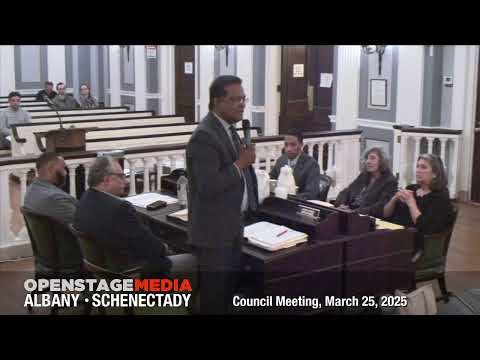
The Schenectady City Council held a public hearing March 24 on a proposed ordinance that would add section 182-8 to chapter 182 of the Schenectady City Code to establish a formal sound-permit application process.
A resident who addressed the council said she supported the proposed changes but urged the city to avoid assigning primary enforcement responsibility to the police. “I support the proposed changes to the city's noise ordinance, including the addition of a sound permit application process, creating a formal and transparent process for permitted sound is a step in the right direction,” the resident said. “That said, I don't believe the police department should be the primary avenue for addressing noise complaints.”
The speaker argued noise disturbances are not criminal matters and said routing enforcement through law enforcement “introduces the potential for unnecessary escalation and negative outcomes.” She suggested the city consider a dedicated quality-of-life or code-enforcement officer trained for nonemergency responses as an alternative to police-led enforcement. “Dedicated quality of life or code enforcement officer trained specifically for non emergency responses could help address complaints more effectively and with less risk of conflict,” she said.
The council president closed the public hearing after the single speaker and proceeded with the meeting agenda; the transcript records no final adoption or vote on the ordinance during the session.
Why it matters: The ordinance would create a formal permitting process for amplified or permitted sound in the city. Who enforces it — police or civilian code officers — will shape how complaints are handled and could affect residents' safety and perceptions of fairness.
The council set a four-minute limit for public-hearing remarks and asked speakers to keep comments narrowly focused on the hearing topic. The record shows the matter remains at the hearing stage; no final vote on the ordinance was recorded in the March 24 proceedings.