Get Full Government Meeting Transcripts, Videos, & Alerts Forever!
Get email alerts on the Traffic Enforcement topic
No spam. Unsubscribe anytime.
Lake Wales staff recommend automated red-light and school-zone cameras, propose revenue-share for first year
Summary
City of Lake Wales public-safety officials recommended awarding a contract to Altamet (Ultima) to install automated red-light cameras and school-zone speed-enforcement cameras at selected high-violation school zones and intersections, and staff proposed using a revenue-share fee for the first year to avoid upfront city costs.
City of Lake Wales public-safety officials recommended that the commission approve a contract with Altamet (doing business as Ultima) to deploy automated red-light cameras and a school-zone speed-enforcement program, saying the systems aim to reduce dangerous driving near schools and at high-violation intersections.
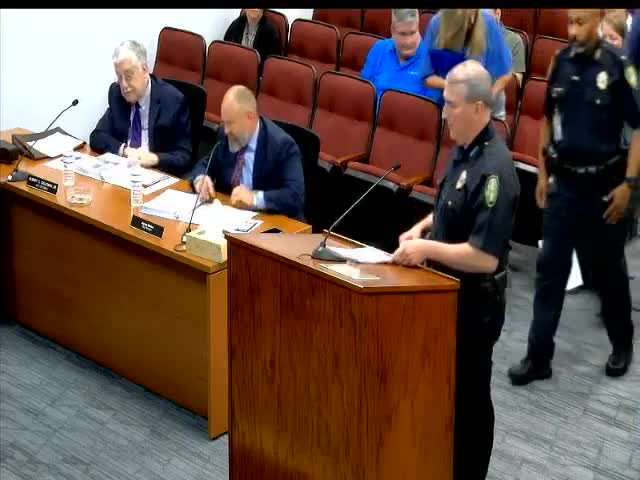
Chief Velasquez introduced the item and said the city issued a request for proposals and a selection committee recommended Altamet to “manage our program.” He added that Lieutenant Edward Palmer would run the program for the department.
Lorraine Johnson, regional sales manager for Altamet, described the company’s experience and outreach approach and said, “This is not a gotcha program. This is designed to modify driver behavior,” pointing to multi-jurisdiction results, including a cited Lake Alfred example where violations dropped roughly 66 percent after the camera program and public information campaign.
Lieutenant Edward Palmer reviewed the city’s spot studies and recommended initial camera placements. He presented data from two-day field studies and then averaged those results to an “average daily violation” metric for school days. Palmer recommended starting the automated speed-enforcement program at Lake Wales High School, McLaughlin School of Excellence, Hillcrest Elementary and other high-violation school zones; for red-light enforcement he proposed starting at three State Road 60 intersections with the highest measured violation rates in the studies (60 & Buck More, 60 & Third, 60 & First).
Palmer noted the school-zone enforcement counts capture only violations of 11 miles per hour or more over posted limits, in keeping with the systems and the vendor’s configuration; Altamet’s presentation said citations are issued for those higher-speed infractions only. He also included an example breakdown of where fine revenue is allocated by state law: a portion to the municipality, a portion to the county school district (divided among schools based on enrollment), and a small share for school crossing-guard programs.
Staff described contract options for the school-zone program: a revenue-share ($20 per paid citation to the vendor) or a fixed monthly fee similar to the red-light pricing. The city manager and staff said the administration would recommend the revenue-share option for the first year to avoid upfront costs; the vendor’s representative confirmed the contract allows conversion to a fixed-fee model after a year. The vendor also said the contract includes cost-neutrality language and a termination-for-convenience clause so the city would not owe money if camera deployment produced no citations.
Commissioners asked about implementation details including how long the required public-information and 30-day warning period would run, how school-district distributions are handled, and whether citations affect insurance or driving points. The vendor and staff said the citations are civil fines with no driving points if paid; unpaid fines can progress to uniform traffic citations. On the allocation question, staff said the law requires the city to forward the school-share to the Polk County School District, which divides the funds among schools and charter schools according to the statute.
Commissioner comments during discussion ranged from safety support — noting high speeds observed in school zones and repeated near-miss incidents — to concern about the penalty’s effect on low-income residents. Staff and the vendor replied that the program’s public-education campaign and the 30-day warning period are intended to change behavior more than to maximize citations.
No formal commission vote or final contract award was recorded in the transcript portion provided; staff characterized the presentation as the administration’s recommendation and said a formal action item would be brought forward for the commission to approve a contract and pricing option at a subsequent meeting.