Get Full Government Meeting Transcripts, Videos, & Alerts Forever!
Get email alerts on the Culture Museums topic
No spam. Unsubscribe anytime.
Lake Wales History Museum outlines reopening, exhibits and accessibility priorities
Summary
The Lake Wales History Museum told the City Commission it has reopened a foundational gallery, expects two more galleries to open this spring and summer, served more than 7,000 visitors while largely closed, and is prioritizing ADA access, partnerships and a revenue-generating freight space.
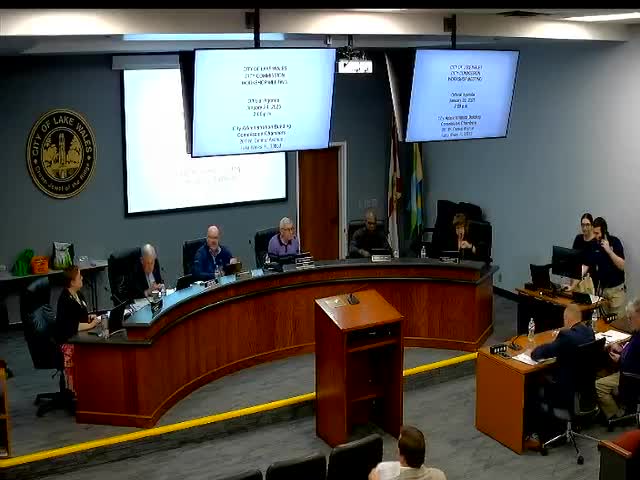
Angela Rosado, speaking for the Lake Wales History Museum, updated the City Commission on the museum’s phased reopening, recent attendance, funding and program plans.
Rosado said the museum “collects, preserves, and share[s] the heritage of Lake Wales,” and described a three-phase approach to reopening gallery spaces and building new exhibits. She told commissioners the museum served “over 7,000 visitors” during an extended partial closure and was awarded “over $65,000 in grants,” which helped sustain programming while the building was not fully open.
The presentation described completed work on a first gallery that now hosts a founders exhibit, notable places and an introduction to the town’s railroad history; a second gallery focused on railroad panels and electrical work that museum staff expect to open by the end of spring; and a larger middle gallery, which Rosado said is the museum’s “biggest project” and is estimated to be finished by the end of the summer. Rosado said the main gallery will highlight downtown business history, Pioneer Days and the area’s three foundational industries: cattle, turpentine and citrus.
Rosado and board members identified ADA accessibility and the museum’s freight room as immediate priorities. The museum has solicited funds and partners for a ramp and other accessibility improvements; Rosado said Bill Redmond “is a great advocate for ADA accessibility,” and that the board will pursue solutions with the city. The freight room is being positioned as a flexible program and event space that could generate earned revenue through rentals for music, weddings and other private events.
Rosado described recent programming aimed at broader audiences: the Unbound Society nonfiction book club, walking tours led by a returning volunteer collections worker, youth dance classes and a “Schools Out” block party. She said the museum staged a reimagined “Beers with Pioneers” event and reported Pioneer Days drew about 6,900 visitors over two days, that “over 50% of our visitors actually lived outside of Lake Wales,” and that “over 70% rated the event as either very good or excellent.” The museum used survey responses and third-party foot-traffic data from a service called Placer AI to measure visitor origin and satisfaction for outdoor festival events that lack ticketing.
Commissioners and museum representatives also discussed stewardship of historic properties the museum oversees. Rosado said the museum’s current operational lease covers staffing and day-to-day operations but does not include rehabilitating outlying historic properties that are not currently operational. She offered museum consultation for projects such as roof and window repairs and named an external contractor (Austin Historical) that the museum has worked with for historic window and door work.
No formal action was taken during the presentation. Commissioners asked for follow-up on membership and fundraising, and a board retreat scheduled for February 17 was mentioned as the next step for a multiyear plan.
Rosado closed by sharing updated contact and partnership information and invited commissioners to follow up with questions or requests for consultation.