Get Full Government Meeting Transcripts, Videos, & Alerts Forever!
Get email alerts on the School Budget topic
No spam. Unsubscribe anytime.
Superintendent outlines $450,000 shortfall and potential cuts as board weighs FY26 priorities
Summary
Superintendentand budget staff told the board a $450,000 gap remains under the recommended FY26 budget if local transfers are reduced; staff presented a menu of potential reductions and noted priorities they would try to preserve.
NEW KENT COUNTY, Va.
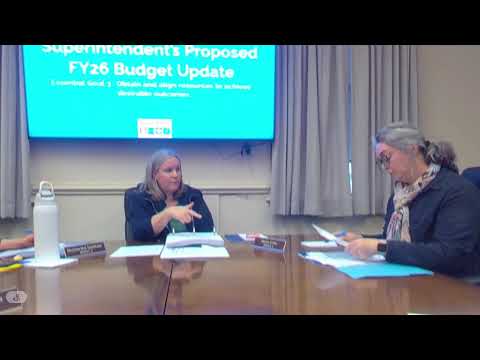
School budget staff told the New Kent County School Board on March 17 that a projected shortfall of about $450,000 remains in the superintendent's recommended fiscal year 2026 budget if the county transfer is reduced as currently proposed.
Miss Morgan, the budget presenter, said the division's recommended budget assumed an additional local transfer of $1.2 million but that the county manager's proposed budget included a $450,000 smaller transfer (about $750,000). "Which leaves us from our recommended budget, deficit of about 450,000, assuming no new money comes in," Morgan said.
Budget staff presented a menu of potential reductions and timing options to bring the budget into balance if local funding does not increase. Staff emphasized that many proposed cuts would harm classroom resources or support services and that they would continue to advocate for additional local funding.
Key figures and proposals discussed at the work session included:
- A recommended state revenue increase in the superintendent's proposal of roughly $1.4 million, which staff said they expected to hold.
- A projected $450,000 gap tied to a lower county transfer than the division requested.
- A proposed 1 percent additional step for teachers that staff estimated would cost about $205,000; staff said the board already planned a 3 percent across-the-board scale increase and the step would be incremental on top of that.
- Several proposed position reductions or timing changes to achieve savings: holding a vacant special education executive-director position open and considering hiring certain positions midyear (maintenance technician, other vacancies) rather than at the start of the fiscal year; converting or reprioritizing proposed hires (for example, using paraprofessional funding for a secondary teaching role) to reduce net cost.
- Discussion of enrollment (average daily membership, ADM) assumptions: staff noted a proposed upward adjustment in ADM compared with the originally budgeted figure; presenters said the increase was small but that the composition and grade levels of new students could materially affect special education and staffing needs.
- Preschool screening results: staff reported nearly 200 children/families screened during recent preschool intake, and discussed the value of opening an additional pre-K classroom because state funding supports that expansion.
- Federal funding changes: staff reminded the board that ESSER grant funds have ended and that some federal programs (title funds) remain but will not replace operating funds; staff said they remain cautiously optimistic about most federal revenues for next year but said continued year-to-year grant dependence reduces flexibility.
Board members asked follow-up questions about contingency strategies, how positions could be repurposed across schools, and the mechanics of transferring budgeted salary lines between organizational codes. Morgan explained the district could internally reassign salary dollars between like-purpose salary lines and would bring personnel recommendations to the board when hires are proposed.
Morgan said the materials and a possible recommended package of cuts or retained positions would be posted to board documents before the April 14 second reading of the superintendent's budget, the next major decision point staff identified.
Ending
Staff did not present a final adoption-ready budget at the March 17 work session; instead they presented options to close a roughly $450,000 gap and asked the board for direction ahead of the April 14 second reading and possible approval meeting.