
Stafford presents three elementary redistricting scenarios; ES 18 projected under capacity in all options
Get AI-powered insights, summaries, and transcripts
Sign Up Free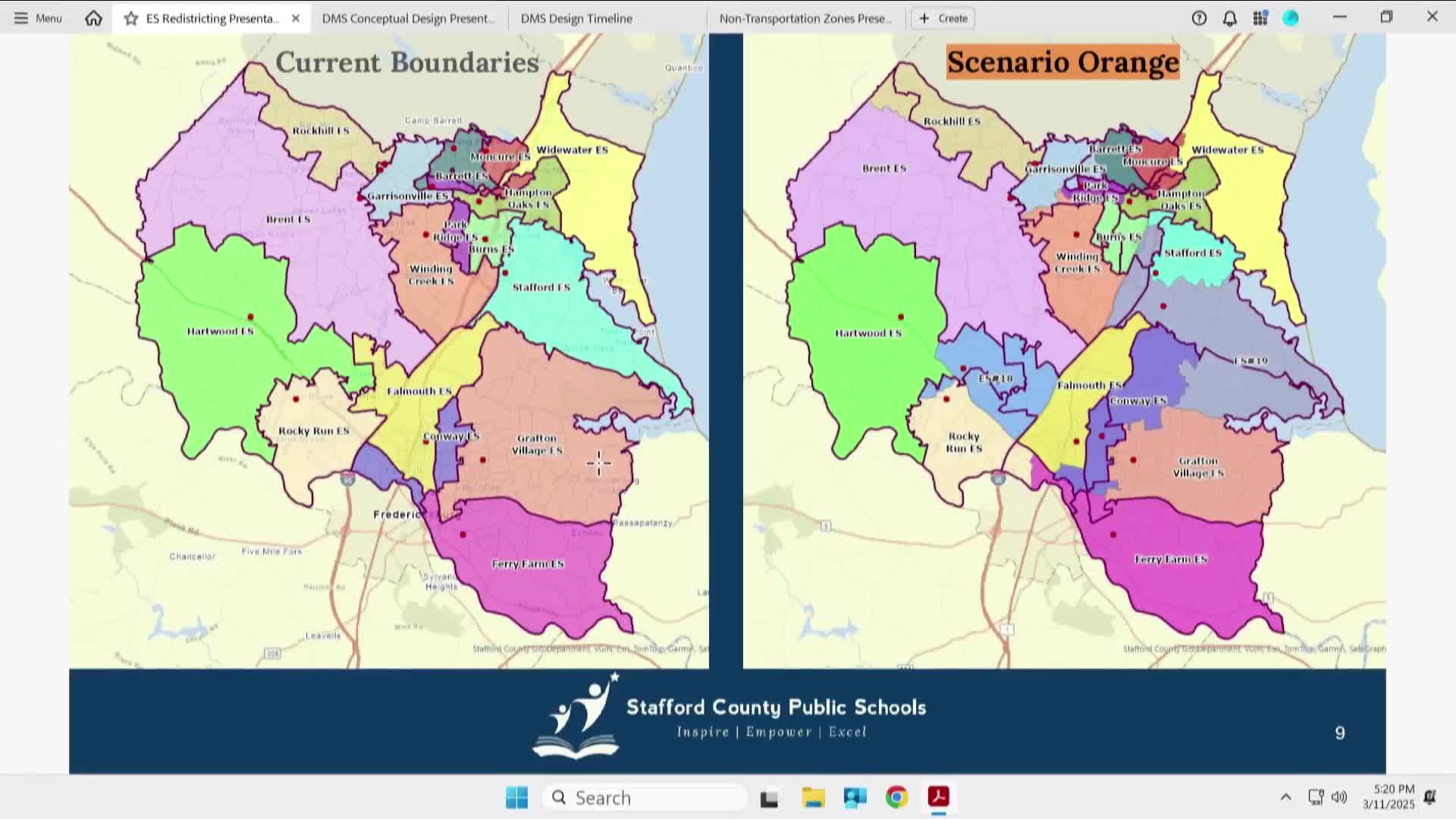
Summary
School staff presented three boundary scenarios for two new elementary schools (ES 18 and ES 19) and data on projected capacity, demographics and feeder impacts. No boundary decisions were made; staff will hold community meetings and collect feedback.
Staff presented three draft boundary scenarios for elementary redistricting tied to the opening of two new schools, identified in the presentation as elementary school 18 (ES 18) and elementary school 19 (ES 19), and invited board feedback and public input.
The presentation, led by a staff planner, reviewed policy considerations used to redraw boundaries and showed maps, enrollment projections and demographic changes for each scenario. The planner said each existing elementary school in the county is affected and summarized the evaluation factors: forecasted enrollment and capacity, space optimization, Title I and demographic impacts, and transportation efficiency.
Why this matters: the scenarios reassign planning units across 19 elementary schools to balance enrollment and relieve crowding while accommodating projected residential growth. The data staff showed includes utilization estimates for opening year and three- and five-year horizons; those numbers will influence staffing, Title I and class-size-reduction (CSR) eligibility, and transportation routing.
Key findings and details: ES 18 opens below capacity in all three scenarios — 70% ("red"), 84% ("orange") and 98% ("yellow") — with ES 18’s demographic projection at roughly 51–54% free/reduced lunch, 17–18% English learners (ELL/DLL) and about 15% special education (SPED) depending on the scenario. ES 19 is projected near 95% utilization at opening and stays below 100% through 2030; its demographic projection was shown at about 50% free/reduced lunch, 24% ELL and 15% SPED in the materials.
Staff said scenario red produces no schools above 100% capacity at opening in 2026, one school slated to be overcapacity by 2028 and two schools projected above 100% by 2030 (max ~103%). Burns and Montclair were cited as examples of schools near or slightly above 100% in 2030.
Board members asked specific questions on feeder relationships, transportation routing and how the scenarios interact with future development. Transportation staff (comments reported during the presentation) reviewed planning-unit routing choices and recommended sending some planning units to ES 19 for routing efficiency. Several board members pressed staff on Hartwood Elementary’s projected utilization, saying they wanted scenarios that reduce pressure on Hartwood. Staff responded that Hartwood remains high under the reviewed scenarios and that further adjustments can be considered.
Staff clarified procedural effects on programs: a newly opened school’s eligibility for Title I and class-size-reduction programs is governed by state rules and typical timelines. Staff explained that new schools often cannot receive Title I funding in their first year because Title I funding uses a March 30 point-in-time count and a multi-year averaging process for some designations; class-size-reduction designation and funding often follow a similarly timed state recalculation and may require a full year of membership data.
Next steps and engagement: staff will post the scenario maps and data on the division website the morning after the presentation and hold community town-halls (first scheduled March 13 at 6 p.m., Stafford High School; an additional session was listed for April 1 at North Stafford High School). Staff said they will collect digital comments, run routing and assignment refinements, and return with additional information, including the counts of impacted rising fifth graders and transportation implications for any proposed grandfathering/exemptions.
Ending: No formal action or boundary adoption occurred; the board directed staff to continue community engagement and to provide more data on feeder alignment, the number and location of affected students, and Title I/CSR implications before the board makes a boundary decision.