Get Full Government Meeting Transcripts, Videos, & Alerts Forever!
Get email alerts on the School Transportation topic
No spam. Unsubscribe anytime.
Stafford County staff propose two-tier elementary bell schedule to improve bus reliability
Summary
District staff presented survey results and an implementation timeline for a two-tier elementary bell schedule for 2025–26 aimed at improving on-time bus arrivals and route consistency; the school division will launch family communications and an opt-in process this spring.
The Stafford County School Board on March 20 heard a staff plan to introduce a two-tier elementary bell schedule for the 2025–26 school year intended to improve bus on-time performance and consistency in pick-up and drop-off times.
District leaders said the change would not alter the existing order of start times (high school first, elementary second, middle school last) but would split elementary schools into two start-time tiers to reduce route bottlenecks and free some buses for other runs.
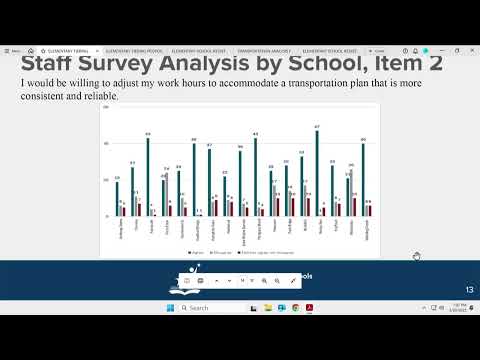
Dr. Amanda Schutz, director of research, evaluation and strategic improvement for Stafford County Public Schools, summarized a short survey of parents and elementary staff and said the district “saw more agreement than disagreement overall” with statements that families and staff would support adjusted start times if they improved on-time arrivals and consistency. Schutz told the board the surveys were brief and asked respondents whether they would be willing to adjust family routines or work hours to accommodate a more reliable transportation plan.
Board members and transportation staff discussed how the tiers were paired by route length and how some longer routes (for example, Widewater) cannot be made earlier without removing those buses from high‑school runs. A transportation staff member explained that many buses assigned to later elementary tiers are scheduled that way so they can first complete high‑school routes and then perform elementary runs.
Staff acknowledged pockets of concern at two elementary sites (Ferry Farm and Widewater) where survey responses showed slightly more disagreement than agreement. Staff said principals and school leaders followed up with those schools to investigate community concerns, which centered on morning traffic patterns, how nearby schools interact (for example elementary/middle pairings), end‑of‑day travel and the effect of upcoming redistricting.
Because redistricting will take effect after next year, staff said this implementation is intended as a first shift that the district will evaluate during the 2025–26 school year and again after new attendance zones are set. District staff said they do not plan additional schedule changes for the 2025–26 school year; any further changes would be considered for 2026.
District staff laid out an implementation timeline: an initial family communication would be released the day after the meeting, an opt‑in transportation selection will open April 8, and routes and route assignments will be provided to families on July 29 (two weeks before school starts). Staff said the opt‑in selection is a form-based selection intended to identify which students will ride buses and which will not, and that schools will follow up to help achieve a high response rate. Staff also described a July 29 deadline for distributing finalized route information, noting families who register after the routing window may not receive immediate routing and that the district historically allows up to two weeks for route additions.
Board members emphasized the need to temper expectations and to communicate clearly with families about the plan being a first step that may require tweaks. “It’s a start,” Board member Halstead said.
Staff said they would continue targeted work with law enforcement and the county on specific bus loops and car‑rider procedures (for example at Garrisonville and AG Wright) and would monitor morning traffic and end‑of‑day travel as the plan rolls out.
No formal board vote was recorded on the tiered schedule during the work session; staff presented the proposal and received direction to proceed with communications and the opt‑in process.